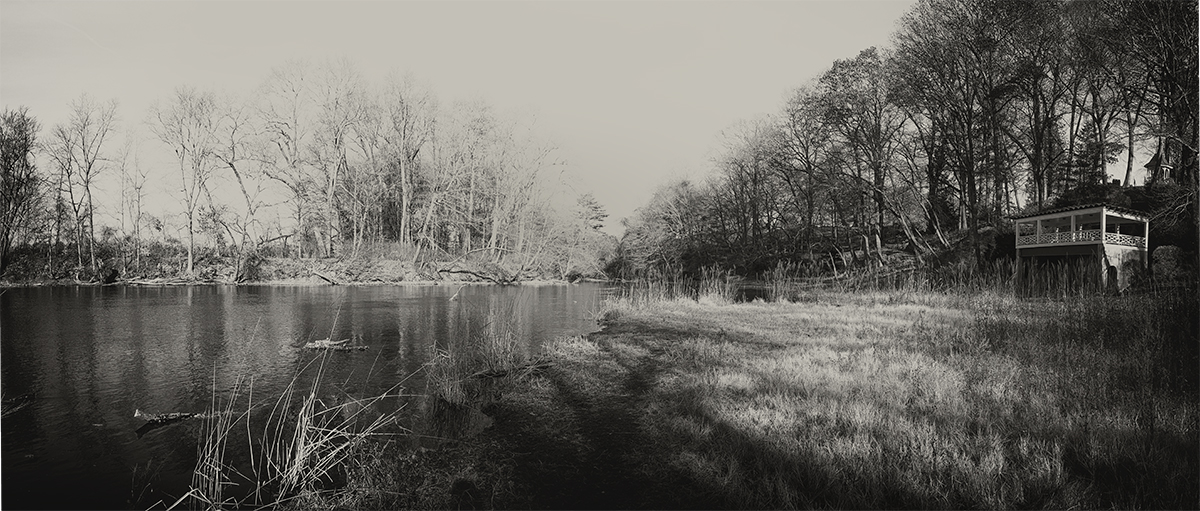
Around 15,000 years ago, glacial Lake Hitchcock was a 200 mile-long shallow body of water in central Connecticut and Massachusetts. Over thousands of years, the lake dried up and left a sediment-filled valley and the Farmington and Connecticut Rivers. Near the present-day town of Farmington CT, the Farmington River is blocked in it’s southeast course by the Metacomet Ridge and takes an abrupt swing north. Off it goes for 14 miles, eventually crossing the ridge in Tarrifville. This is a picture I took a few days ago of the bend in the river, the place where the river changes direction.
Before the British arrived, native Americans called the valley home. The name the Tunxis people gave to this area was Wuttankshau (or Wuttanshau), meaning “the point where the river bends.” In 1640, Puritans settled here in what is now the town of Farmington. At that time, no other English-speaking settlement could be found this far west in New England. Much like the bend in the river, the makeup of the population here would change its course dramatically.


⭐️⭐️⭐️⭐️⭐️
👋⭐
Historical sites and turning points are interesting, but as a rule there was always someone who was before a settler. Maybe it’s time to call them rebuilders instead….
In some cases, “rebuilders” works. Other times “conquerors” might be accurate. The Tunxis people (along with virtually all Native Americans in New England) were decimated by a plague of diseases brought here from Europe between 1616 and 1619. The ones who managed to survive were crushed in war, forced from their land and sometimes taken into slavery. The Puritans did rebuild, but they got plenty of help from fate.
Translating between languages is difficult. The term “settlers” is a direct translation from Swedish—implying “new builders.” Yet, other cultures have always existed beforehand, having already built the land—whether in South or North America, or, here in the Nordic region, in Sápmi. It reflects the same drive to “rebuild” entire cultures to fit our own Western ideal.
A Swedish word (and concept) which implies “new builders”…thanks for explaining, I had a feeling something was lost in translation. The Sami, I’m sure, would have a lot to share with most Native Americans
great story
Thanks for reading!
I like Wuttankshau. Looks like a nice place.
Thanks. Based on what I’ve seen in your landscapes from Epe, I think you would like it here