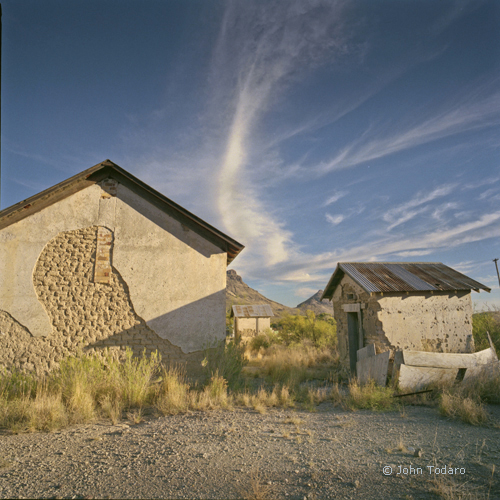
Abandoned Farm House, Eastern Colorado

I’ve queued up another image from the archives–one with a similar story to the glowing gate from the previous post. In both cases, the capture involved archaic weaponry: a roll of Kodak negative film and an obscure 120 film camera. For this one, it was the Fuji 645W, an odd plastic camera known for its unusually sharp lens. I also owned the 645S–similarly designed with the addition of a “roll bar”. I liked them both because they were undersized. I could travel light and shoot without a tripod. Nowadays they’re stored in the basement in a shoe box near my record collection.

The abandoned house was discovered after an afternoon of zig-zagging through the plains. As usual, we were out on the greyest roads on the map.  Once you get into this part of the country you begin asking yourself,  “Now what do we do?”

My companion took no pictures, but I was engaging the question.

The plains are the least photographed part of North America–a fact which is even more astonishing when you realize that they represent about a third of the United States.

As I’ve written before, this is a place which is currently reexamining a number of historic assumptions–having had a lengthy quarrel with invading Europeans. At the moment, the plains are back in charge, especially west of the 100th meridian where the middle of North America is filling up with ghost towns. It’s the same story from Saskatchewan to the Texas panhandle.

There have been books which tell the of the struggle, and Willa Cather’s My Antonia is a personal favorite. But the contest has also being written into the the photographic record. Two photographers come to mind: John Vachon and David Plowden.

Vachon was an artist employed by the FSA seventy years ago during the depression, and was one of the first photographers to focus a lens on the life and landscapes of the farming population of the Dakotas.  By the 1930’s it was already apparent that this was not an easy place for a gig. He took many images, but none is more deeply felt than the one of school children playing in a snow storm.  It was recess. It looks cold, and the children are constructing a fort. Behind them: a one-roomed schoolhouse in blowing sheets of snow. A few decades later, Plowden published The Floor of The Sky. This time, many of the photographs were in color.  The photographer wisely chose to make C Prints. They were warm-toned, bittersweet and full of lonely grass.

Both photographers looked closely at the people as well.  As I flip through their books nowadays, it’s hard not to notice the similarity between the furrows in the fields and the deep lines in the faces.

There’s a link for Vachon’s image (at the Library of Congress) below in the comments.

And, keeping within this theme–two related posts from a few months ago:

https://johntodaro.wordpress.com/2010/12/06/one-room-schoolhouse-western-south-dakota/

https://johntodaro.wordpress.com/2011/01/26/abandoned-home-approaching-storm-north-dakota/

Photography from the Sea Kayak: Bullhead Bay, Southampton

A few years ago, I paddled up to this dinghy while exploring the wetlands of Bullhead Bay in my sea kayak.  The bay is a good place for this sort of exploration and much of the land from there up to Scallop Pond has been preserved by the Town of Southampton and The Nature Conservancy. The picture was taken in November–a time of the year when you pretty much have the estuary to yourself. In this setting, the boat seemed appropriately named.

The picture was captured on transparency film using  a Contax G2 with a 90mm lens. In order to do this, some preparations were needed.

Once I was positioned close to the dinghy, I inflated a paddle float and placed it on my paddle. Holding the paddle behind my back, I braced myself against the water. By using a paddle float in this fashion, you create a relatively stable outrigger from which you can then carefully take some photographs.

The 90mm is a fast lens, and this situation is a good example of when you might prefer a fast prime to a zoom. A slower zoom would’ve been unusable at ISO 100, and also would’ve been very difficult to stabilize while trying to shoot one-handed.

Because I was willing to take an expensive camera out onto the bay without any waterproof housing, I was taking some chances. To minimize the risk of water damage, I sealed my equipment in a water-tight dry bag which I then sat on top of my lap. I also stashed a bottle of fresh water in my cockpit so that I could wash my hands before handling the camera. The deflated paddle float was bungeed to the boat. After taking a few pictures the camera went back into the dry bag and I continued on my way.

Attempting this procedure in rougher surf requires a bit more attention to bracing properly, but I’ve done it successfully several times.

The picture at the link below was taken near Cedar Point with the same camera and the same film.  On that occasion,  I was bracing myself against a fast moving tidal rip in thirty feet of water:

https://johntodaro.com/buoy-6-profile.htm

The red dinghy up above required a bit of post-processing. The first step was to make a high-res scan on my Epson V 700. After a bit of clean-up work I settled on a cropped square image which made it very compatible with a number of my full-frame images from the Hasselblad. One thing I’ve noticed about scans from Provia F is that the intensely blue bias of the film often benefits from a bit of desaturation in Photoshop.

View From the Haerter Bridge: Panasonic Wide Converter (DMW-GWC1)

Here’s a photograph captured with my new Panasonic Wide Converter…a Micro 4/3 camera accessory which is also known as the DMW-GWC1. If you ask me, better names must certainly exist.

As I’ve explained in other posts, the converter attaches to the Panasonic 14mm f/2.5 and presto—you have an 11mm lens. This is equipment for those who occupy a very specific niche: The Micro 4/3 completist, or at least anyone in possession of the 14mm Panasonic lens who’s curious about a wider field of view (and doesn’t want to fork up the $600-plus for the comparable Olympus lens).

The picture was captured as a RAW file (handheld, and using a Panasonic GF2). The RAW was converted to JPEG in order to publish it here at my site. No color adjustments were made, and the file hasn’t been sharpened. A slight reduction in contrast was employed in order to make the image more internet-friendly. (Keep in mind–you really should be checking out at these photographs on a MAC monitor anyway if you want them to be spot-on, a point which is especially relevant when it comes to highlight detail.)

If you’re wondering, the gradation from the upper left to the upper right in this photograph is entirely natural (the sun was shining a few degrees starboard). Happily the files from converter photos show only a slight (but acceptable) amount of vignetting. If you’re horrified by any vignetting, the post-processing fix will cost you all of four seconds. Barrel distortion is present, but can be likewise dealt with in Photoshop. If you’re not shooting architectural subjects it may not matter anyway. Overall, the optics of the converter seem  comparable to the 14mm lens it attaches to.

The location of the picture:  Sag Harbor, USA…on the eastern end of fish-shaped Long Island where our wild roses are now blooming.

Several more of my converter photographs along with additional comments may be found at the following links:

https://johntodaro.wordpress.com/2012/05/18/swan-at-havens-beach-panasonic-wide-converter-dmw-gwc1/
https://johntodaro.wordpress.com/2012/06/04/sag-harbor-photography-wall-and-flowers-shooting-with-the-dmw-gwc1/

My friend Peter (at .documenting.the.obvious) has  published a more thorough review of the DMW GWC1, (especially as regards vignetting, barrel distortion and corner sharpness). Visit his post at the link below but please take some time to enjoy his many unusual photographs:

http://dothob.wordpress.com/2012/06/23/into-the-great-wide-open/

Sag Harbor Photography: Wall and Flowers – Shooting with the DMW-GWC1

I’ve been working with my Panasonic wide converter, a recently introduced accessory which is also known as the DMW-GWC1. If you ask me, there are gasoline additives with sexier names–but don’t let that scare you off.

As I noted several posts back, the DMW-GWC1 is screwed onto the front of Panasonic’s popular 14mm Micro 4/3 lens. Once attached, the lens is persuaded to yield a wider field of view (about the same as a 22mm lens on a 35mm camera). If you’re accustomed to using a 28mm, the converter is decidedly more expansive.

The first thing you notice is the increased depth of field, something which opens up many new creative possibilities. This is especially true when used on cameras like the Panasonic G3 with it’s full range of manual controls and live viewfinder. The second thing you notice is that whatever is close to your lens has an appearance of being much further away.

Over the last few days, I’ve been using the converter on subjects that are well below the horizon–a technique which is admittedly counterintuitive. A lens this wide has an enormous appetite for skies, but summer is on the way and  there’ll be plenty of time to go looking for clouds.

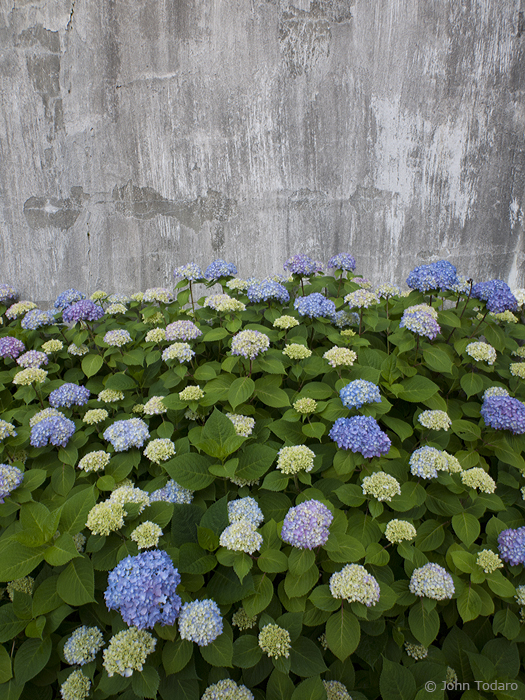
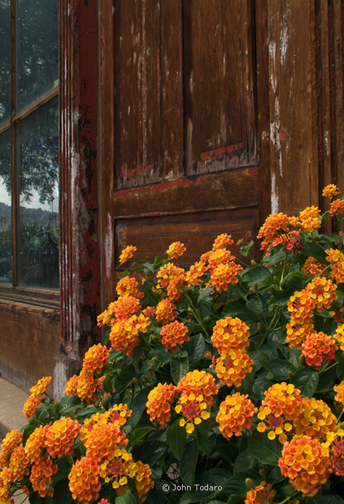
The Hydrangeas were discovered while walking up to the coffee shop a few mornings ago in Sag Harbor Village. The image was captured quickly without the need of a tripod.  I was in full shade. Everything’s in focus in the picture because there’s more depth of field than you can shake a stick at. Moments later I was sipping coffee and making sure my lens cap was affixed to my converter. The bulbous glass accepts no filters, so you have to be careful.

The image is essentially a copy of the RAW file with no further color or contrast correction.  To me, that’s a good sign.

As you can see, the converter performs well in low light, yielding images that are both bright and fully accurate in terms of color. I haven’t yet pushed this thing into more challenging light and contrast, but I can tell you that within the gentle gamut of shade, it’s fine.

Nice work, Panasonic.

My other two posts for the DMW-GWC1 may be found here:

https://johntodaro.wordpress.com/2012/05/18/swan-at-havens-beach-panasonic-wide-converter-dmw-gwc1/

https://johntodaro.wordpress.com/2012/06/06/view-from-the-haerter-bridge-panasonic-wide-converter-dmw-gwc1/

For those into the particulars, the image was handheld @ 200 ISO, f9.o @ 1/100. I was using the Panasonic G3.

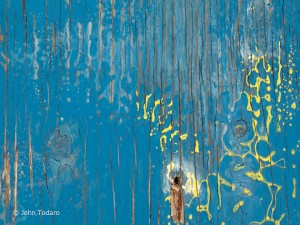
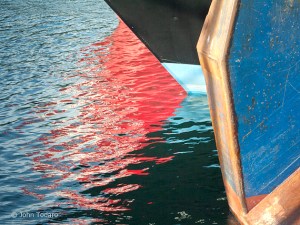
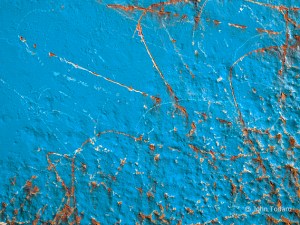
Abstractions: New Photographs From New Bedford

The photographs were taken last week at the commercial fishing docks in New Bedford, Massachusetts. There are close-up details (and reflections) of boats, and studies of metal and wood surfaces from around the docks. In truth, many of these images could be more accurately described as semi-abstract. All were shot without a tripod which encouraged a free-flowing sense of connecting ideas.

New Bedford is a city with a waterfront revitalization in progress and is worth visiting if you’re in southern New England. The National Park Service administers New Bedford Whaling National Historic Park which includes a museum and visitor center located within walking distance of where the pictures were made.

Any of the thumbnails above can be enlarged by clicking on them. Email me if you have any questions about what you’re looking at.

Not Just For Portraits…the Olympus M. Zuiko 45mm f1.8

In December, as I’ve mentioned, I picked up a lens for my Panasonic Micro 4/3 outfit – the Olympus M. Zuiko 45mm, a lens of such beguiling compactness, it could snuggle up next to a golfball. But more to the point, it’s the very satisfying speed (f 1.8) which has been making most of the news.

By designing it both small and fast, they’ve escorted handheld telephoto imaging into a new dimension. Interestingly, the M. Zuiko suggests a miniature version of my much-used 90mm Sonnar (for my Contax G2)–a Zeiss telephoto that was another good performer when used without a tripod.

Much has been written about the lens’ ability to deliver a creamy soft focus when used wide open (aka bokeh). As you might know, this is an old technique which is quite the rage at the moment. And it is true–with this lens, a very shallow depth of field is possible, to an extent not previously achievable with point-and-shoot.  If you’re into bokeh, this lens is your huckleberry.

Needless to say I’m generally not using it for portraits (nor for shallow depth of field). The picture above demonstrates how an effective handheld picture is possible in low light outside. My camera was set at ISO 400, at a moderate f 9 aperture, with a shutter speed of 1/400. Because I was only ten feet from my subject, the depth of field achieved here (with a handheld camera) is quite impressive throughout the image.  Plus, because this lens is so fast, the image was recorded in the very sweet central area of the glass. (Using a zoom I would’ve been shooting much closer to wide open, and would’ve also required a tripod which would’ve made this particular image nearly impossible to take.)

To me, getting handheld images like this is a testimony to the compactness of this lens, and the beauty of the Micro 4/3 system.  The 45 f 1.8 is capable of delivering stunning bokeh wide open, moderate bokeh when used around f 5.6 (something which I often employ when shooting in fog), and superb depth of field at the higher f stops (which, in truth, is even greater than a comparable 35mm lens because the lens construction for Micro 4/3 is so much smaller).  In these terms, the Olympus 45mm f1.8 is extraordinarily versatile and one of the most usable telephotos ever made.

The lilliputian character of this lens relates directly to the Micro 4/3 sensor. It should be interesting to see if the (significantly larger) Sony NEX 7 system will have a comparable fully automatic prime telephoto available in the next year. I doubt it, but even if one comes along, it’s likely to be larger. For landscapes I much prefer a fast telephoto that’s usable without a tripod. I’m not ditching my Panasonics, and I suspect there’s an argument to make for using both formats.

BTW–This is how I’m currently working with my 4/3 primes:

I pack the Panasonic G 3 and the GF 2 into a small Tenba bag. The weight of both cameras (and all three prime lenses) is less than my old Hasselblad 180mm. That’s a lot of lightweight equipment using very little space. I keep the 14mm Panasonic on my G 3 and the 45mm Olympus on my GF 2. Since my GF 2 is silver, the lens is quite bewitching when paired this body.

The odd man out is my equally speedy 20mm f 1.7 which I can quickly install onto either body when needed. Having two bodies affixed with prime lenses makes it very easy to switch horses in the middle of a shoot. Advice: if you already have a GF body and are considering the G 3 (or GX 1)–keep your original camera. With prime lenses in your bag, having more than one body makes a lot of sense.

Here’s some specs on the lens from the Olympus press release:

http://www.olympus-global.com/en/news/2011a/nr110630zuiko45e.html

Some Words for Micro Four Thirds, Prime Lenses (and the New Mexico Plains)

I promise this won’t be a review. Well at least not exactly. I will take this opportunity to crank out a bit of a “rolling plug”

I started working in the 4/3 format earlier this year using a Panasonic Lumix GF2 and a pair of those morsel-sized a la carte lenses. I have the 14mm and the 20mm primes which translate into a 28mm and 40mm respectively (0n a 35mm camera). These lenses are sometimes referred to as “pancakes” and we can rest assured that whoever conjured up such a name had a functional imagination. (We could also call them truffles, or slightly flattened cupcakes).

There’s been plenty of hype about this format along with all the hyperactive comparisons that we’ve come to expect at regular intervals every time a new product arrives. Rejoice in knowing that I won’t contribute anything else to that particular subject.

Those in love with increasing numbers of megapixels got their fix a couple of years ago when the format first surfaced. Plus there was a larger sensor. We now know that the RAW files produced by any of the Olympus or Panasonic bodies will serve you well if you caress them properly. But … be warned:  If you own one of these cameras, don’t doubt for a minute that you’ll be seriously tempted by the next wave (spelled: NEX 7). If you decide to chase that carrot next February it will be your strictly your decision. My advice is to sit back and relax. Be a tortoise. Avoid the bleeding edge. They’ve stumbled onto a nice balance between performance and weight here at the moment — and we might as well enjoy it.

My friend (and fellow photographer) John Ellsworth told me last week that handling one of these micro 4/3 lenses is something like handling a “chess piece”. I enjoyed the thought. (He was actually referring to the Olympus M Zuiko 45mm f1.8, another lens which I finally sprung for). John and I are old enough to remember what 120 film cameras feel like when they’re hanging around your neck.

Anyway, the photograph above was taken with the Panasonic GF 2 (and the 20mm f1.7). With this camera, I’m able to focus the picture and adjust the exposure by the very simple act of touching the screen, (something which I still regard with amazement). I’ve been surprised to read that touch-screen navigation has aggravated some photographers. It seems there’s those who’d rather twist a dial. I’m fine with the touch screen because it appeals to my severely limited capacity to follow instructions. Look at it this way: touching a screen requires only one finger and turning a dial takes two.

I’ll admit that since I bought this camera I’ve been cornering opportunities to explore the speed of these lenses. Believe it or not you can perform a variation on street photography far from any lamppost. The 20mm lens is also capable of producing shallow depth of field. In Japan they call this effect “bokeh”. I’m still uneasy with the pronunciation but I’ve been using the word a lot lately because it’s a lot sexier than saying “shallow depth of field”.

At any rate, my camera was hand-held for this picture and was therefore free to shoot six or seven variations in several positions and all in less than a minute. I feel like I’m playing jazz when I’m not off mucking around with my tripod and its multitude of extended joints. Let’s face it;  tripods are a bit clunky by nature. They also require at least three fingers to operate. That makes them even more complicated than turning a dial and much more so than touching a screen. I use them strictly when I need to.

Enough with cameras. Let’s move on to the West.

I’ve visited the eastern plains of New Mexico many times over the years and I always wonder why everyone else is driving though the place as fast as they can. I concede that there’s nothing much to see except for open space, which for me, is pretty much the point. This is not the Grand Canyon. If you spend any time out on the plains your expectations for normal landscapes will need to evolve. The scenery basically comes down to various combinations of grass and clouds, and (for better or worse) the ever present evidence of humans which usually takes the shape of  a fence. There’s cows everywhere but one thing about the plains is that you hardly ever see the people.  That’s okay, because their absence creates interest.

One visit didn’t involve taking any pictures. Many years ago my wife and I took a train ride west from Long Island. We took it all the way to Albuquerque just to see what it was like.

It was long.  Even compared to a bad day at the airport, this was a trip which slowed time down to a slurpy crawl.  It seemed like years before we were rid of the east (but once we were past Chicago things did get more interesting).  My favorite part was the morning after the second night. We got up and walked groggily through the train to a very lovely dining car. I remember cloth napkins. We were seated at small table and had the most delicious breakfast with a very compelling view. We were now chugging through the plains and were finally situated in New Mexico. All you could see was mile after mile of grass, clouds and the ubiquitous fences of ranching. It looked something like my picture up above except it was brighter because the sun coming up.

As I said, it wasn’t a day that I used my camera.  The train window took all the pictures and we stored them in our memory.

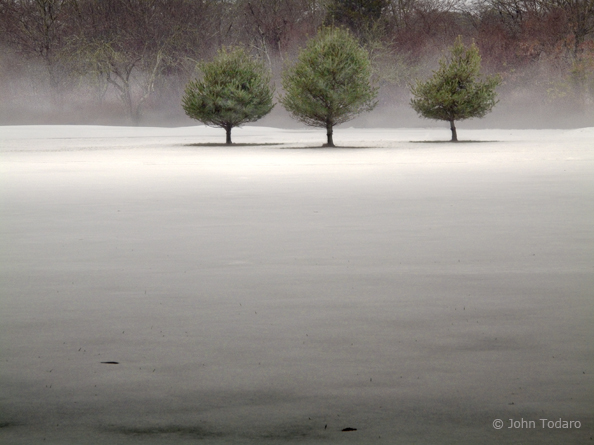
Winter Trees – Barcelona Neck

Barcelona Neck is a peninsula in Northwest Harbor that is home to the 500 acre Linda Gronlund Memorial Nature Preserve. Linda was a Sag Harbor native who died in the Pennsylvania plane crash which occurred on 9-11. The park has a network of well-maintained trails that explore field edges, salt marsh, second growth forest and beaches. There are many water views. My picture above was taken there a few years ago around this time of the year.

The peninsula has historic ties with Sag Harbor, although the park itself is within the Town Of East Hampton. It’s been said that homesick Spanish sailors thought the bluffs at the north end of the peninsula resembled those in Barcelona. On a clear day from on top you can see the distant archipelago formed by Plum Island, Great Gull, Little Gull and Fishers Island.

I gravitate to the park mostly to photograph fields, or more specifically to photograph the “gradient” of habitation as it fades gracefully into the woods. In some respects a lot of my pictures appear to be preoccupied with this, although it’s not usually a conscious function and is sometimes not successful.

Winter arrives in a week. If you live far enough north to have an ice rink in your birdbath then you’ll be enjoying a low angle of sun for another month. It can be a reason to plot an escape, perhaps to a warmer place with a sun on a higher perch. But on the other hand (if you stick around),  you can always grab a camera and try to harvest the light.

Fort Union – Images II and III (Canon G10)

The pair of verticals were taken at Fort Union, in New Mexico (discussed in my previous post). On the trip, I used my older Canon G 10 for situations like these because they seemed to be asking for a telephoto. The tendency of telephotos to simplify potentially distracting elements can be very helpful in some situations. The Canon G series cameras (as well as the S series cameras) have well-deserved reputations for zoom lenses with lots of depth of field, even when maxed-out.

Fort Union is a good place for anyone who enjoys watching clouds, especially through a window. Being in New Mexico, just east of the Rockies, there’s no shortage of spirited skies.  The adobe walls also provide opportunities to frame “blue within red”.  The ruins create scale, and more importantly they create moods. Imagine photographs of the same clouds in these pictures without the foreground walls. Those pictures could be good ones too, but would be entirely different animals.

It would be an enjoyable project to photograph the sky through an individual window at this fort every day for one year.

Fort Union – Image 1 (Panasonic Lumix GF 2)

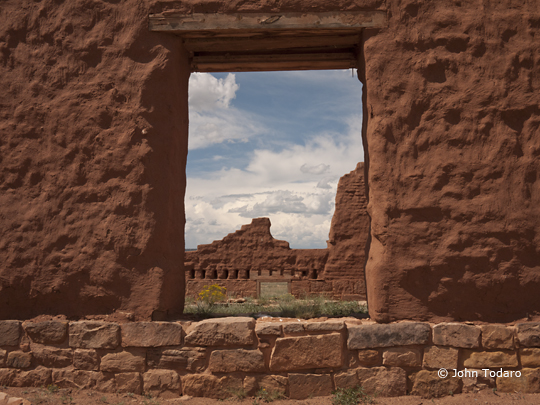
Fort Union is an historic site administered by the National Park Service which preserves the remains of the largest Federal fort along the Santa Fe Trail.  It’s located in New Mexico. The fort’s moment in history commenced during the latter half of the 19th century and lasted up until the arrival of the railroad. It’s an imposing reminder of what a city-sized outpost on the Santa Fe Trail might have once been like. After 100 years, it’s still surrounded by many square miles of prairie and a view of the Rocky Mountains. Although the wagons have long since vanished, it’s become a striking place to photograph, and one with abundant amounts of quiet.

This is the first of several pictures from the fort, a horizontal image with a view through a standing wall. The sun was caught at a good angle here, especially for revealing texture.

If you look closely, there’s a curious smaller window at the bottom of the rear wall.  The view through that window has been “shortened” by a rising knoll of grass behind the fort. The picture was captured with my Panasonic GF 2 and its normal 20mm lens.

Napeague Harbor Sequence – Petite Landscapes

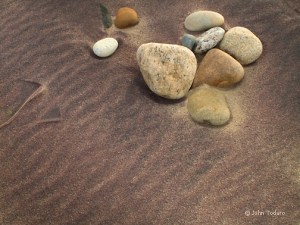
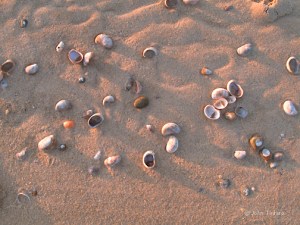
This is is a sequence of four images from various points around the perimeter of Napeague Harbor.  There’s a number of ways to group these, but in this instance I’ve arranged them vertically to convey something of what you might find at your feet during a walk on the beach.  I like to think of these images as petite landscapes – photographs close to the observer, with most of the elements of the larger picture. Clicking on them will produce an enlargement.

For other sequences from Amagansett and elsewhere go to this link:

Hasselblad 903SWC … rambling thoughts

The image is a another from Shafter, TX done with my Hasselblad 903 SWC. The picture from my previous post today was taken about an hour earlier.

Interestingly, this picture was published in a January 1997 Shutterbug article for reasons that now seem strangely outdated. In those days, the magazine devoted one issue per year to the latest and greatest 120 film cameras, with additional articles about photographers working in that format. Due to the equipment discussions, there was excitement generated by that particular Shutterbug, and it was probably the closest the magazine ever came to having a “swimsuit” issue.  Back in 1997, it was an honor to have one’s work  show up on those pages.

Things changed quickly. These days it’s hard to imagine a time when none of us knew what a pixel was. To their credit, Shutterbug made the transition too. Nowadays the discussion revolves around the mystique of the digital SLR and the latest revolution in point and shoot.

In spite of all that, there are still those (including myself)  who savor the look and feel of 120 film cameras such as the 903. Like most people these days, I own a digital camera, but I’m not giving up my Superwide anytime soon. I keep a few rolls of film on hand and have no issue with scanning it. An extra step to the digital work-flow is barely a hassle and more than worth the effort.

Some technical thoughts about using the 903 Superwide:

The detachable viewfinder made for this camera is the easiest way to view an image. Over the years when taking a picture, I’ve generally left the viewfinder on and used it to compose my photograph. If you’ve never owned the camera, keep in mind that when using the detachable viewfinder, the lower portion of your view is obscured by the lens barrel. I’ve always gotten around this little snag by turning the camera sideways in order to view the lower part of my image. For focusing, I use the hyperfocal-focusing marks on the lens barrel.

If greater precision is needed for composing and focusing, a ground glass back is available from Hasselblad and may be used in conjunction with any of the prism finders. I use it with the PM 5. Using the ground glass back with a prism finder requires that you remove the film back, and that you’re okay with viewing an upside down image. It also requires a shutter locked in the open position with a good cable release. Once you’ve done all that and your picture is composed and focused, the ground glass back (and prism finder) is removed and the film back is reinstalled. Obviously, all this is done with the camera on a tripod.

Additional photographs I’ve taken with the 903 may be seen by clicking on this link:

https://johntodaro.wordpress.com/category/viewpoints/square-format-hasselblad/

Keep in mind that colors and contrast of the images at this site will be most accurate when viewed on a calibrated MAC monitor. This is most relevant to photographs that have a wide range of contrast such as many of the ones I photographed with the 903.

If you’ve got any other questions about the camera, feel free to post a comment.


Things to do in Moab … did he say, “admire the flowers?”

Consider this post a recess.

I recently was shopping in the health food store in Sag Harbor on Eastern Long Island and I was wearing my Moab hat. Someone came over and asked:

“What’s a Moab?”

A question like that isn’t that uncommon out here in the salt-soaked forests east of the Hudson River. In fact many people around are likely to assume the name Edward Abbey is an Edward Albee typo.

Me and Moab go back a long ways. It began in August 1978 when I was passing through what was then a town with only two places to eat. We were in one of them ordering breakfast and preparing to head up to nearby Arches National Park.  I was traveling with a close friend and my brother. It was the “salad years” for three of us and thanks to Edward Abbey, we had recently discovered Utah.

At the restaurant, I phoned home and my father informed me that Sagamore Hill National Historic Site had called. My father hated talking on the phone so I considered myself lucky. The three of us fished around for pocket change and I rang them up. The curator needed a staff photographer after Labor Day and I was offered the job.

I took it.

Many years later I returned to Moab with my wife and son and geez… had that place changed. They’d discovered over a thousand more arches inside the park. That made me feel old. Next they invented mountain bikes and all the people showed up. This was a clearly a town that had shifted gears since I first arrived.

You had to hand it to old Ed Abbey. He wrote Desert Solitaire and became the unwitting founding father of both Earth First and the Moab Chamber Of Commerce. Considering some of the pricey developments springing up,  you have to wonder what he’d make of it all.

I don’t know about him but I think that it’s good.

Some in southern Utah won’t agree, but the vacationing eco-tourists and Europeans on holiday are living proof that their state doesn’t require any more roads or mines, or forests full of cows. The good citizens need to remember that green types tend to travel with plenty of the green stuff. If Moab is any indication, more wilderness might actually boost their economy.

Enough with that. Now onto the photographs.

Nowadays there’s lots of good photographers exhibiting in Moab. In fact, the last time I was there, I’d say there were more photographers than gas stations. All of these guys are very good, although in Moab and everywhere else in Utah they tend to be white guys over fifty – something like myself.

And so… where are my arch pictures?

Unfortunately, I’ve got a tendency to withhold pictures that people want to see the most. I can’t help it, it’s my nature. I have photographs of arches but you have to wait. At any rate, Moab is one sweet town to walk around. Remember, that’s coming from a guy whose hometown got some sort of award from National Geographic (I keep forgetting to read the little sign they put up across from our library).

Thus, from Moab, I have flowers. Yarrow, Lantana, Roses and a Sunflower, all of which were photographed around Main Street, some near my favorite restaurants. I don’t know if Moab is overrated for anything but it’s underrated for flowers. My advice to visitors:  admire the flowers.

Some comments:

Yes, the Yarrow is dried up which in my opinion is the way it looks best – the place is a desert after all. The sunflower is complimented by a common garden hose which is the first one I’ve ever photographed. The final image is a fascinating one. I was struck by the way the two tripod legs looked and kept them in the picture. Photographers tend to avoid getting tripods in their photographs for obvious reasons but in this case, I let them be.  It’s a self-portrait, of sorts.

There are good textures in these pictures. People have seen them at different shows and think I took them in Paris.

I didn’t. They’re just from Moab.

Now for some off topic family favorites… and the rest of the photographs:

Favorite Waffle: Jailhouse Cafe ••• Favorite Mexican Food: Miguel’s Baja Grill ••• Best Deal: 99 cent Clif Bars at GearHeads ••• Favorite Thrift Store: Wabisabi (where my hat came from) ••• Favorite Bookstore: Back of Beyond (where my t-shirt came from) ••• Favorite Muffin: Chocolate Peanut Butter Vegan Muffin at Love Muffin Cafe ••• Favorite Shower: Slickrock Campground ••• Favorite Snack: Apricot Suncakes, Moonflower Market, Inc.

Favorite Utah National Park: Capitol Reef (sorry Arches)

Favorite Book About the Area: Park Slayer Pursuit,  a short book which my son wrote in 7th grade (sorry Mr. Abbey)


Contrarian Words For Diane Arbus

“A photograph is a secret about a secret. The more it tells you the less you know.”

Diane Arbus’ quote about photography is exquisite. It’s simple and it’s paradoxical. She teases us with her description of how photographs communicate, and she tantalizes logic by suggesting that the more you learn about a photograph the less you will know.

Good stuff.

Her work was mysterious. It was mysterious in a rarified sense that exists outside of the constraints of language. Her photographs were attached to nothing. No ideologies, dogma or religion. Those systems require words, and when one wraps a thing with that sort of language it takes on structure. Creativity can function within those structures but flourishes when it’s free.  Diane was one who reclaimed the word mysterious in her work. Religions do not own this word.

Arbus nudges us. With simple words she points to the process. Creations need no creeds and imagination requires nothing larger than itself. Sometimes I’ve wondered if the liberation of art is the one of the most unsung contributions of modern civilization. When John Lennon wrote the words to his song Imagine, he understood. After all, it took an odd leap of imagination to suggest that above us is only sky.

There is a downside to this modern paradigm of art:

Fame and money.

In spite of the temptations, Arbus didn’t give away her secrets. The rest of us have to deal with it in our own way.

Diane Arbus committed suicide in 1971.  During the ten years prior to that, she assembled a body of work that filled a niche so ravishingly that it inspires awe. She had no peer. Her portraits are raw, gripping, astonishing and completely unforgettable. She once said that her “favorite thing was to go where I’ve never been.”  That was her work. Even her detractors will admit that her photographs succeeded at this. Perhaps her pictures represent a new form of totem, a courageous one with a direct gaze and no need for a disembodied spirit.  For us it provides evidence for what an imagination looks like when it has been unleashed properly.

Like most photographers, my work bears no resemblance to hers and she would’ve had little interest in what I do. It’s not always easy, but I try not to give away the secrets.  I hope that once in awhile I’ve made an image that has gotten there.  I offer the photograph at the top of the post in her memory – a bouquet, of sorts, for Diane.

I recall a rank smell blowing in from the salt marsh and there was a nearly implausible red glow of fading sunlight. It flowed through the marsh and spilled over the pilings like fresh blood. It was a beautiful moment to which I gave my best.

Much has been written about Diane Arbus, her life and her work. A starting point is her Wikipedia entry which has a number of worthwhile links:

http://en.wikipedia.org/wiki/Diane_Arbus

An outstanding online catalogue of her work may be found here:

http://diane-arbus-photography.com/

House In Fog With Orange Door – Eckley, Pennsylvania

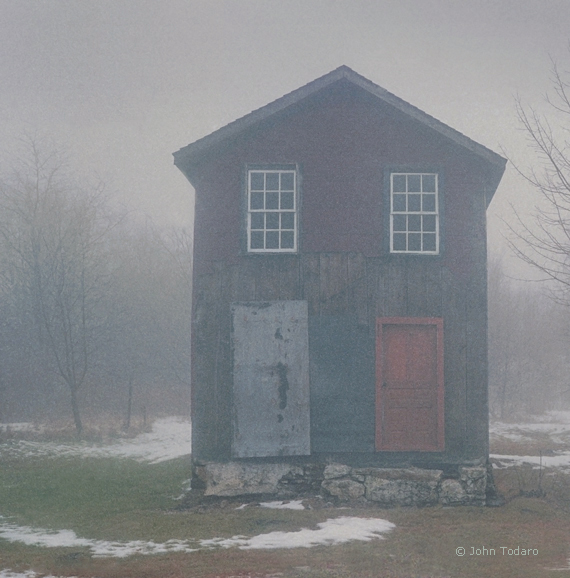
This photograph was taken a few years ago at Eckley, an historic mining town in Northeastern Pennsylvania.  Nowadays it’s an unusually quiet place tucked into the mountains – two straight rows of company houses which face each other across a simple road.  At the time of our visit it was a place of abundant texture, because the laborious work of restoration had barely begun.

Much like the photographs in the two previous posts, this is a portrait of a building blending with its landscape. Again, a solitary structure photographed from the front in two dimensions without the intrusion of architectural perspective. I’ve done this habitually over the years, at first being unaware of my tendency. Over time, I’ve grown attached to this technique the same way one becomes fond of good advice. It’s not always the answer but it is a way of looking at things that has its own unusual language. I’m not exactly sure what’s going on aesthetically, but let’s take a stab at it.

An image of an old building taken directly front-on creates a facade – a face of sorts with character and personality. Under the right circumstances, this will have a tendency to simplify a composition rather than complicate it. Simplicity is good. This angle often represents the most lyrical view.  It can also hint at humor and at times can impart a desirable sense of the surreal. Importantly, these images defy the funneling effects of perspective, and bring a calm stability which keeps one’s eyes attached to surface qualities. Textures are enhanced in such pictures because they’re not competing with perspective. What appeals to me most in this image is the muted harmony of closely matched color values. The teal green of grass is both complimented and refreshed by the vertical orange door. In a dense fog, colors will often appear as similar grays, at least to the talented squinter.

House With Red Roof, Gaspé, Québec

This piece will introduce a new category, one with an overly long and confusing title that definitely requires pruning:

Solitary dwellings, abandoned structures and other unattended human artifacts photographed within the greater landscape.


At the moment, I can’t think of a shorter way to say it, and if you have suggestions for a more truncated one – by all means post a comment.

Why put photographs into such a category in the first place? I’m not exactly sure, other than the fact that when I go back and look at what I’ve been doing for the last 35 years, obvious patterns emerge. I find myself peering through a camera at the lonely stuff we left behind; and if we hadn’t left it behind then there was probably no one home:

…a miners’ cabin in Eckley Pennsylvania…a capsized boat in Springs…an abandoned Chevy truck  on the plains of Colorado…the desolate corral in southern Utah…a house with a tin roof in North Carolina…the house with the red roof in Québec.

The list goes on and on even though I never set out to perform variations on a theme. I guess it just happened that way. Perhaps it’s because I take the pictures and the patterns take care of themselves.

Finding myself in front of the solitary houses was the beginning of the process. Next came the postures – how the stuff posed, where it was positioned relative to the camera. In each instance there was a right combination of things that evoked the desired mood.  For photographers, it can occur without warning. Things come together and you’ve arrived at your picture – and when that happens it feels something like it did back in middle school the first time you pulled open your combination lock. It’s why I like this job.

Again, the patterns:  A lonely house leashed with a power line. An abandoned home beneath the complex geometry of a storm.  One hundred and fifty years ago a photographer no doubt discovered that by shifting his position a few feet to the left, he set his picture ablaze with mood. This is key. With my own work, the moods have varied over time but hopefully not too much. If I’ve been doing my job right  I’ve just wanted the pictures to speak of simple things:

Solitude, detachment and fluidity.  If a photograph of a house is able to convey something timeless, that’s wonderful.  But if it also suggests something about the passage of time, then that is a picture with a taste for one of our finest paradoxes. Sometimes my pictures have gotten there but others have fallen short.  All honest photographers know there’s luck involved.

Over the coming weeks I’ll be posting more of this work – photographs of the lonely stuff out there in the landscape.

I’ve come up with a shorter title:

Solitary Structures:

https://johntodaro.wordpress.com/category/viewpoints/solitary-structures/

Wainscott Photographs: Killcare and the Pebble

Killcare

The view of the ocean from Wainscott and the west end of Georgica is dominated by the iconic home known locally as Killcare. Whether seen up close or from a quarter mile down the beach, it catches the eye and stirs the imagination the way few buildings ever do.  I’ve been watching it for twenty years, in every manner of light – holding its own on the dunes amidst the awesome flux of landscape. I feel lucky to have glimpsed a small part of a creative project that’s lasted for over a century.

On a certain level, the subject of this picture is impermanence because I can’t help but notice that the structure’s isolation within the landscape is made more beautiful by that fact. The picture is also about the curiosity of brushing against it with your own mutable presence. In a sense I was taking a cue from the house – interfacing with the landscape to see if there was any poetry in it.  I’ve sometimes walked my own shadow into a picture and felt the chilly effects of an unannounced visitor. On other occasions I’ve left my footprints where others had left theirs and then faced the empty beach to release the shutter.

This time it was a pebble – the one that got tossed into the temporary trough of flatwater that forms on the beach in between breaking waves.  I’ve been tossing pebbles into spots like these for as long as I can remember.  As always the event began with radiating concentric circles. There was time for a single exposure. The ripples subsided and the water itself began the process of evaporation. This was a scene in no mind to stay in one place. In ten minutes nothing remained  but swash marks. The piece is entitled Killcare –  a landscape and a self portrait.

Montauk Photographs – Shadmoor


The camera at this location was one with a sweeping view of the Atlantic,  a logical segueway from the photograph in the previous post from Bandon, Oregon. This time I was visiting Shadmoor State Park in Montauk,  New York.  Again, the weapon of choice – the Hasselblad 903 SWC. By way of comparison, the Montauk photo was made on positive film (or transparency), and the picture from the West Coast was a negative. Same camera, different coast and different film.

If you are still intrigued by putting a roll of film in your camera, the two pictures provide a good opportunity to study the differences between negatives and transparencies. Whereas the Bandon picture has a decidedly warmer pallet, the Montauk scene is one of cool tones and snappier contrast. The smoothness of the Bandon picture is answered by Montauk’s abundant detail. Two different looks – both of which can translate agreeably into digital files (assuming you still have the patience for scanning). To some of us, there is nothing like the delicious clumpy grain of silver halide.

In the decade that’s passed since I took this picture, the 99 acres of Shadmoor have  been declared a State Park and its cliffs have become dangerously eroded. These days a fence keeps visitors away from the edge in an effort to protect the habitat and prevent injuries. The park is unique for many reasons, not the least of which are its wetlands, its thick stands of Shadbush, and the historic bunkers that have been fronting the Atlantic Ocean since WW II.

To see other photographs taken with the Hasselblad 903 SWC click on this link:

https://johntodaro.wordpress.com/category/viewpoints/square-format-hasselblad/

Bandon, Oregon – Hasselblad 903 SWC

This photograph was taken fifteen years ago, looking west from the left-coast  at an ocean I’ve rarely photographed. It was November and I was high on a bluff  in Bandon Oregon – an unpretentious town at the end of a dusty road with a surprisingly epic view of the Pacific. Something about this place reminded me of off-season Montauk and  similar towns – timeless places putting on their winter clothes – communities that can be counted on not to change for the worse.

Admittedly the view of the ocean here was more like Montauk on steroids – scenery on a truly grand scale. Appropriately, I chose my Hasselblad 903 SWC – a medium format camera that came fixed with what quite possibly was the finest wide angle lens ever made – the 38mm f4.5 Biogon. This was a camera unburdened with bells and whistles and redundant gadgetry. With it’s detachable viewfinder and ability to accept a ground glass back, the 903 has reigned for years as the ultimate choice for wide angle devotees.  Perhaps for this reason, the camera has earned it’s nickname “Superwide” although the number of people familiar with it on that basis is sadly dwindling. In the previous century when Hasselblads were in vogue both here and on the moon, the Superwide had a much deserved reputation for pinpoint accuracy and corner-to-corner sharpness. But now, due to the lack of a digital back, it sadly falls out of fashion with those of us producing millions of pixels. Perhaps its moon is waning.

My friend Jonathan who studies these things tells me that the 903  was first produced in Sweden in 1954 which also happens to be the same year I was manufactured. An early prototype was unceremoniously shipped to our shores around the time Charlie Parker was making his final recordings. With only minor modifications it has remained unchanged ever since. You can still buy it, or you can buy an older one and put a brand new back on it which will attach with no problem. That was the point.  It was produced when things were still bench-made by guys who assembled things with a panache for precision. It was put together with sturdy parts and close attention to details. The damn thing worked. It felt good in your hands. When you put it back in it’s case and took it out the following spring, it didn’t need any improvements. Once you bought this camera there was no need to upgrade your operating system.

And so I am not yet ready for it’s elegy. Digital imaging is here for good and I’m not inclined toward orthodoxy whether it’s on one side of this argument or the other. I can live with the complexities of being a hybrid and will happily scan my film.

To see other photographs taken with the Hasselblad 903 SWC click on this link:

https://johntodaro.wordpress.com/category/viewpoints/square-format/

For a commentary about the use of the detachable rangefinder and  ground glass back on the 903, go to this link:

https://johntodaro.wordpress.com/2011/03/26/hasselblad-903swc-rambling-thoughts/

East Hampton Photographs-Main Beach (Square Format)

This image was taken with my Hasselblad 903 SWC one winter morning during the opening blast of daylight – a moment when everything ignites into a harmony of striking colors. I was much in the mood for photography especially with the addition of all those footprints and not a single person in sight. On this occasion and on many others,  framing the scene in a square made it sing with the sweetest voice.

Squares are uncommon and if you chose to put your landscape into one,  you can congratulate yourself on an unconventional choice. In these days of digital capture, the square is becoming downright eccentric.

Having no bias for up or down and not being partial to across, square compositions can also be what you might call pleasantly ambiguous. If you’ve been frustrated by horizontality – try throwing a square around your scene and you might be onto something. The photographer David Plowden did this to the seriously horizontal high plains of the American west back in the 70’s and made extraordinary use of squares.

Many landscapes, to be sure, will never work as squares. But setting landscapes to default horizontals shows little imagination.  Squares can create a surprising twist on a feeling. They can bring mystery through the door and take the mundane out to the trash. Squares can say something new rather than old, and can sometimes speak volumes when there’s otherwise nothing to say.

To see other photographs taken with the Hasselbad 903 SWC, go to the Location and Topic menu on the sidebar on the right and click on Square Format-Hasselblad. You’ll find additional commentaries about the camera at several of those posts.

.