Abandoned Farm House, Eastern Colorado

I’ve queued up another image from the archives–one with a similar story to the glowing gate from the previous post. In both cases, the capture involved archaic weaponry: a roll of Kodak negative film and an obscure 120 film camera. For this one, it was the Fuji 645W, an odd plastic camera known for its unusually sharp lens. I also owned the 645S–similarly designed with the addition of a “roll bar”. I liked them both because they were undersized. I could travel light and shoot without a tripod. Nowadays they’re stored in the basement in a shoe box near my record collection.

The abandoned house was discovered after an afternoon of zig-zagging through the plains. As usual, we were out on the greyest roads on the map.  Once you get into this part of the country you begin asking yourself,  “Now what do we do?”

My companion took no pictures, but I was engaging the question.

The plains are the least photographed part of North America–a fact which is even more astonishing when you realize that they represent about a third of the United States.

As I’ve written before, this is a place which is currently reexamining a number of historic assumptions–having had a lengthy quarrel with invading Europeans. At the moment, the plains are back in charge, especially west of the 100th meridian where the middle of North America is filling up with ghost towns. It’s the same story from Saskatchewan to the Texas panhandle.

There have been books which tell the of the struggle, and Willa Cather’s My Antonia is a personal favorite. But the contest has also being written into the the photographic record. Two photographers come to mind: John Vachon and David Plowden.

Vachon was an artist employed by the FSA seventy years ago during the depression, and was one of the first photographers to focus a lens on the life and landscapes of the farming population of the Dakotas.  By the 1930’s it was already apparent that this was not an easy place for a gig. He took many images, but none is more deeply felt than the one of school children playing in a snow storm.  It was recess. It looks cold, and the children are constructing a fort. Behind them: a one-roomed schoolhouse in blowing sheets of snow. A few decades later, Plowden published The Floor of The Sky. This time, many of the photographs were in color.  The photographer wisely chose to make C Prints. They were warm-toned, bittersweet and full of lonely grass.

Both photographers looked closely at the people as well.  As I flip through their books nowadays, it’s hard not to notice the similarity between the furrows in the fields and the deep lines in the faces.

There’s a link for Vachon’s image (at the Library of Congress) below in the comments.

And, keeping within this theme–two related posts from a few months ago:

https://johntodaro.wordpress.com/2010/12/06/one-room-schoolhouse-western-south-dakota/

https://johntodaro.wordpress.com/2011/01/26/abandoned-home-approaching-storm-north-dakota/

Some Words for Micro Four Thirds, Prime Lenses (and the New Mexico Plains)

I promise this won’t be a review. Well at least not exactly. I will take this opportunity to crank out a bit of a “rolling plug”

I started working in the 4/3 format earlier this year using a Panasonic Lumix GF2 and a pair of those morsel-sized a la carte lenses. I have the 14mm and the 20mm primes which translate into a 28mm and 40mm respectively (0n a 35mm camera). These lenses are sometimes referred to as “pancakes” and we can rest assured that whoever conjured up such a name had a functional imagination. (We could also call them truffles, or slightly flattened cupcakes).

There’s been plenty of hype about this format along with all the hyperactive comparisons that we’ve come to expect at regular intervals every time a new product arrives. Rejoice in knowing that I won’t contribute anything else to that particular subject.

Those in love with increasing numbers of megapixels got their fix a couple of years ago when the format first surfaced. Plus there was a larger sensor. We now know that the RAW files produced by any of the Olympus or Panasonic bodies will serve you well if you caress them properly. But … be warned:  If you own one of these cameras, don’t doubt for a minute that you’ll be seriously tempted by the next wave (spelled: NEX 7). If you decide to chase that carrot next February it will be your strictly your decision. My advice is to sit back and relax. Be a tortoise. Avoid the bleeding edge. They’ve stumbled onto a nice balance between performance and weight here at the moment — and we might as well enjoy it.

My friend (and fellow photographer) John Ellsworth told me last week that handling one of these micro 4/3 lenses is something like handling a “chess piece”. I enjoyed the thought. (He was actually referring to the Olympus M Zuiko 45mm f1.8, another lens which I finally sprung for). John and I are old enough to remember what 120 film cameras feel like when they’re hanging around your neck.

Anyway, the photograph above was taken with the Panasonic GF 2 (and the 20mm f1.7). With this camera, I’m able to focus the picture and adjust the exposure by the very simple act of touching the screen, (something which I still regard with amazement). I’ve been surprised to read that touch-screen navigation has aggravated some photographers. It seems there’s those who’d rather twist a dial. I’m fine with the touch screen because it appeals to my severely limited capacity to follow instructions. Look at it this way: touching a screen requires only one finger and turning a dial takes two.

I’ll admit that since I bought this camera I’ve been cornering opportunities to explore the speed of these lenses. Believe it or not you can perform a variation on street photography far from any lamppost. The 20mm lens is also capable of producing shallow depth of field. In Japan they call this effect “bokeh”. I’m still uneasy with the pronunciation but I’ve been using the word a lot lately because it’s a lot sexier than saying “shallow depth of field”.

At any rate, my camera was hand-held for this picture and was therefore free to shoot six or seven variations in several positions and all in less than a minute. I feel like I’m playing jazz when I’m not off mucking around with my tripod and its multitude of extended joints. Let’s face it;  tripods are a bit clunky by nature. They also require at least three fingers to operate. That makes them even more complicated than turning a dial and much more so than touching a screen. I use them strictly when I need to.

Enough with cameras. Let’s move on to the West.

I’ve visited the eastern plains of New Mexico many times over the years and I always wonder why everyone else is driving though the place as fast as they can. I concede that there’s nothing much to see except for open space, which for me, is pretty much the point. This is not the Grand Canyon. If you spend any time out on the plains your expectations for normal landscapes will need to evolve. The scenery basically comes down to various combinations of grass and clouds, and (for better or worse) the ever present evidence of humans which usually takes the shape of  a fence. There’s cows everywhere but one thing about the plains is that you hardly ever see the people.  That’s okay, because their absence creates interest.

One visit didn’t involve taking any pictures. Many years ago my wife and I took a train ride west from Long Island. We took it all the way to Albuquerque just to see what it was like.

It was long.  Even compared to a bad day at the airport, this was a trip which slowed time down to a slurpy crawl.  It seemed like years before we were rid of the east (but once we were past Chicago things did get more interesting).  My favorite part was the morning after the second night. We got up and walked groggily through the train to a very lovely dining car. I remember cloth napkins. We were seated at small table and had the most delicious breakfast with a very compelling view. We were now chugging through the plains and were finally situated in New Mexico. All you could see was mile after mile of grass, clouds and the ubiquitous fences of ranching. It looked something like my picture up above except it was brighter because the sun coming up.

As I said, it wasn’t a day that I used my camera.  The train window took all the pictures and we stored them in our memory.

Red Shack In Blowing Snow – New Suffolk, 1988

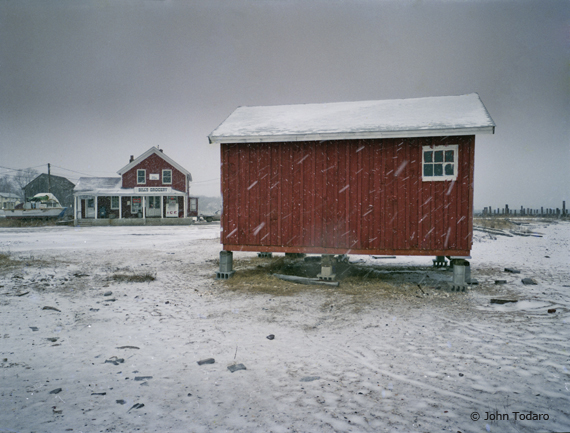
On a winter’s day about twenty five years ago, I was photographing over on the North Fork with my Fuji 645’s.  The New Suffolk waterfront in those days was the location of the former post office – a homey red building which doubled as a grocery store. It was an inviting hang-out for locals who could grab some coffee and catch up with the neighbors.

For a period of time, the store was known as Bill’s Grocery (later to become Fagan’s). It had a lovely view of Robin’s Island, which on warmer days one could enjoy from the porch.  New Suffolk, in those times, possessed a degree of character which has since begun to evaporate here on eastern Long Island. Back then (and even today when I look at this picture) it’s hard not to notice the similarity between this building and the Springs General Store on Accabonac Harbor here in East Hampton.

Sadly, New Suffolk’s general store never did enjoy the same degree of longevity as its cousin in Springs. On a Thursday morning in 1993 (only a few years after this picture was taken) it burned to the ground despite the Cutchogue Fire Departments’ best efforts. Last year I inquired at the local library to see if anyone knew the history behind the quirky red shack in front of the post office (the one-eyed building which is the main subject of my photograph).  Was it a fish shack or a bait shop? A tool shed? Was it moved there temporarily to sit out the winter on concrete blocks? The reference librarian was unfamiliar with the building and after a bit of research, told me that no one seemed to remember it. It lives on, at least in the picture … a long-forgotten shack  on the docks of New Suffolk, caught in a snowy gale.

Anyone with any details about this relatively recent footnote to North Fork history please feel free to comment!

Melancholy and the Mother Road – San Jon, NM


This picture dates from just a few weeks ago when were exploring an especially ragged section of Route 66 somewhere in the vicinity of San Jon.  The town lies in the eastern part of New Mexico very near the Texas border, a sparsely populated region with an occasional mesa and abundant mesquite. The old route veers south of the interstate here, and leaves the pavement behind.

The evening was coming on and it wasn’t clear if we’d gotten lost.  My son was up front, and my wife was in the back squinting at the Delorme Atlas wondering if we were near San Jon or another town called Lesbia. Not much appeared to be left of either place and there wasn’t anyone around to ask.

It grew darker. On the north side of the road we slowed down and crept up to the scene in this photograph. I turned off the ignition because the sky was exquisite. Needless to say it was time to get out the camera.

Behind the former gas station were some brushy remains of buildings that might have once been a motor court. The place had clearly seen better times, and with the final touch of a collapsing roof was nothing short of haunting.

Amarillo – Twelve Megabytes for The Ant Farm

Another predawn expedition on our recent trip took me to the outskirts of Amarillo. I’d been curious about the Cadillac Ranch for years. This was the place where they buried some cars in a cornfield so I wanted to have a look. Back in 1974 the project was the brainstorm of a local iconoclast (who prefers to be called Stanley Marsh 3).  He was assisted by an unusual group of friends known as the Ant Farm.

I was never sure what I’d think of the Ranch,  and now that I was in Amarillo I wasn’t even sure where it was. My atlas indicated that the ten Cadillacs were located somewhere west of the city on the south side of I 40. This also happens to be the former path of Route 66, and so it was undoubtedly considered a perfect place for the half-burials.

I drove out there and couldn’t find them. It seemed I needed coffee.

There was a Starbucks on Soncy Road at the previous exit. I returned, wondering if my family was still asleep at our nearby motel. Inside the coffee shop, the two employees who took my order debated the best way to send me to the Cadillacs. I thanked them and headed back, this time with plenty of caffeine  and several sets of directions.

I found the Ranch right away. It was right off of the Interstate in a field just like the one in my imagination.

As you can see from my photograph, the cars have been spray-painted over the years. The interesting thing is that Marsh and the Ant Farm have encouraged everyone to do this. Purists argue that the original Caddys were far lovelier with their peeling factory paint and without all the annoying graffiti.  Now that I’ve seen the cars in person I completely disagree. I’ll elaborate on that in a moment.

In the meantime, empty cans of paint littered the ground in open defiance of Texas law.

Being a photographer, I noted that the sun was about to peer over the horizon, so I got to work. The impulse is to stand back from the cars in order to take a group portrait. I have to admit they look good from back there (something like a GM version of Stonehenge).  But I also felt I was taking pictures of a Little League team. I took a few anyway and they looked like all the other ones I’d Googled back home.

I decided to go in closer. What I discovered, is that when appoaches the cars they inspire a palpable sense of reverence. I sidled up to one. The fins were high above my head and looked especially wonderful in the first rays of daylight. I was feeling something like one of the apes in Kubrick’s 2001 and so I placed two fingers on a wheel. I was surprised that it spun freely.

Of the pictures I took after that, the one I liked the best was the one at the top of my post. Truthfully, it’s not easy photographing someone else’s artwork.

The problem is, whose artwork is it exactly?

These handsome vehicles were first penciled up by a creative team of designers back at General Motors. That was a long time ago, so I don’t know if anyone has properly celebrated their achievements. Years later, ten Cadillacs were dragged from their various junkyards to be partially interred here in a cornfield. This was not an easy task and involved the use of a crane and other massive equipment. Like it or not, Marsh and his friends made an auspicious attempt to clarify the meaning of the cars. They also remade a landscape.  Since then, anyone who has sprayed any paint here has tweaked the project slightly, and those who of us who come here and take the pictures have taken it somewhere else.

Everyone’s involved at Cadillac Ranch. It keeps going.  That appears to be the point.

Did I spray paint something?

Yes. I picked up a couple of spent cans and shook them until I found some paint. Carefully aiming, I hissed out a tribute on a wheel strut.  I did this for Joe Strummer, the former frontman for The Clash who would’ve thought the Ant Farm rocked.

It was red paint, of course.

Vintage Photograph of Uihlein’s (Montauk, 1988)

Keeping with the theme of bygone scenes and time exposures, this post resurrects an off-season glimpse of Montauk made some twenty three years ago. To me, this quiet image is especially welcome given the degree of rowdiness emanating from Montauk during our current summer. The evening I took this picture, the town was about as remote as you could get on Long Island – a sandy wind-blown place at the end of the road (with just enough characters to keep things interesting).

The good news is that this old boat shack is still there hunkered down by the harbor and minding its own business. Like many current residents, the building now sports a face-lift and some newly acquired shrubbery. Back in the eighties, it counted the days of winter with a degree of solitude which is almost unimaginable in the current decade.

Much like the photograph of my previous post, this was an image recorded at dusk. Here, an especially gloomy evening had been caught unawares. There is an uneasy feeling that no one is left in town. A compelling pair of neon lights have blinked on, and are available to tell the story.

East Hampton Train Station, 1987

It’s August first. On queue this morning is a vintage picture of our local train station from twenty five years ago. I shot the scene employing one of two Fuji 645 cameras that I was playing around with at the time. It was a color negative, and the image was a time exposure. Over the years, the area around Railroad Avenue has changed considerably. In 1987, the area had a scruftier look. I could be wrong, but it seemed to be a part of town that conveyed a sense of being “way out east”. When we moved here earlier that year, that’s exactly what we were looking for. We were not moving into the Hamptons, so much as we were moving onto the South Fork. There was a difference, although admittedly it was mostly a state of mind.

Years have passed. The picture is a window into former times. Looking back, I’d have to say I was fortunate to have caught the building in early evening (November, as I recall). In the distance, the sun has sunk away. The lamps have gone on and have struck up an agreement of sorts, between natural and artificial light.  As is often the case, such agreements are lonely ones.

Thunderstorm Near A Remote Corral

It’s nearly August, a month which has found us wandering west for so many years that it’s difficult to recall one trip from another.  Several summers ago we were emerging from an overnight camp in the San Rafael Swell – a rarely-visited desert area in south-central Utah. The region is roughly the size of Long Island and is criss-crossed by a handful of graded roads.  It’s easy to to end up in a bit of a mess in this place, and so one needs to think long and hard before making any sort of turn. We were dusty, in need of showers and speculating on the location of the nearest gallon of iced tea. Mostly, we were hoping our little rental car would eventually make it to some sort of Mexican restaurant. The nearest town of any size was Price, some 35 miles to the north.

In the back seat my young son gazed out at a land which was only beginning to scratch his imagination. While making our way across the grasslands which rise onto a plateau to the west, huge storm clouds began to gather. This was an event which quickly rewrote the landscape. As the winds picked up, the heat began to back away like a Fundy tide. The west is a mercurial place. I pulled over near a corral and removed my tripod from the trunk. A picture was taken between the opening salvo of raindrops with the smell of ozone releasing the floodgates of memory. In the car, my wife was begging me to get back in.

The Outhouse of Mulford Farm

The image below was taken last week during a morning of fickle weather. For several hours it alternated between stormy and foggy with the ocean blowing air into the village that felt damper than a boat sponge. The turbulence is standard fare in May and is caused by warmer morning temperatures and their ongoing argument with the chilly ocean.

You’re looking at an unceremonious outhouse located at the historic Mulford Farm in East Hampton Village which I photographed in the fog.

Interestingly, a bit of research has uncovered a wealth of information about outhouses.  I was surprised to read that they’ve been called biffies – a term which may have had its origin with Browning Ferris Industries, a waste collection company (with a conspicuous logo) which once serviced portable toilets. Long ago, Girl Scouts put another spin on it when a biffy became a bathroom in the forest for you. Various campers have also employed the term kybo.  This is thought to have originated in Vermont where Kybo Coffee cans were once filled with lyme and placed inside the structures to keep the odors to a minimum. I would’ve loved to have visited one of those north woods shacks with a Kybo can, especially in the moonlight beneath a silhouette of spruce.

Less frequently the outhouse has been referred to as a backhouse, and in Australia, they’re known as dunnies. In New Zealand you might call them long drops. 

Outhouses originated in Europe over 500 years ago which means they’ve been around for centuries. During the depression, WPA carpenters were hired by the government to build them in rural areas. You don’t hear about that in eighth grade American history. One wonders if any of those New Deal outhouses are still in service today?

Where I grew up on the west Coast of Florida some of my classmates lived in homes with privies near the woods. Whenever I visited these places I was awestruck. To a transplanted New Yorker in elementary school, having an outhouse on the property was evidence of very serious credentials. These friends of mine were not living in the rubber stamped homes popping up elsewhere in Florida (such as the one I lived in) and they didn’t come from the wealthiest families.  It didn’t matter. Their dwellings had  abundant wealth of character.

Outhouses at Mulford Farm would’ve been constructed during colonial times. It was during those years when the crescent moon cutout was first employed. The ones with crescents were for women and ones with stars were for men. I was truly amazed to discover this and it raises an obvious question. Why did the star fall out of fashion?   It’s been theorized that men let their privies fall into such horrible states of disrepair that they faded out, becoming rotted piles of wood in forgotten rural places.

It’s the feminine crescent cutout which has stood the test of time.

Southampton Photographs – Meadow Lane Boathouse

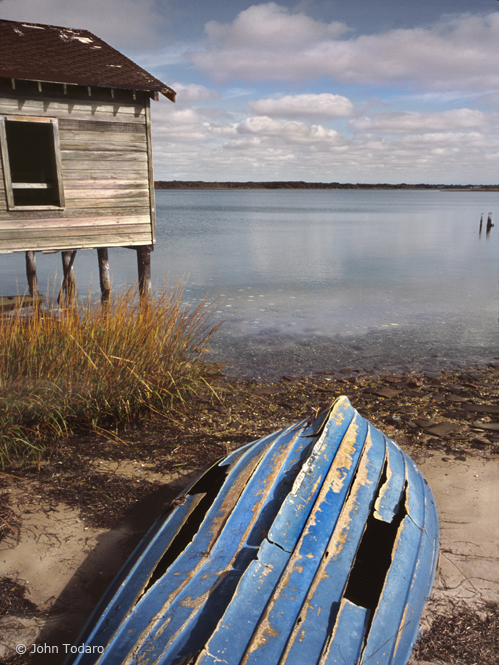
A morning kayak trip across Shinnecock Bay yielded several photographs of the historic Meadow Lane boathouse. Although this structure rises from the marshy flats of Eastern Long Island, much about it reminds me of similar abandoned buildings from the high plains – both from an historical context and also because of its sequestered setting. For Southampton, the boathouse is a footnote to a local history which is all but gone. It stands (at least for now) as a monument to former times. Approaching it from the bay by kayak is a good way to get a feel for this place – a building far more connected to the sea than the land.

Other photographs of abandoned structures from the west and elsewhere may be seen by clicking on this link:

https://johntodaro.wordpress.com/category/viewpoints/solitary-structures/

Here’s a link to another photograph from Shinnecock Bay on the same kayak outing:

https://johntodaro.wordpress.com/2010/05/13/southampton-photographs-great-egrets-and-duck-blind-shinnecock-bay/

House In Fog With Orange Door – Eckley, Pennsylvania

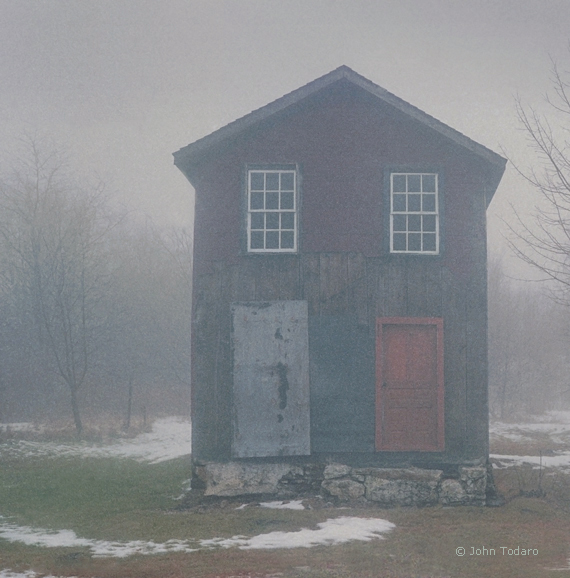
This photograph was taken a few years ago at Eckley, an historic mining town in Northeastern Pennsylvania.  Nowadays it’s an unusually quiet place tucked into the mountains – two straight rows of company houses which face each other across a simple road.  At the time of our visit it was a place of abundant texture, because the laborious work of restoration had barely begun.

Much like the photographs in the two previous posts, this is a portrait of a building blending with its landscape. Again, a solitary structure photographed from the front in two dimensions without the intrusion of architectural perspective. I’ve done this habitually over the years, at first being unaware of my tendency. Over time, I’ve grown attached to this technique the same way one becomes fond of good advice. It’s not always the answer but it is a way of looking at things that has its own unusual language. I’m not exactly sure what’s going on aesthetically, but let’s take a stab at it.

An image of an old building taken directly front-on creates a facade – a face of sorts with character and personality. Under the right circumstances, this will have a tendency to simplify a composition rather than complicate it. Simplicity is good. This angle often represents the most lyrical view.  It can also hint at humor and at times can impart a desirable sense of the surreal. Importantly, these images defy the funneling effects of perspective, and bring a calm stability which keeps one’s eyes attached to surface qualities. Textures are enhanced in such pictures because they’re not competing with perspective. What appeals to me most in this image is the muted harmony of closely matched color values. The teal green of grass is both complimented and refreshed by the vertical orange door. In a dense fog, colors will often appear as similar grays, at least to the talented squinter.

House With Red Roof, Gaspé, Québec

This piece will introduce a new category, one with an overly long and confusing title that definitely requires pruning:

Solitary dwellings, abandoned structures and other unattended human artifacts photographed within the greater landscape.


At the moment, I can’t think of a shorter way to say it, and if you have suggestions for a more truncated one – by all means post a comment.

Why put photographs into such a category in the first place? I’m not exactly sure, other than the fact that when I go back and look at what I’ve been doing for the last 35 years, obvious patterns emerge. I find myself peering through a camera at the lonely stuff we left behind; and if we hadn’t left it behind then there was probably no one home:

…a miners’ cabin in Eckley Pennsylvania…a capsized boat in Springs…an abandoned Chevy truck  on the plains of Colorado…the desolate corral in southern Utah…a house with a tin roof in North Carolina…the house with the red roof in Québec.

The list goes on and on even though I never set out to perform variations on a theme. I guess it just happened that way. Perhaps it’s because I take the pictures and the patterns take care of themselves.

Finding myself in front of the solitary houses was the beginning of the process. Next came the postures – how the stuff posed, where it was positioned relative to the camera. In each instance there was a right combination of things that evoked the desired mood.  For photographers, it can occur without warning. Things come together and you’ve arrived at your picture – and when that happens it feels something like it did back in middle school the first time you pulled open your combination lock. It’s why I like this job.

Again, the patterns:  A lonely house leashed with a power line. An abandoned home beneath the complex geometry of a storm.  One hundred and fifty years ago a photographer no doubt discovered that by shifting his position a few feet to the left, he set his picture ablaze with mood. This is key. With my own work, the moods have varied over time but hopefully not too much. If I’ve been doing my job right  I’ve just wanted the pictures to speak of simple things:

Solitude, detachment and fluidity.  If a photograph of a house is able to convey something timeless, that’s wonderful.  But if it also suggests something about the passage of time, then that is a picture with a taste for one of our finest paradoxes. Sometimes my pictures have gotten there but others have fallen short.  All honest photographers know there’s luck involved.

Over the coming weeks I’ll be posting more of this work – photographs of the lonely stuff out there in the landscape.

I’ve come up with a shorter title:

Solitary Structures:

https://johntodaro.wordpress.com/category/viewpoints/solitary-structures/

Abandoned Structures/High Plains – Hasselblad 903SWC

Another from western North Dakota taken with the Hasselblad 903. I’ve called this one Quiet House. More images of abandoned structures on the high plains (and elsewhere) can be seen by clicking on this link:

https://johntodaro.wordpress.com/category/viewpoints/solitary-structures/

To see other photographs taken with the Hasselblad 903 SWC, go to the same menu and click on Square Format-Hasselblad. You’ll find additional commentaries about the camera at several of those posts.

One-Room Schoolhouse, Western South Dakota

We encountered this building a number of years ago while driving across South Dakota. I’d been hoping to see such places and so we’d driven the entire state on the grayest highways we could find on the road map.

We climbed out of the car into a landscape which mixed the serene with the surreal as effectively as any Hopper painting. Around and behind the building there was nothing but grass as far as you could see –  a scene of such elemental minimalism that it was close to breathtaking.  For me, finding these places has become the defining moments of many trips and I’ve never been able to walk away from them without engaging the camera.

Between the 1890’s and the 1950’s one room schoolhouses existed at regular intervals across the high plains. These were the same years when the middle third of our continent underwent a radical transformation – and as we all know, the changes didn’t come easy. If the prairie was easy to plow it was often harder to tame.  The wooden grain elevators and other structures have now mostly faded into the landscape. Perhaps what remains is totemic, an expression of a deep-rooted simplicity that belongs to that landscape and belongs with us as a people. If the buildings stay with us, they will be the relics of an uncomplicated esthetic that existed before the arrival of modern clutter.

While I was taking this picture, my wife and two year old son played nearby in the grass. For me it was easy to conjure up the bygone recesses… running children in hand sewn-clothes, scolding teachers and fifth grade crushes. My son was oblivious to those thoughts because it was June and a good time for insects. The winds picked up and I walked around the building with my camera. Each side seemed to have it’s own game – four courts of light and four plays of texture. Above us the sky was strewn with clouds – distant, but at the same time appearing unusually close. My wife and son sat down on the doorstep and I took pictures of them. When we peered in the windows we discovered desks, shelves, furniture covered with blankets and a long-forgotten piano.

Yesterday I found a link to historic photographs of Kansas one-room schoolhouses. The site is an excellent example of an archive doing exactly what it’s supposed to do. My wife and I spent much time poring over the pictures, especially the class portraits. These were auspicious warm-weather events with kids in their finest clothes – days when everyone was ushered outside onto the grass to pose before the large camera. The children formed a group and their teachers were placed behind them. Everyone stood still and the exposure was made filling the air with the smell of magnesium flash powder. Behind the class the photographers kept it simple…always the school house and maybe a glimpse of prairie. You might find, as we did, that the faces of the children will unleash your imaginations with the details of their many possible stories:

http://www.kansasheritage.org/orsh/Gallery/index.htm

More images of abandoned buildings from the Dakotas (and elsewhere) can be seen by clicking on this link:

https://johntodaro.wordpress.com/category/viewpoints/solitary-structures/


Wainscott Photographs: Killcare and the Pebble

Killcare

The view of the ocean from Wainscott and the west end of Georgica is dominated by the iconic home known locally as Killcare. Whether seen up close or from a quarter mile down the beach, it catches the eye and stirs the imagination the way few buildings ever do.  I’ve been watching it for twenty years, in every manner of light – holding its own on the dunes amidst the awesome flux of landscape. I feel lucky to have glimpsed a small part of a creative project that’s lasted for over a century.

On a certain level, the subject of this picture is impermanence because I can’t help but notice that the structure’s isolation within the landscape is made more beautiful by that fact. The picture is also about the curiosity of brushing against it with your own mutable presence. In a sense I was taking a cue from the house – interfacing with the landscape to see if there was any poetry in it.  I’ve sometimes walked my own shadow into a picture and felt the chilly effects of an unannounced visitor. On other occasions I’ve left my footprints where others had left theirs and then faced the empty beach to release the shutter.

This time it was a pebble – the one that got tossed into the temporary trough of flatwater that forms on the beach in between breaking waves.  I’ve been tossing pebbles into spots like these for as long as I can remember.  As always the event began with radiating concentric circles. There was time for a single exposure. The ripples subsided and the water itself began the process of evaporation. This was a scene in no mind to stay in one place. In ten minutes nothing remained  but swash marks. The piece is entitled Killcare –  a landscape and a self portrait.