November Light – Sagg Main Beach

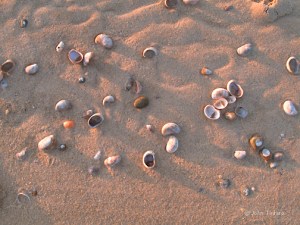
This recent scene from Sagg Main demonstrates the sun’s current position relative to the beach at sunrise. It shines directly down the beach and sets the place ablaze. You won’t see that here in summer. Another interesting thing about the picture is the graceful pattern formed by the tire tracks – something which I’m usually trying to avoid!

 The picture was photographed with the Panasonic Lumix Gf2.

Fort Union – Images II and III (Canon G10)

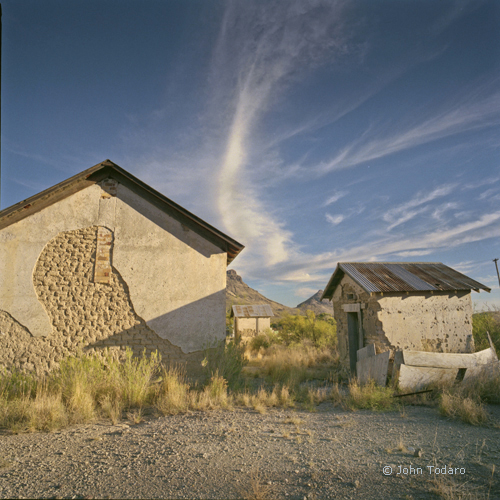
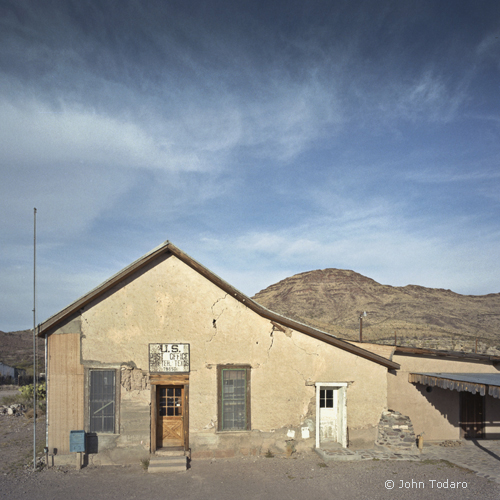
The pair of verticals were taken at Fort Union, in New Mexico (discussed in my previous post). On the trip, I used my older Canon G 10 for situations like these because they seemed to be asking for a telephoto. The tendency of telephotos to simplify potentially distracting elements can be very helpful in some situations. The Canon G series cameras (as well as the S series cameras) have well-deserved reputations for zoom lenses with lots of depth of field, even when maxed-out.

Fort Union is a good place for anyone who enjoys watching clouds, especially through a window. Being in New Mexico, just east of the Rockies, there’s no shortage of spirited skies.  The adobe walls also provide opportunities to frame “blue within red”.  The ruins create scale, and more importantly they create moods. Imagine photographs of the same clouds in these pictures without the foreground walls. Those pictures could be good ones too, but would be entirely different animals.

It would be an enjoyable project to photograph the sky through an individual window at this fort every day for one year.

Fort Union – Image 1 (Panasonic Lumix GF 2)

Fort Union is an historic site administered by the National Park Service which preserves the remains of the largest Federal fort along the Santa Fe Trail.  It’s located in New Mexico. The fort’s moment in history commenced during the latter half of the 19th century and lasted up until the arrival of the railroad. It’s an imposing reminder of what a city-sized outpost on the Santa Fe Trail might have once been like. After 100 years, it’s still surrounded by many square miles of prairie and a view of the Rocky Mountains. Although the wagons have long since vanished, it’s become a striking place to photograph, and one with abundant amounts of quiet.

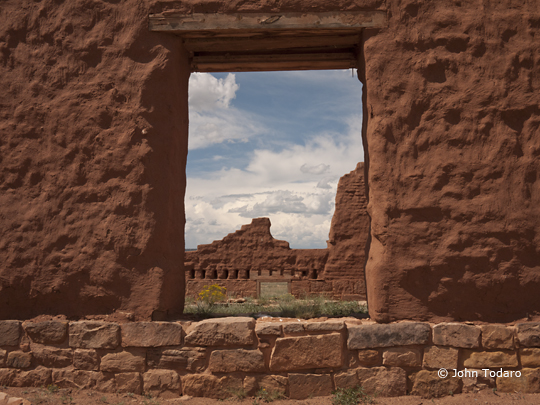
This is the first of several pictures from the fort, a horizontal image with a view through a standing wall. The sun was caught at a good angle here, especially for revealing texture.

If you look closely, there’s a curious smaller window at the bottom of the rear wall.  The view through that window has been “shortened” by a rising knoll of grass behind the fort. The picture was captured with my Panasonic GF 2 and its normal 20mm lens.

Melancholy and the Mother Road – San Jon, NM


This picture dates from just a few weeks ago when were exploring an especially ragged section of Route 66 somewhere in the vicinity of San Jon.  The town lies in the eastern part of New Mexico very near the Texas border, a sparsely populated region with an occasional mesa and abundant mesquite. The old route veers south of the interstate here, and leaves the pavement behind.

The evening was coming on and it wasn’t clear if we’d gotten lost.  My son was up front, and my wife was in the back squinting at the Delorme Atlas wondering if we were near San Jon or another town called Lesbia. Not much appeared to be left of either place and there wasn’t anyone around to ask.

It grew darker. On the north side of the road we slowed down and crept up to the scene in this photograph. I turned off the ignition because the sky was exquisite. Needless to say it was time to get out the camera.

Behind the former gas station were some brushy remains of buildings that might have once been a motor court. The place had clearly seen better times, and with the final touch of a collapsing roof was nothing short of haunting.

Amarillo – Twelve Megabytes for The Ant Farm

Another predawn expedition on our recent trip took me to the outskirts of Amarillo. I’d been curious about the Cadillac Ranch for years. This was the place where they buried some cars in a cornfield so I wanted to have a look. Back in 1974 the project was the brainstorm of a local iconoclast (who prefers to be called Stanley Marsh 3).  He was assisted by an unusual group of friends known as the Ant Farm.

I was never sure what I’d think of the Ranch,  and now that I was in Amarillo I wasn’t even sure where it was. My atlas indicated that the ten Cadillacs were located somewhere west of the city on the south side of I 40. This also happens to be the former path of Route 66, and so it was undoubtedly considered a perfect place for the half-burials.

I drove out there and couldn’t find them. It seemed I needed coffee.

There was a Starbucks on Soncy Road at the previous exit. I returned, wondering if my family was still asleep at our nearby motel. Inside the coffee shop, the two employees who took my order debated the best way to send me to the Cadillacs. I thanked them and headed back, this time with plenty of caffeine  and several sets of directions.

I found the Ranch right away. It was right off of the Interstate in a field just like the one in my imagination.

As you can see from my photograph, the cars have been spray-painted over the years. The interesting thing is that Marsh and the Ant Farm have encouraged everyone to do this. Purists argue that the original Caddys were far lovelier with their peeling factory paint and without all the annoying graffiti.  Now that I’ve seen the cars in person I completely disagree. I’ll elaborate on that in a moment.

In the meantime, empty cans of paint littered the ground in open defiance of Texas law.

Being a photographer, I noted that the sun was about to peer over the horizon, so I got to work. The impulse is to stand back from the cars in order to take a group portrait. I have to admit they look good from back there (something like a GM version of Stonehenge).  But I also felt I was taking pictures of a Little League team. I took a few anyway and they looked like all the other ones I’d Googled back home.

I decided to go in closer. What I discovered, is that when appoaches the cars they inspire a palpable sense of reverence. I sidled up to one. The fins were high above my head and looked especially wonderful in the first rays of daylight. I was feeling something like one of the apes in Kubrick’s 2001 and so I placed two fingers on a wheel. I was surprised that it spun freely.

Of the pictures I took after that, the one I liked the best was the one at the top of my post. Truthfully, it’s not easy photographing someone else’s artwork.

The problem is, whose artwork is it exactly?

These handsome vehicles were first penciled up by a creative team of designers back at General Motors. That was a long time ago, so I don’t know if anyone has properly celebrated their achievements. Years later, ten Cadillacs were dragged from their various junkyards to be partially interred here in a cornfield. This was not an easy task and involved the use of a crane and other massive equipment. Like it or not, Marsh and his friends made an auspicious attempt to clarify the meaning of the cars. They also remade a landscape.  Since then, anyone who has sprayed any paint here has tweaked the project slightly, and those who of us who come here and take the pictures have taken it somewhere else.

Everyone’s involved at Cadillac Ranch. It keeps going.  That appears to be the point.

Did I spray paint something?

Yes. I picked up a couple of spent cans and shook them until I found some paint. Carefully aiming, I hissed out a tribute on a wheel strut.  I did this for Joe Strummer, the former frontman for The Clash who would’ve thought the Ant Farm rocked.

It was red paint, of course.

Vintage Photograph of Uihlein’s (Montauk, 1988)

Keeping with the theme of bygone scenes and time exposures, this post resurrects an off-season glimpse of Montauk made some twenty three years ago. To me, this quiet image is especially welcome given the degree of rowdiness emanating from Montauk during our current summer. The evening I took this picture, the town was about as remote as you could get on Long Island – a sandy wind-blown place at the end of the road (with just enough characters to keep things interesting).

The good news is that this old boat shack is still there hunkered down by the harbor and minding its own business. Like many current residents, the building now sports a face-lift and some newly acquired shrubbery. Back in the eighties, it counted the days of winter with a degree of solitude which is almost unimaginable in the current decade.

Much like the photograph of my previous post, this was an image recorded at dusk. Here, an especially gloomy evening had been caught unawares. There is an uneasy feeling that no one is left in town. A compelling pair of neon lights have blinked on, and are available to tell the story.

East Hampton Train Station, 1987

It’s August first. On queue this morning is a vintage picture of our local train station from twenty five years ago. I shot the scene employing one of two Fuji 645 cameras that I was playing around with at the time. It was a color negative, and the image was a time exposure. Over the years, the area around Railroad Avenue has changed considerably. In 1987, the area had a scruftier look. I could be wrong, but it seemed to be a part of town that conveyed a sense of being “way out east”. When we moved here earlier that year, that’s exactly what we were looking for. We were not moving into the Hamptons, so much as we were moving onto the South Fork. There was a difference, although admittedly it was mostly a state of mind.

Years have passed. The picture is a window into former times. Looking back, I’d have to say I was fortunate to have caught the building in early evening (November, as I recall). In the distance, the sun has sunk away. The lamps have gone on and have struck up an agreement of sorts, between natural and artificial light.  As is often the case, such agreements are lonely ones.

Thunderstorm Near A Remote Corral

It’s nearly August, a month which has found us wandering west for so many years that it’s difficult to recall one trip from another.  Several summers ago we were emerging from an overnight camp in the San Rafael Swell – a rarely-visited desert area in south-central Utah. The region is roughly the size of Long Island and is criss-crossed by a handful of graded roads.  It’s easy to to end up in a bit of a mess in this place, and so one needs to think long and hard before making any sort of turn. We were dusty, in need of showers and speculating on the location of the nearest gallon of iced tea. Mostly, we were hoping our little rental car would eventually make it to some sort of Mexican restaurant. The nearest town of any size was Price, some 35 miles to the north.

In the back seat my young son gazed out at a land which was only beginning to scratch his imagination. While making our way across the grasslands which rise onto a plateau to the west, huge storm clouds began to gather. This was an event which quickly rewrote the landscape. As the winds picked up, the heat began to back away like a Fundy tide. The west is a mercurial place. I pulled over near a corral and removed my tripod from the trunk. A picture was taken between the opening salvo of raindrops with the smell of ozone releasing the floodgates of memory. In the car, my wife was begging me to get back in.

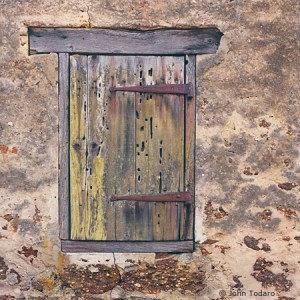
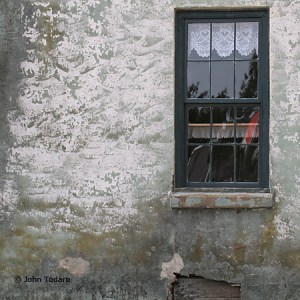
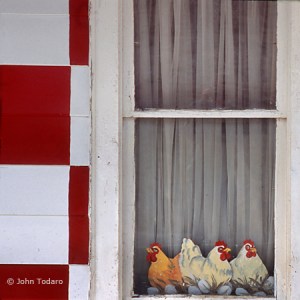
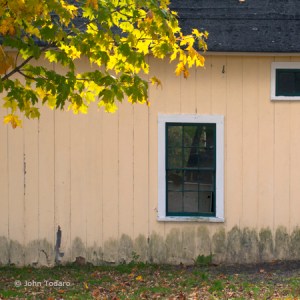
Thirteen Photographs Of Mostly Walls


The titles of the photographs can be accessed by holding your cursor over the images. Clicking on a thumbnail will produce an enlargement.

The locations:

  • 1   Green Door (Oatman, AZ)
  • 2   Ventana (Santa Fe, NM)
  • 3   Angelita (Oatman, AZ)
  • 4   Yucca (Presidio County, TX)
  • 5   Chilis (Oatman, AZ)
  • 6   Canyon Road (Santa Fe, NM)
  • 7   Cabana (Southampton, NY)
  • 8   Death (Death Valley Junction, CA)
  • 9   Kitchen Wall (Capitol Reef National Park, UT)
  • 10 Shuttered Forge (Batsto, NJ)
  • 11 White Wall (Western MD)
  • 12 Window Hens (Southern VT)
  • 13  Berkshire Barn (Western MA)

Slipper Shells (and a Scallop) – Amagansett Photographs

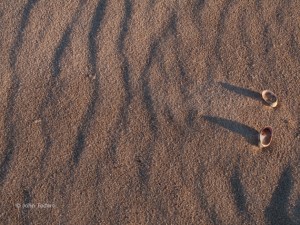
Here are four close-up studies  of shells found at low tide on the south side of Napeague Harbor. I like to think of these images as fractions of the larger landscape – scenes which are found in abundance on any beach that has not been visited by tires. Unfortunately a passion for recording of such details is generally not recognized in beach driving debates.

Dawn Sky With Cormorants – Sammy’s Beach toward Hedges Banks

This was recorded on a recent morning from the East Hampton side of Gardiner’s Bay at Sammy’s Beach.  From this spot there are expansive views in all directions and it’s possible to walk north to the Cedar Point Lighthouse, a distance of three miles. The flock of birds entering the scene from the right hand side of the image are Double Crested Cormorants and so I’ve appropriately entitled the piece Cormorants.

Sixteen Abstract Photographs

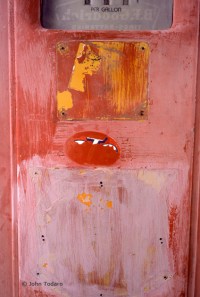
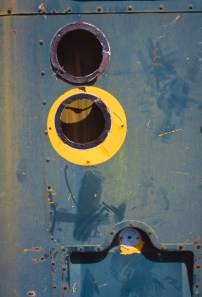
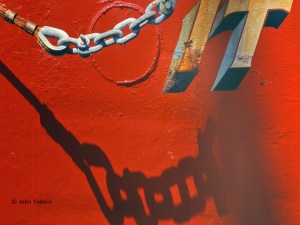
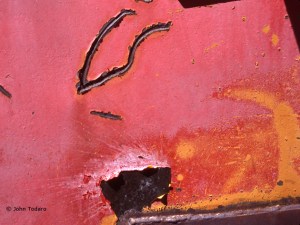
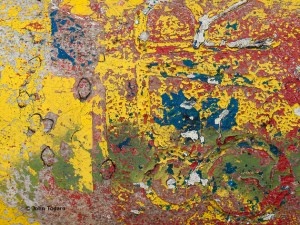
These pictures are straight photographs shot close up of a wide assortment of surfaces. You can enlarge any of them by clicking on them. The numbered titles  of the individual pieces will pop up if you hold your cursor over the image.

The specifics:

  • 1.  Truck detail,  northern AZ
  • 2.  Gas pump, Oatman, AZ
  • 3.  Truck detail,  northern AZ
  • 4.  Truck detail,  northern AZ
  • 5.  Buoy, Cumberland Island, Georgia
  • 6.  Truck detail,  northern AZ
  • 7.  Ship bow, New Bedford, MA
  • 8.  Ship detail, New Bedford, MA
  • 9.  Truck detail, southern AZ
  • 10. Shipyard detail, Westhampton Beach, NY
  • 11. Rusted car detail, Moab, UT
  • 12. Buoy, Amagansett, NY
  • 13. Wheel hub, southern AZ
  • 14. Shipyard detail, Westhampton Beach, NY
  • 15. Bouy, Amagansett, NY
  • 16. Buoy, Amagansett, NY

Reading Summer Streams

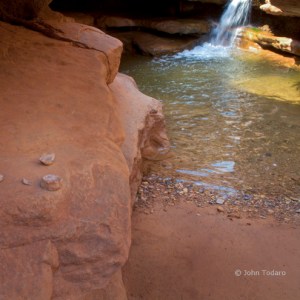
During the last four summers we vacationed in southern Utah, a place  more famous for massive canyon walls than trickling desert streams. But the two sometimes combine to make a hike in arid country far more refreshing than you might expect.

In Capitol Reef National Park we’ve followed stream beds for an entire day. In nearby Escalante,  Pine Creek is another place to do this. The creeks in canyon country are generally shallow and often flow across naked rock for miles. In some spots they pass through slickrock gorges that are so narrow that the trail essentially becomes the stream. Before venturing into any of these places, one needs to check the weather because sudden downpours can produce flash floods.

Surprisingly, even in mid summer the water in the streams is frigid. We’ve taken hikes in August where you’re either wet and shivering or baking in temperatures that approach 100 degrees. It all depends on whether or not you’re in the water. Get yourself wet and your teeth chatter. Hike back into the sun and you open the oven door.

Hiking Sulphur Creek in Capitol Reef involves so many stream crossings that you can’t keep track of them. After a half a mile or so, any hope of dry boots is squashed. The easiest thing to do is simply get in the stream and stay there. There are sandals designed for this.  There are also a number of waterfalls passing over rock chutes that require careful navigation. Because the canyon walls rise hundreds of feet in these places, you either find a way to climb through the pour-offs or turn around and go back. You have two choices for many of these hikes – either get wet or completely soaked.

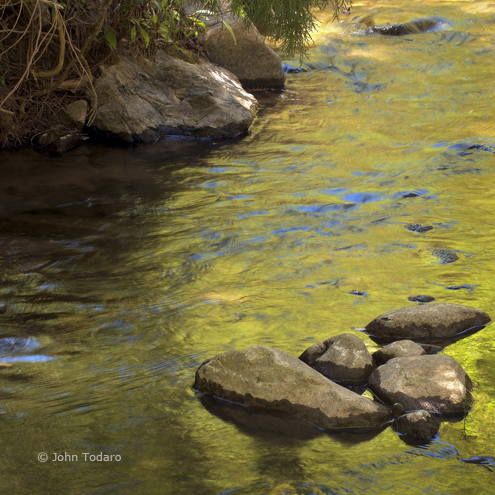
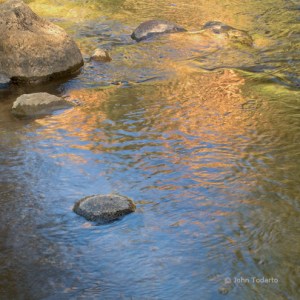
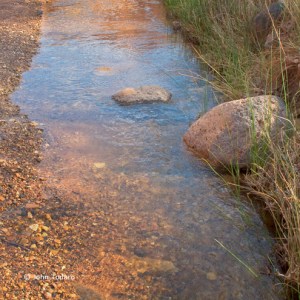
Aside from enjoying the water, I always get out the camera. The images I’m looking for are in the cloistered places where the creek plunges into the shade of canyon walls. It’s here that I’ve found the most compelling reflections. When studying the way the water looks from a variety of angles, you sometimes find pockets of irresistible color. In the shade, reflections of rocks, leaves and sky become deeply saturated.

It’s been in these sequestered locations where I’ve found many of my favorite pictures.  It’s no coincidence that they’re also some of my favorite places.


The Outhouse of Mulford Farm

The image below was taken last week during a morning of fickle weather. For several hours it alternated between stormy and foggy with the ocean blowing air into the village that felt damper than a boat sponge. The turbulence is standard fare in May and is caused by warmer morning temperatures and their ongoing argument with the chilly ocean.

You’re looking at an unceremonious outhouse located at the historic Mulford Farm in East Hampton Village which I photographed in the fog.

Interestingly, a bit of research has uncovered a wealth of information about outhouses.  I was surprised to read that they’ve been called biffies – a term which may have had its origin with Browning Ferris Industries, a waste collection company (with a conspicuous logo) which once serviced portable toilets. Long ago, Girl Scouts put another spin on it when a biffy became a bathroom in the forest for you. Various campers have also employed the term kybo.  This is thought to have originated in Vermont where Kybo Coffee cans were once filled with lyme and placed inside the structures to keep the odors to a minimum. I would’ve loved to have visited one of those north woods shacks with a Kybo can, especially in the moonlight beneath a silhouette of spruce.

Less frequently the outhouse has been referred to as a backhouse, and in Australia, they’re known as dunnies. In New Zealand you might call them long drops. 

Outhouses originated in Europe over 500 years ago which means they’ve been around for centuries. During the depression, WPA carpenters were hired by the government to build them in rural areas. You don’t hear about that in eighth grade American history. One wonders if any of those New Deal outhouses are still in service today?

Where I grew up on the west Coast of Florida some of my classmates lived in homes with privies near the woods. Whenever I visited these places I was awestruck. To a transplanted New Yorker in elementary school, having an outhouse on the property was evidence of very serious credentials. These friends of mine were not living in the rubber stamped homes popping up elsewhere in Florida (such as the one I lived in) and they didn’t come from the wealthiest families.  It didn’t matter. Their dwellings had  abundant wealth of character.

Outhouses at Mulford Farm would’ve been constructed during colonial times. It was during those years when the crescent moon cutout was first employed. The ones with crescents were for women and ones with stars were for men. I was truly amazed to discover this and it raises an obvious question. Why did the star fall out of fashion?   It’s been theorized that men let their privies fall into such horrible states of disrepair that they faded out, becoming rotted piles of wood in forgotten rural places.

It’s the feminine crescent cutout which has stood the test of time.

Southampton Photographs – Meadow Lane Boathouse

A morning kayak trip across Shinnecock Bay yielded several photographs of the historic Meadow Lane boathouse. Although this structure rises from the marshy flats of Eastern Long Island, much about it reminds me of similar abandoned buildings from the high plains – both from an historical context and also because of its sequestered setting. For Southampton, the boathouse is a footnote to a local history which is all but gone. It stands (at least for now) as a monument to former times. Approaching it from the bay by kayak is a good way to get a feel for this place – a building far more connected to the sea than the land.

Other photographs of abandoned structures from the west and elsewhere may be seen by clicking on this link:

https://johntodaro.wordpress.com/category/viewpoints/solitary-structures/

Here’s a link to another photograph from Shinnecock Bay on the same kayak outing:

https://johntodaro.wordpress.com/2010/05/13/southampton-photographs-great-egrets-and-duck-blind-shinnecock-bay/

Napeague Harbor Sequence – Petite Landscapes

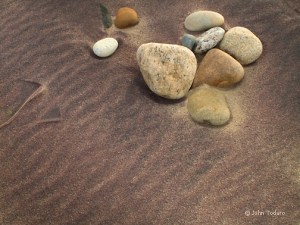
This is is a sequence of four images from various points around the perimeter of Napeague Harbor.  There’s a number of ways to group these, but in this instance I’ve arranged them vertically to convey something of what you might find at your feet during a walk on the beach.  I like to think of these images as petite landscapes – photographs close to the observer, with most of the elements of the larger picture. Clicking on them will produce an enlargement.

For other sequences from Amagansett and elsewhere go to this link:

Hasselblad 903SWC … rambling thoughts

The image is a another from Shafter, TX done with my Hasselblad 903 SWC. The picture from my previous post today was taken about an hour earlier.

Interestingly, this picture was published in a January 1997 Shutterbug article for reasons that now seem strangely outdated. In those days, the magazine devoted one issue per year to the latest and greatest 120 film cameras, with additional articles about photographers working in that format. Due to the equipment discussions, there was excitement generated by that particular Shutterbug, and it was probably the closest the magazine ever came to having a “swimsuit” issue.  Back in 1997, it was an honor to have one’s work  show up on those pages.

Things changed quickly. These days it’s hard to imagine a time when none of us knew what a pixel was. To their credit, Shutterbug made the transition too. Nowadays the discussion revolves around the mystique of the digital SLR and the latest revolution in point and shoot.

In spite of all that, there are still those (including myself)  who savor the look and feel of 120 film cameras such as the 903. Like most people these days, I own a digital camera, but I’m not giving up my Superwide anytime soon. I keep a few rolls of film on hand and have no issue with scanning it. An extra step to the digital work-flow is barely a hassle and more than worth the effort.

Some technical thoughts about using the 903 Superwide:

The detachable viewfinder made for this camera is the easiest way to view an image. Over the years when taking a picture, I’ve generally left the viewfinder on and used it to compose my photograph. If you’ve never owned the camera, keep in mind that when using the detachable viewfinder, the lower portion of your view is obscured by the lens barrel. I’ve always gotten around this little snag by turning the camera sideways in order to view the lower part of my image. For focusing, I use the hyperfocal-focusing marks on the lens barrel.

If greater precision is needed for composing and focusing, a ground glass back is available from Hasselblad and may be used in conjunction with any of the prism finders. I use it with the PM 5. Using the ground glass back with a prism finder requires that you remove the film back, and that you’re okay with viewing an upside down image. It also requires a shutter locked in the open position with a good cable release. Once you’ve done all that and your picture is composed and focused, the ground glass back (and prism finder) is removed and the film back is reinstalled. Obviously, all this is done with the camera on a tripod.

Additional photographs I’ve taken with the 903 may be seen by clicking on this link:

https://johntodaro.wordpress.com/category/viewpoints/square-format-hasselblad/

Keep in mind that colors and contrast of the images at this site will be most accurate when viewed on a calibrated MAC monitor. This is most relevant to photographs that have a wide range of contrast such as many of the ones I photographed with the 903.

If you’ve got any other questions about the camera, feel free to post a comment.


Romancing the Hasselblad – Shafter, Texas

Shafter, Texas sits in an area so sparsely populated that it makes much of the rest of the west seem tame by comparison. It is a region of vast ranches, grasslands and desert scrub which occupies hundreds of square miles south to the Mexican border.  In the distance are isolated mountain ranges that receive little rainfall and almost no visitors. To the east is the nearly one million acres of Big Bend National Park. The last time I was in Shafter, there were less than ten citizens.

This is an area which gives new meaning to the word remote.

I’ve returned from various trips to this part of Texas with some of my favorite landscapes. In almost every instance, I used the Hasselblad 903 SWC because it’s a place where the exceptionally wide Zeiss Biogon can do it’s thing.

Things to do in Moab … did he say, “admire the flowers?”

Consider this post a recess.

I recently was shopping in the health food store in Sag Harbor on Eastern Long Island and I was wearing my Moab hat. Someone came over and asked:

“What’s a Moab?”

A question like that isn’t that uncommon out here in the salt-soaked forests east of the Hudson River. In fact many people around are likely to assume the name Edward Abbey is an Edward Albee typo.

Me and Moab go back a long ways. It began in August 1978 when I was passing through what was then a town with only two places to eat. We were in one of them ordering breakfast and preparing to head up to nearby Arches National Park.  I was traveling with a close friend and my brother. It was the “salad years” for three of us and thanks to Edward Abbey, we had recently discovered Utah.

At the restaurant, I phoned home and my father informed me that Sagamore Hill National Historic Site had called. My father hated talking on the phone so I considered myself lucky. The three of us fished around for pocket change and I rang them up. The curator needed a staff photographer after Labor Day and I was offered the job.

I took it.

Many years later I returned to Moab with my wife and son and geez… had that place changed. They’d discovered over a thousand more arches inside the park. That made me feel old. Next they invented mountain bikes and all the people showed up. This was a clearly a town that had shifted gears since I first arrived.

You had to hand it to old Ed Abbey. He wrote Desert Solitaire and became the unwitting founding father of both Earth First and the Moab Chamber Of Commerce. Considering some of the pricey developments springing up,  you have to wonder what he’d make of it all.

I don’t know about him but I think that it’s good.

Some in southern Utah won’t agree, but the vacationing eco-tourists and Europeans on holiday are living proof that their state doesn’t require any more roads or mines, or forests full of cows. The good citizens need to remember that green types tend to travel with plenty of the green stuff. If Moab is any indication, more wilderness might actually boost their economy.

Enough with that. Now onto the photographs.

Nowadays there’s lots of good photographers exhibiting in Moab. In fact, the last time I was there, I’d say there were more photographers than gas stations. All of these guys are very good, although in Moab and everywhere else in Utah they tend to be white guys over fifty – something like myself.

And so… where are my arch pictures?

Unfortunately, I’ve got a tendency to withhold pictures that people want to see the most. I can’t help it, it’s my nature. I have photographs of arches but you have to wait. At any rate, Moab is one sweet town to walk around. Remember, that’s coming from a guy whose hometown got some sort of award from National Geographic (I keep forgetting to read the little sign they put up across from our library).

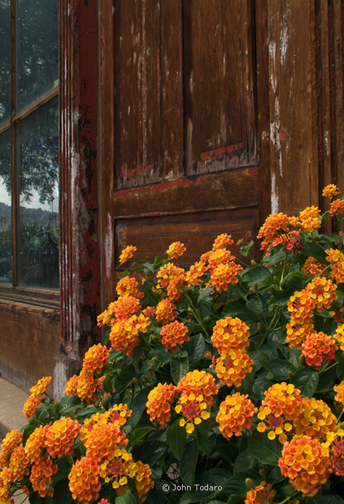
Thus, from Moab, I have flowers. Yarrow, Lantana, Roses and a Sunflower, all of which were photographed around Main Street, some near my favorite restaurants. I don’t know if Moab is overrated for anything but it’s underrated for flowers. My advice to visitors:  admire the flowers.

Some comments:

Yes, the Yarrow is dried up which in my opinion is the way it looks best – the place is a desert after all. The sunflower is complimented by a common garden hose which is the first one I’ve ever photographed. The final image is a fascinating one. I was struck by the way the two tripod legs looked and kept them in the picture. Photographers tend to avoid getting tripods in their photographs for obvious reasons but in this case, I let them be.  It’s a self-portrait, of sorts.

There are good textures in these pictures. People have seen them at different shows and think I took them in Paris.

I didn’t. They’re just from Moab.

Now for some off topic family favorites… and the rest of the photographs:

Favorite Waffle: Jailhouse Cafe ••• Favorite Mexican Food: Miguel’s Baja Grill ••• Best Deal: 99 cent Clif Bars at GearHeads ••• Favorite Thrift Store: Wabisabi (where my hat came from) ••• Favorite Bookstore: Back of Beyond (where my t-shirt came from) ••• Favorite Muffin: Chocolate Peanut Butter Vegan Muffin at Love Muffin Cafe ••• Favorite Shower: Slickrock Campground ••• Favorite Snack: Apricot Suncakes, Moonflower Market, Inc.

Favorite Utah National Park: Capitol Reef (sorry Arches)

Favorite Book About the Area: Park Slayer Pursuit,  a short book which my son wrote in 7th grade (sorry Mr. Abbey)


Contrarian Words For Diane Arbus

“A photograph is a secret about a secret. The more it tells you the less you know.”

Diane Arbus’ quote about photography is exquisite. It’s simple and it’s paradoxical. She teases us with her description of how photographs communicate, and she tantalizes logic by suggesting that the more you learn about a photograph the less you will know.

Good stuff.

Her work was mysterious. It was mysterious in a rarified sense that exists outside of the constraints of language. Her photographs were attached to nothing. No ideologies, dogma or religion. Those systems require words, and when one wraps a thing with that sort of language it takes on structure. Creativity can function within those structures but flourishes when it’s free.  Diane was one who reclaimed the word mysterious in her work. Religions do not own this word.

Arbus nudges us. With simple words she points to the process. Creations need no creeds and imagination requires nothing larger than itself. Sometimes I’ve wondered if the liberation of art is the one of the most unsung contributions of modern civilization. When John Lennon wrote the words to his song Imagine, he understood. After all, it took an odd leap of imagination to suggest that above us is only sky.

There is a downside to this modern paradigm of art:

Fame and money.

In spite of the temptations, Arbus didn’t give away her secrets. The rest of us have to deal with it in our own way.

Diane Arbus committed suicide in 1971.  During the ten years prior to that, she assembled a body of work that filled a niche so ravishingly that it inspires awe. She had no peer. Her portraits are raw, gripping, astonishing and completely unforgettable. She once said that her “favorite thing was to go where I’ve never been.”  That was her work. Even her detractors will admit that her photographs succeeded at this. Perhaps her pictures represent a new form of totem, a courageous one with a direct gaze and no need for a disembodied spirit.  For us it provides evidence for what an imagination looks like when it has been unleashed properly.

Like most photographers, my work bears no resemblance to hers and she would’ve had little interest in what I do. It’s not always easy, but I try not to give away the secrets.  I hope that once in awhile I’ve made an image that has gotten there.  I offer the photograph at the top of the post in her memory – a bouquet, of sorts, for Diane.

I recall a rank smell blowing in from the salt marsh and there was a nearly implausible red glow of fading sunlight. It flowed through the marsh and spilled over the pilings like fresh blood. It was a beautiful moment to which I gave my best.

Much has been written about Diane Arbus, her life and her work. A starting point is her Wikipedia entry which has a number of worthwhile links:

http://en.wikipedia.org/wiki/Diane_Arbus

An outstanding online catalogue of her work may be found here:

http://diane-arbus-photography.com/

House In Fog With Orange Door – Eckley, Pennsylvania

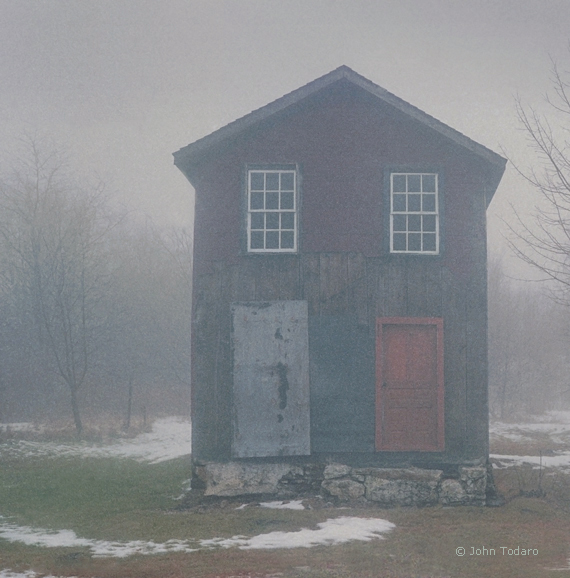
This photograph was taken a few years ago at Eckley, an historic mining town in Northeastern Pennsylvania.  Nowadays it’s an unusually quiet place tucked into the mountains – two straight rows of company houses which face each other across a simple road.  At the time of our visit it was a place of abundant texture, because the laborious work of restoration had barely begun.

Much like the photographs in the two previous posts, this is a portrait of a building blending with its landscape. Again, a solitary structure photographed from the front in two dimensions without the intrusion of architectural perspective. I’ve done this habitually over the years, at first being unaware of my tendency. Over time, I’ve grown attached to this technique the same way one becomes fond of good advice. It’s not always the answer but it is a way of looking at things that has its own unusual language. I’m not exactly sure what’s going on aesthetically, but let’s take a stab at it.

An image of an old building taken directly front-on creates a facade – a face of sorts with character and personality. Under the right circumstances, this will have a tendency to simplify a composition rather than complicate it. Simplicity is good. This angle often represents the most lyrical view.  It can also hint at humor and at times can impart a desirable sense of the surreal. Importantly, these images defy the funneling effects of perspective, and bring a calm stability which keeps one’s eyes attached to surface qualities. Textures are enhanced in such pictures because they’re not competing with perspective. What appeals to me most in this image is the muted harmony of closely matched color values. The teal green of grass is both complimented and refreshed by the vertical orange door. In a dense fog, colors will often appear as similar grays, at least to the talented squinter.

House With Red Roof, Gaspé, Québec

This piece will introduce a new category, one with an overly long and confusing title that definitely requires pruning:

Solitary dwellings, abandoned structures and other unattended human artifacts photographed within the greater landscape.


At the moment, I can’t think of a shorter way to say it, and if you have suggestions for a more truncated one – by all means post a comment.

Why put photographs into such a category in the first place? I’m not exactly sure, other than the fact that when I go back and look at what I’ve been doing for the last 35 years, obvious patterns emerge. I find myself peering through a camera at the lonely stuff we left behind; and if we hadn’t left it behind then there was probably no one home:

…a miners’ cabin in Eckley Pennsylvania…a capsized boat in Springs…an abandoned Chevy truck  on the plains of Colorado…the desolate corral in southern Utah…a house with a tin roof in North Carolina…the house with the red roof in Québec.

The list goes on and on even though I never set out to perform variations on a theme. I guess it just happened that way. Perhaps it’s because I take the pictures and the patterns take care of themselves.

Finding myself in front of the solitary houses was the beginning of the process. Next came the postures – how the stuff posed, where it was positioned relative to the camera. In each instance there was a right combination of things that evoked the desired mood.  For photographers, it can occur without warning. Things come together and you’ve arrived at your picture – and when that happens it feels something like it did back in middle school the first time you pulled open your combination lock. It’s why I like this job.

Again, the patterns:  A lonely house leashed with a power line. An abandoned home beneath the complex geometry of a storm.  One hundred and fifty years ago a photographer no doubt discovered that by shifting his position a few feet to the left, he set his picture ablaze with mood. This is key. With my own work, the moods have varied over time but hopefully not too much. If I’ve been doing my job right  I’ve just wanted the pictures to speak of simple things:

Solitude, detachment and fluidity.  If a photograph of a house is able to convey something timeless, that’s wonderful.  But if it also suggests something about the passage of time, then that is a picture with a taste for one of our finest paradoxes. Sometimes my pictures have gotten there but others have fallen short.  All honest photographers know there’s luck involved.

Over the coming weeks I’ll be posting more of this work – photographs of the lonely stuff out there in the landscape.

I’ve come up with a shorter title:

Solitary Structures:

https://johntodaro.wordpress.com/category/viewpoints/solitary-structures/

Abandoned Structures/High Plains – Hasselblad 903SWC

Another from western North Dakota taken with the Hasselblad 903. I’ve called this one Quiet House. More images of abandoned structures on the high plains (and elsewhere) can be seen by clicking on this link:

https://johntodaro.wordpress.com/category/viewpoints/solitary-structures/

To see other photographs taken with the Hasselblad 903 SWC, go to the same menu and click on Square Format-Hasselblad. You’ll find additional commentaries about the camera at several of those posts.

One-Room Schoolhouse, Western South Dakota

We encountered this building a number of years ago while driving across South Dakota. I’d been hoping to see such places and so we’d driven the entire state on the grayest highways we could find on the road map.

We climbed out of the car into a landscape which mixed the serene with the surreal as effectively as any Hopper painting. Around and behind the building there was nothing but grass as far as you could see –  a scene of such elemental minimalism that it was close to breathtaking.  For me, finding these places has become the defining moments of many trips and I’ve never been able to walk away from them without engaging the camera.

Between the 1890’s and the 1950’s one room schoolhouses existed at regular intervals across the high plains. These were the same years when the middle third of our continent underwent a radical transformation – and as we all know, the changes didn’t come easy. If the prairie was easy to plow it was often harder to tame.  The wooden grain elevators and other structures have now mostly faded into the landscape. Perhaps what remains is totemic, an expression of a deep-rooted simplicity that belongs to that landscape and belongs with us as a people. If the buildings stay with us, they will be the relics of an uncomplicated esthetic that existed before the arrival of modern clutter.

While I was taking this picture, my wife and two year old son played nearby in the grass. For me it was easy to conjure up the bygone recesses… running children in hand sewn-clothes, scolding teachers and fifth grade crushes. My son was oblivious to those thoughts because it was June and a good time for insects. The winds picked up and I walked around the building with my camera. Each side seemed to have it’s own game – four courts of light and four plays of texture. Above us the sky was strewn with clouds – distant, but at the same time appearing unusually close. My wife and son sat down on the doorstep and I took pictures of them. When we peered in the windows we discovered desks, shelves, furniture covered with blankets and a long-forgotten piano.

Yesterday I found a link to historic photographs of Kansas one-room schoolhouses. The site is an excellent example of an archive doing exactly what it’s supposed to do. My wife and I spent much time poring over the pictures, especially the class portraits. These were auspicious warm-weather events with kids in their finest clothes – days when everyone was ushered outside onto the grass to pose before the large camera. The children formed a group and their teachers were placed behind them. Everyone stood still and the exposure was made filling the air with the smell of magnesium flash powder. Behind the class the photographers kept it simple…always the school house and maybe a glimpse of prairie. You might find, as we did, that the faces of the children will unleash your imaginations with the details of their many possible stories:

http://www.kansasheritage.org/orsh/Gallery/index.htm

More images of abandoned buildings from the Dakotas (and elsewhere) can be seen by clicking on this link:

https://johntodaro.wordpress.com/category/viewpoints/solitary-structures/


Shipwreck, Two Mile Hollow Beach

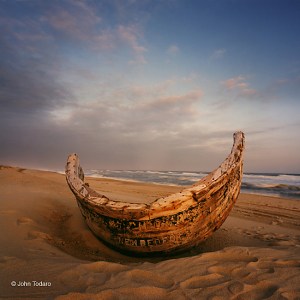
In Sag Harbor, you may have noticed the weathered wooden ship stern which decorated the grounds in front of the Bay Street Theater for a number of years. Before ending up there, it spent most of the last century submerged near Two Mile Hollow Beach between East Hampton and Amagansett where it was said to be visible during times of exceptionally low tides. When it washed ashore on a cold afternoon fifteen years ago, I drove to the beach and joined a crowd of hushed-voiced locals who had already converged on the scene. We huddled around the boat in the last hour of daylight.  It seems that whenever the ocean coughs up a ship or a whale they  arrive with equal measures of sadness and curiosity. Except for the words on the transom indicating a home port of New Bedford, no one could say much about the vessel. As the sun went down I took some photographs. The remains of the boat sat on the beach glowing – a gilted wooden crescent.  I returned the next afternoon hoping to see it again but it was already gone.

Wainscott Photographs: Killcare and the Pebble

Killcare

The view of the ocean from Wainscott and the west end of Georgica is dominated by the iconic home known locally as Killcare. Whether seen up close or from a quarter mile down the beach, it catches the eye and stirs the imagination the way few buildings ever do.  I’ve been watching it for twenty years, in every manner of light – holding its own on the dunes amidst the awesome flux of landscape. I feel lucky to have glimpsed a small part of a creative project that’s lasted for over a century.

On a certain level, the subject of this picture is impermanence because I can’t help but notice that the structure’s isolation within the landscape is made more beautiful by that fact. The picture is also about the curiosity of brushing against it with your own mutable presence. In a sense I was taking a cue from the house – interfacing with the landscape to see if there was any poetry in it.  I’ve sometimes walked my own shadow into a picture and felt the chilly effects of an unannounced visitor. On other occasions I’ve left my footprints where others had left theirs and then faced the empty beach to release the shutter.

This time it was a pebble – the one that got tossed into the temporary trough of flatwater that forms on the beach in between breaking waves.  I’ve been tossing pebbles into spots like these for as long as I can remember.  As always the event began with radiating concentric circles. There was time for a single exposure. The ripples subsided and the water itself began the process of evaporation. This was a scene in no mind to stay in one place. In ten minutes nothing remained  but swash marks. The piece is entitled Killcare –  a landscape and a self portrait.

Montauk Photographs – Shadmoor


The camera at this location was one with a sweeping view of the Atlantic,  a logical segueway from the photograph in the previous post from Bandon, Oregon. This time I was visiting Shadmoor State Park in Montauk,  New York.  Again, the weapon of choice – the Hasselblad 903 SWC. By way of comparison, the Montauk photo was made on positive film (or transparency), and the picture from the West Coast was a negative. Same camera, different coast and different film.

If you are still intrigued by putting a roll of film in your camera, the two pictures provide a good opportunity to study the differences between negatives and transparencies. Whereas the Bandon picture has a decidedly warmer pallet, the Montauk scene is one of cool tones and snappier contrast. The smoothness of the Bandon picture is answered by Montauk’s abundant detail. Two different looks – both of which can translate agreeably into digital files (assuming you still have the patience for scanning). To some of us, there is nothing like the delicious clumpy grain of silver halide.

In the decade that’s passed since I took this picture, the 99 acres of Shadmoor have  been declared a State Park and its cliffs have become dangerously eroded. These days a fence keeps visitors away from the edge in an effort to protect the habitat and prevent injuries. The park is unique for many reasons, not the least of which are its wetlands, its thick stands of Shadbush, and the historic bunkers that have been fronting the Atlantic Ocean since WW II.

To see other photographs taken with the Hasselblad 903 SWC click on this link:

https://johntodaro.wordpress.com/category/viewpoints/square-format-hasselblad/

Bandon, Oregon – Hasselblad 903 SWC

This photograph was taken fifteen years ago, looking west from the left-coast  at an ocean I’ve rarely photographed. It was November and I was high on a bluff  in Bandon Oregon – an unpretentious town at the end of a dusty road with a surprisingly epic view of the Pacific. Something about this place reminded me of off-season Montauk and  similar towns – timeless places putting on their winter clothes – communities that can be counted on not to change for the worse.

Admittedly the view of the ocean here was more like Montauk on steroids – scenery on a truly grand scale. Appropriately, I chose my Hasselblad 903 SWC – a medium format camera that came fixed with what quite possibly was the finest wide angle lens ever made – the 38mm f4.5 Biogon. This was a camera unburdened with bells and whistles and redundant gadgetry. With it’s detachable viewfinder and ability to accept a ground glass back, the 903 has reigned for years as the ultimate choice for wide angle devotees.  Perhaps for this reason, the camera has earned it’s nickname “Superwide” although the number of people familiar with it on that basis is sadly dwindling. In the previous century when Hasselblads were in vogue both here and on the moon, the Superwide had a much deserved reputation for pinpoint accuracy and corner-to-corner sharpness. But now, due to the lack of a digital back, it sadly falls out of fashion with those of us producing millions of pixels. Perhaps its moon is waning.

My friend Jonathan who studies these things tells me that the 903  was first produced in Sweden in 1954 which also happens to be the same year I was manufactured. An early prototype was unceremoniously shipped to our shores around the time Charlie Parker was making his final recordings. With only minor modifications it has remained unchanged ever since. You can still buy it, or you can buy an older one and put a brand new back on it which will attach with no problem. That was the point.  It was produced when things were still bench-made by guys who assembled things with a panache for precision. It was put together with sturdy parts and close attention to details. The damn thing worked. It felt good in your hands. When you put it back in it’s case and took it out the following spring, it didn’t need any improvements. Once you bought this camera there was no need to upgrade your operating system.

And so I am not yet ready for it’s elegy. Digital imaging is here for good and I’m not inclined toward orthodoxy whether it’s on one side of this argument or the other. I can live with the complexities of being a hybrid and will happily scan my film.

To see other photographs taken with the Hasselblad 903 SWC click on this link:

https://johntodaro.wordpress.com/category/viewpoints/square-format/

For a commentary about the use of the detachable rangefinder and  ground glass back on the 903, go to this link:

https://johntodaro.wordpress.com/2011/03/26/hasselblad-903swc-rambling-thoughts/

East Hampton Photographs-Main Beach (Square Format)

This image was taken with my Hasselblad 903 SWC one winter morning during the opening blast of daylight – a moment when everything ignites into a harmony of striking colors. I was much in the mood for photography especially with the addition of all those footprints and not a single person in sight. On this occasion and on many others,  framing the scene in a square made it sing with the sweetest voice.

Squares are uncommon and if you chose to put your landscape into one,  you can congratulate yourself on an unconventional choice. In these days of digital capture, the square is becoming downright eccentric.

Having no bias for up or down and not being partial to across, square compositions can also be what you might call pleasantly ambiguous. If you’ve been frustrated by horizontality – try throwing a square around your scene and you might be onto something. The photographer David Plowden did this to the seriously horizontal high plains of the American west back in the 70’s and made extraordinary use of squares.

Many landscapes, to be sure, will never work as squares. But setting landscapes to default horizontals shows little imagination.  Squares can create a surprising twist on a feeling. They can bring mystery through the door and take the mundane out to the trash. Squares can say something new rather than old, and can sometimes speak volumes when there’s otherwise nothing to say.

To see other photographs taken with the Hasselbad 903 SWC, go to the Location and Topic menu on the sidebar on the right and click on Square Format-Hasselblad. You’ll find additional commentaries about the camera at several of those posts.

.

Sequence Photographs Vol 2 – San Rafael Swell, Utah

Northeast of Capitol Reef National Park in southern Utah is a vast wild area– a complex of eroded sandstone landscapes known as the San Rafael Swell. For those impressed with numbers, the area occupied by the San Rafael (pronounced Rah-FELL) is approximately one million acres. By way of analogy, it’s about the same size as Long Island where I live– but unlike our Island, the Swell is not home to several million people. There are generally more canyons here than conversations, and you will sometimes encounter more rattlesnakes than visitors. Its seemingly endless array of stony washes, hoodoos, slickrock and isolated pools can be difficult to describe and sometimes hard to photograph with any justice. We’ve hiked and camped the Swell so often, I’ve lost track of how many times I’ve been there.

Anywhere else in the country the San Rafael would’ve been declared a National Park or Monument years ago. But in Utah (a state not lacking anything spectacular) the affairs of the Swell have fallen largely into the hands of the Department of the Interior’s Bureau of Land Management. There are several wilderness study areas under consideration, but the BLM (in case you haven’t heard) has had the occasional affair with mining, off-road vehicle interests and gas exploration. Currently, the Swell exists with both ongoing threats and a growing push to create a National Monument. For those motivated toward preservation, The Southern Utah Wilderness Alliance (SUWA) is the principle group trying to save the place. http://www.suwa.org/site/PageServer

This past summer, we made several day trips in from Hanksville or Green River. In the silence and heat that can transform a summer’s stroll on slickrock into something that’s really gotten your attention, the camera can be a playful device to bring to that awareness.

On these hikes it was random passing stuff that stopped me. The look of a rock or a stick — the  tread across sandstone. Textures and color — hidden corners of big places — the small things in a huge landscape.

In the canyons I collect details like I used to collect postage stamps when I was a kid. Back home I sort through the photographs and see how they look in groups. Once in awhile when sequencing pictures like this something comes together. I settle on an arrangement of three:

A Cottonwood leaf… polka dots raindrops on a rock… a dry image of lichens.

Southampton Photographs – Great Egrets and Duck Blind, Shinnecock Bay

A worthwhile excursion by sea kayak (assuming the winds are cooperating) takes you from the landing east of the Shinnecock Canal over to the marshy area which backs up to Meadow Lane in Southampton. The bay is shallow, easy to cross and is a place that’s full of expectations for rare birds.

Early on the morning I took this picture, getting over to the beach was no issue. The sky had intriguing color and there was a captivating chill in the air. Once in the marshes, I spent some time floating about in the vicinity of the old boathouse. I was occupied by short paddle strokes and subsequent long glides over mud banks which were pleasantly stuffed with mussels. It’s the quiet in places like this that appeals the most– and I was trying to keep it that way because I had a hunch that something interesting lay ahead.  I’d packed my camera in a dry bag just in case and the bag was stuffed under my spray skirt.

Just west of the boathouse I suddenly came upon two Great Egrets sunning on top of a duck blind. These birds are by no means rare in Southampton, but good photographs of them are– especially if the photographer is nervous about keeping his camera dry and isn’t looking for reasons to capsize his boat. They watched with suspicious eyes.

With a bit of luck, I managed to locate my camera, change a lens, brace myself with a paddle float, and capture an image just as the birds flew off.

Sequence Photographs – Seaweed and Sand, Amagansett

I’ve been working on a project which involves grouping compatible images into sequences.  This began a few years ago with a series I called “Dune Studies” –seen here:

https://johntodaro.wordpress.com/2011/02/15/amagansetteast-hampton-dune-image-sequence/

Last summer while on vacation in Utah, the idea gained momentum.  We were taking hikes each day, often following streams in canyons. On these walks, I was photographing water reflections, rocks and lichens- all subjects that were easily found a few feet away.

At home, I began sorting through these pictures along with others shot on local beaches during similar walks. I found that if you assemble a group of three or four images, the results can suggest the movement of both time and space experienced during a walk.

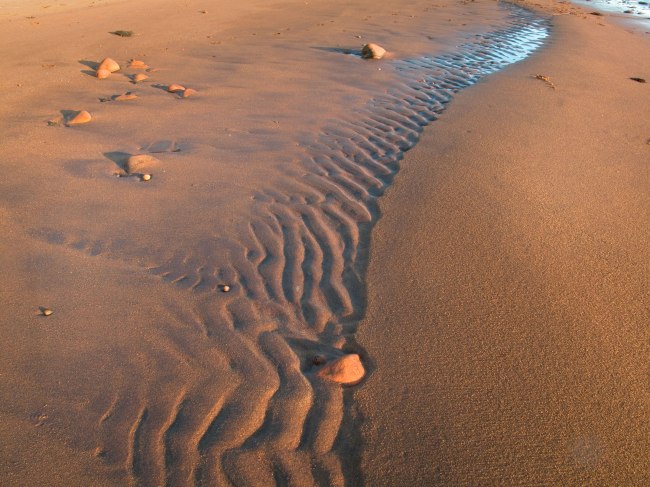
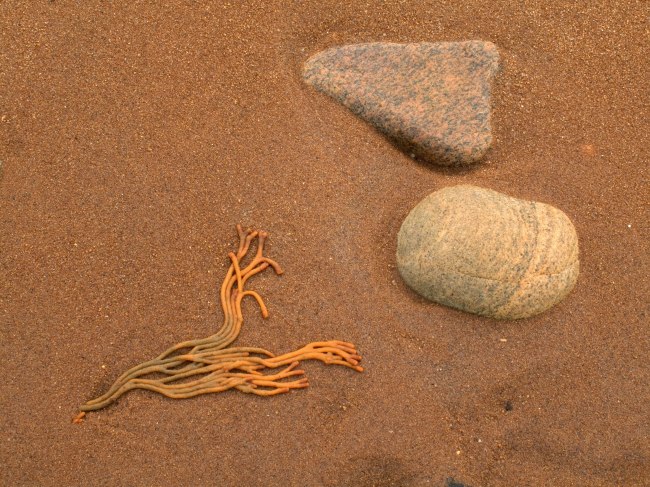
Over the last few months I’ve put together 8 sequences of either three or four pictures each. I made two groups from last summer’s Utah trip- one of lichens and another of creeks. All the rest of the photographs were taken on beaches in East Hampton and Amagansett. In addition to those, I created a series of photographs made on various segments of the Paumanok Path (a 125 mile trail that winds across eastern Long Island). Two of my beach sequences (including the one on this page) are from Napeague Harbor at low tide. This harbor, especially in the vicinity of the Walking Dunes, has striking color and texture:

All of these sequences share characteristics—For one thing, they’re made up of individual photographs of what one might expect to encounter when hiking in a quiet place.  But with these pictures I don’t want to convey the larger landscape. This isn’t about distant horizons or dramatic skies. What matters here are the textures and colors of “local” things – subjects found while walking, often no more than ten feet away.

That’s the stepping-off point. Sequencing begins another process.

To do this, it seems to help if you view your project much as a painter might. You dab, so to speak, and you try things out. You play with line and texture. You move things around until it all starts to work.

If you pay attention to your groups you soon have something new. You’ve created a sequence of photographs that is asking to be viewed as a single unit. Its lines, colors, textures are now an integrated whole.

At times, the impressions generated from these sequences can be both refreshing and complex.

More sequences from the beach (and elsewhere) can be seen by clicking here:

https://johntodaro.wordpress.com/category/viewpoints/sequences-and-grouped-images/