St. Francis Church, Ranchos De Taos, 1994

From my archive, I have an image of the much-celebrated St Francis Church in Ranchos de Taos, New Mexico.  Since I have no notes accompanying the original picture, I’m guessing it was taken in 1994.  The negative was shot in color on Kodak Ektar 25 with the same Hasselblad wide-angle camera I used for my two previous posts. Years back, I did make a few small color prints of this picture, but I prefer the black and white conversion. Yesterday, I spent some time cloning out dust using the “old school” method in Photoshop: one speck at a time. And I toned the image with a mild sepia because I like the look of those historic prints of this church (and some links to those pictures can be found down below).

The adobe church was built between 1772 and 1816 when this area of New Mexico was part of the Vice-Royalty of New Spain. It was fortified with a surrounding wall at that time to protect against attacks from Comanches. To me, it’s a stunningly modern-looking building, way ahead of its time in terms of abstract design, and one which looks more extraordinary from behind than from the front.

The church has a large presence in photography history (and has been painted just as often). Here’s some links to some of the more well-known images:

Ansel Adams, 1929

Georgia O’Keefe, 1930

Paul Strand, 1931

Carl Van Vechten, 1933

Laura Gilpin, 1939

Pacific From La Jolla, 2000

From the “other” ocean, comes a picture from March, 2000 originally photographed in color on Kodak Portra 160 film with a Hasselblad 903-SWC. I’ve converted it here to black and white.

As was the case with the previous post, it’s an image that I never scanned or printed (other than on a contact sheet for reference).  I’m showing it with the film border because of an interesting discovery.

Hasselblads are medium format cameras that have detachable backs. Long ago, the company put two V notches onto their backs so that exposed film images would have a Hasselblad mark. With the camera in an upright position (which they almost always are), those V notches will be found on the left edge of the exposed picture. But when I looked at this one yesterday, they were down on the bottom. Here’s a closeup:

This can only mean that I took the picture sideways. My best guess: I raised my tripod with the camera attached to such a height that I couldn’t look through the viewfinder without getting on my toes.  For a quick fix, I must’ve tilted the tripod head 90° to the left and locked it there, bringing the viewfinder down to eye level.  That’s a fast adjustment, especially if the birds are going to fly. And that’s why the V notches are on the bottom instead of the side.
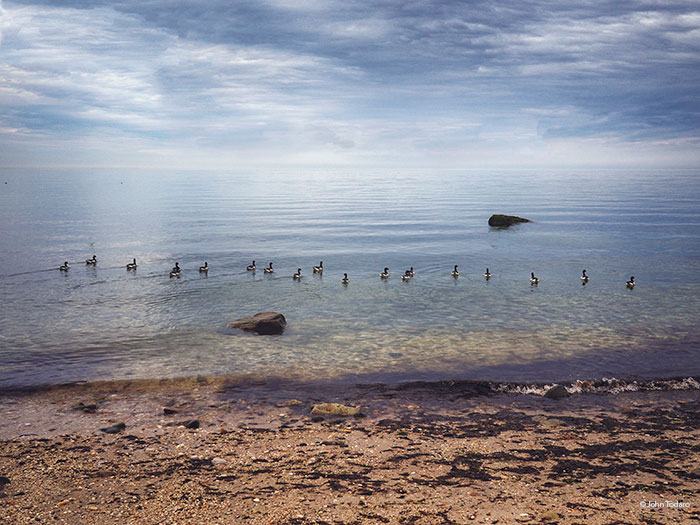
It’s funny, these days there’s lots of apps which simulate ragged film borders. I like playing with them once in awhile but they have the annoying tendency of making me feel old. 😏

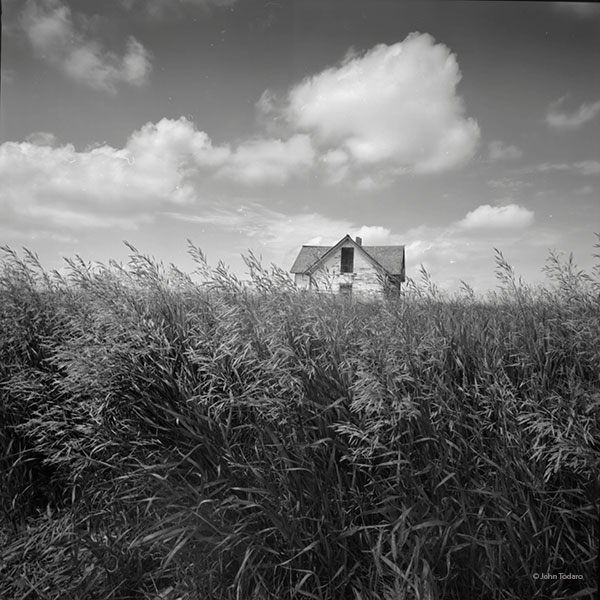
Abandoned Farm, South Dakota, 1999

I’ve been scanning some film from 20+ years ago, images which I never printed or did anything with. I’ve been looking specifically for ones that make good black and white conversions. This picture was taken in color on Agfa Ultra 50, a film that had an unusual contrast and palette which I only shot two or three times. That film was medium format so you’re looking at the uncropped full-frame image. I’m pretty sure I used my Hasselblad 903 SWC for this, a wide view camera that came with a fixed 38mm lens and a detachable viewfinder.  There were no electronic parts. You relied on a hand-held meter (or a good guess) to take your picture.

There’s a new feature in Photoshop’s neural filters suite which removes dust commendably. That’s a job that used to take many hours, especially if you intended to make prints from digital film scans. I scanned this one yesterday with my Epson V700, which is still running after twenty years. I did leave the remaining dust visible up there in the sky. Maybe it will give the image some provenance. 😏