View From the Haerter Bridge: Panasonic Wide Converter (DMW-GWC1)

Here’s a photograph captured with my new Panasonic Wide Converter…a Micro 4/3 camera accessory which is also known as the DMW-GWC1. If you ask me, better names must certainly exist.

As I’ve explained in other posts, the converter attaches to the Panasonic 14mm f/2.5 and presto—you have an 11mm lens. This is equipment for those who occupy a very specific niche: The Micro 4/3 completist, or at least anyone in possession of the 14mm Panasonic lens who’s curious about a wider field of view (and doesn’t want to fork up the $600-plus for the comparable Olympus lens).

The picture was captured as a RAW file (handheld, and using a Panasonic GF2). The RAW was converted to JPEG in order to publish it here at my site. No color adjustments were made, and the file hasn’t been sharpened. A slight reduction in contrast was employed in order to make the image more internet-friendly. (Keep in mind–you really should be checking out at these photographs on a MAC monitor anyway if you want them to be spot-on, a point which is especially relevant when it comes to highlight detail.)

If you’re wondering, the gradation from the upper left to the upper right in this photograph is entirely natural (the sun was shining a few degrees starboard). Happily the files from converter photos show only a slight (but acceptable) amount of vignetting. If you’re horrified by any vignetting, the post-processing fix will cost you all of four seconds. Barrel distortion is present, but can be likewise dealt with in Photoshop. If you’re not shooting architectural subjects it may not matter anyway. Overall, the optics of the converter seem  comparable to the 14mm lens it attaches to.

The location of the picture:  Sag Harbor, USA…on the eastern end of fish-shaped Long Island where our wild roses are now blooming.

Several more of my converter photographs along with additional comments may be found at the following links:

https://johntodaro.wordpress.com/2012/05/18/swan-at-havens-beach-panasonic-wide-converter-dmw-gwc1/

https://johntodaro.wordpress.com/2012/06/04/sag-harbor-photography-wall-and-flowers-shooting-with-the-dmw-gwc1/

My friend Peter (at .documenting.the.obvious) has  published a more thorough review of the DMW GWC1, (especially as regards vignetting, barrel distortion and corner sharpness). Visit his post at the link below but please take some time to enjoy his many unusual photographs:

http://dothob.wordpress.com/2012/06/23/into-the-great-wide-open/

Another Hoodoo…Montauk

I rarely make these statements, but I’d have to say that this picture is my favorite of all my own hoodoo images, east, west or anywhere in between. I do concede that it’s a gloomy scene, but for me it evokes the place, and I can smell the tide and the crumbling earth and the oozing out of spring.

They don’t call them hoodoos for nothing.

Have you ever been at Shadmoor and asked yourself, “How did they get here?” These formations (unlike their more famous cousins in places like Bryce Canyon) are not comprised of eroded sedimentary rock.  What we have here is a mish-mash (my wife’s words) of sand, clay and gravel–also known as glacial till. Long Island itself is pretty much nothing more than a sandbar full of such debris left by retreating glaciers.

The formation of hoodoos here in Shadmoor occurs when water percolates down and begins to move horizontally in the ground. There it pushes out the softer deposits, which kicks off a process of slumping and erosion creating hoodoos out of the remaining harder sediments.  In spring, if you hike down in front of the bluffs on the beach, you’ll often find water leaching out of the clay. In some spots, it forms rivulets which flow onto the sand below. The ocean takes care of the finishing touches with its own brand of erosion, chomping off huge vertical sections after storms.

Montauk Images – Hoodoos In Winter

Anyone who has visited National Parks in Utah (or who has read anything by Edward Abbey) invariably comes away with a fondness for the term “hoodoo”. In the west, a hoodoo is a name for eroded sandstone and limestone formations, especially the ones that conjure up ghastly shapes, anthropomorphic or otherwise. The term is an alternate take on the word voodoo and probably originated in Africa. You can see plenty of hoodoos in Goblin Valley State Park (in central Utah) or in Bryce Canyon.

But the west doesn’t own them all.

Similar spires may be seen in Shadmoor State Park in Montauk, where eroded bluffs create a fantastically ragged coastline. Much like their western cousins, Montauk’s formations continue to erode and reshape themselves (and are arguably just as spectacular).

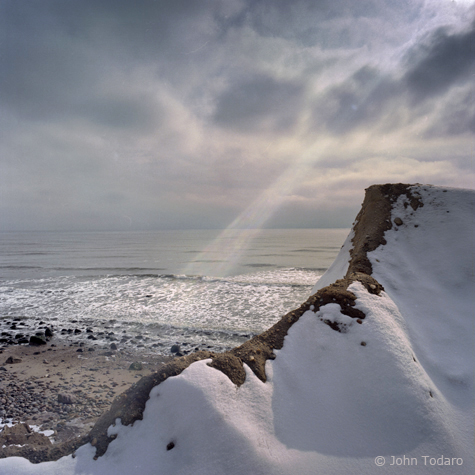
This photograph was taken a few years back on an obstreperous winter’s day when a storm was clearing out. For about a half hour, I was present for a very interesting display of light which included the occasional sunbeam slanting down to the ocean. The picture was shot on negative film with my Hasselblad.

Montauk – Ocean (and Bluffs) At Shadmoor

Shadmoor State Park preserves a half mile of oceanfront in Montauk along with 99 acres of parkland up on top, and is home to a variety of rare plant and animal species and unusual wetland habitats. Sand Plain Gerardia is present here along with thick stands of Black Cherry and Shadbush, the small tree which gives the park its name.


Shadmoor has historic significance because it’s also the location of Camp Wikoff, where Theodore Roosevelt and his troops were quarantined after the Spanish American War.  Additionally, there are two observation bunkers in Shadmoor which date to WW II and which were part of our coastal defenses.

I’ve photographed Shadmoor at various times and seasons. This image is from down on the beach in front of the bluffs facing Ditch Plain. A half mile walk will get you up-close and personal with the famous Montauk hoodoos, which is the local name for the eroded bluffs of the park.

Not Just For Portraits…the Olympus M. Zuiko 45mm f1.8

In December, as I’ve mentioned, I picked up a lens for my Panasonic Micro 4/3 outfit – the Olympus M. Zuiko 45mm, a lens of such beguiling compactness, it could snuggle up next to a golfball. But more to the point, it’s the very satisfying speed (f 1.8) which has been making most of the news.

By designing it both small and fast, they’ve escorted handheld telephoto imaging into a new dimension. Interestingly, the M. Zuiko suggests a miniature version of my much-used 90mm Sonnar (for my Contax G2)–a Zeiss telephoto that was another good performer when used without a tripod.

Much has been written about the lens’ ability to deliver a creamy soft focus when used wide open (aka bokeh). As you might know, this is an old technique which is quite the rage at the moment. And it is true–with this lens, a very shallow depth of field is possible, to an extent not previously achievable with point-and-shoot.  If you’re into bokeh, this lens is your huckleberry.

Needless to say I’m generally not using it for portraits (nor for shallow depth of field). The picture above demonstrates how an effective handheld picture is possible in low light outside. My camera was set at ISO 400, at a moderate f 9 aperture, with a shutter speed of 1/400. Because I was only ten feet from my subject, the depth of field achieved here (with a handheld camera) is quite impressive throughout the image.  Plus, because this lens is so fast, the image was recorded in the very sweet central area of the glass. (Using a zoom I would’ve been shooting much closer to wide open, and would’ve also required a tripod which would’ve made this particular image nearly impossible to take.)

To me, getting handheld images like this is a testimony to the compactness of this lens, and the beauty of the Micro 4/3 system.  The 45 f 1.8 is capable of delivering stunning bokeh wide open, moderate bokeh when used around f 5.6 (something which I often employ when shooting in fog), and superb depth of field at the higher f stops (which, in truth, is even greater than a comparable 35mm lens because the lens construction for Micro 4/3 is so much smaller).  In these terms, the Olympus 45mm f1.8 is extraordinarily versatile and one of the most usable telephotos ever made.

The lilliputian character of this lens relates directly to the Micro 4/3 sensor. It should be interesting to see if the (significantly larger) Sony NEX 7 system will have a comparable fully automatic prime telephoto available in the next year. I doubt it, but even if one comes along, it’s likely to be larger. For landscapes I much prefer a fast telephoto that’s usable without a tripod. I’m not ditching my Panasonics, and I suspect there’s an argument to make for using both formats.

BTW–This is how I’m currently working with my 4/3 primes:

I pack the Panasonic G 3 and the GF 2 into a small Tenba bag. The weight of both cameras (and all three prime lenses) is less than my old Hasselblad 180mm. That’s a lot of lightweight equipment using very little space. I keep the 14mm Panasonic on my G 3 and the 45mm Olympus on my GF 2. Since my GF 2 is silver, the lens is quite bewitching when paired this body.

The odd man out is my equally speedy 20mm f 1.7 which I can quickly install onto either body when needed. Having two bodies affixed with prime lenses makes it very easy to switch horses in the middle of a shoot. Advice: if you already have a GF body and are considering the G 3 (or GX 1)–keep your original camera. With prime lenses in your bag, having more than one body makes a lot of sense.

Here’s some specs on the lens from the Olympus press release:

http://www.olympus-global.com/en/news/2011a/nr110630zuiko45e.html

Winter Beaches – Square Format Images

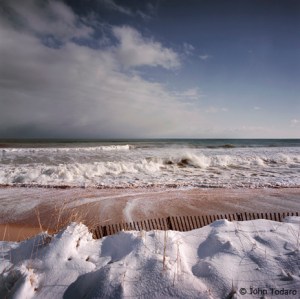
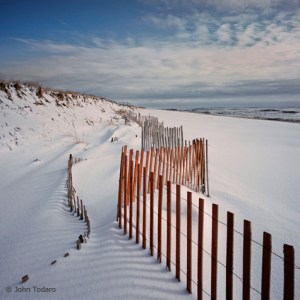
The four square format ocean landscapes were shot on negatives with the Hasselblad 903 SWC – a fixed wide angle camera with a 38mm Biogon lens. To this day, the 903 is totally without peer in terms of its compactness and the ability to deliver a ruthlessly precise and highly accurate wide-angle image. Click on the thumbnails to see an enlarged picture:

November Light – Sagg Main Beach

This recent scene from Sagg Main demonstrates the sun’s current position relative to the beach at sunrise. It shines directly down the beach and sets the place ablaze. You won’t see that here in summer. Another interesting thing about the picture is the graceful pattern formed by the tire tracks – something which I’m usually trying to avoid!

 The picture was photographed with the Panasonic Lumix Gf2.

Slipper Shells (and a Scallop) – Amagansett Photographs

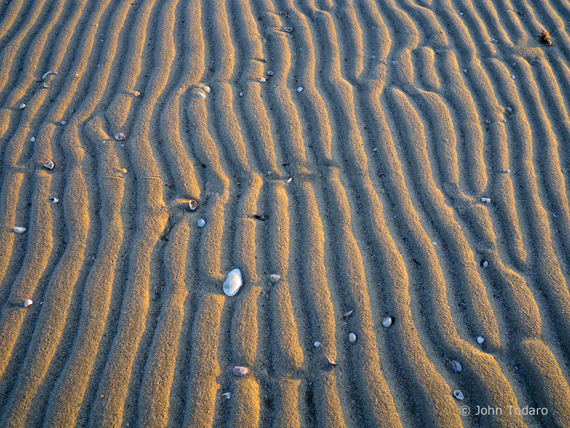
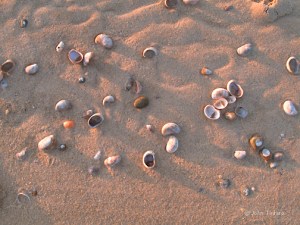
Here are four close-up studies  of shells found at low tide on the south side of Napeague Harbor. I like to think of these images as fractions of the larger landscape – scenes which are found in abundance on any beach that has not been visited by tires. Unfortunately a passion for recording of such details is generally not recognized in beach driving debates.

Dawn Sky With Cormorants – Sammy’s Beach toward Hedges Banks

This was recorded on a recent morning from the East Hampton side of Gardiner’s Bay at Sammy’s Beach.  From this spot there are expansive views in all directions and it’s possible to walk north to the Cedar Point Lighthouse, a distance of three miles. The flock of birds entering the scene from the right hand side of the image are Double Crested Cormorants and so I’ve appropriately entitled the piece Cormorants.

Southampton Photographs – Meadow Lane Boathouse

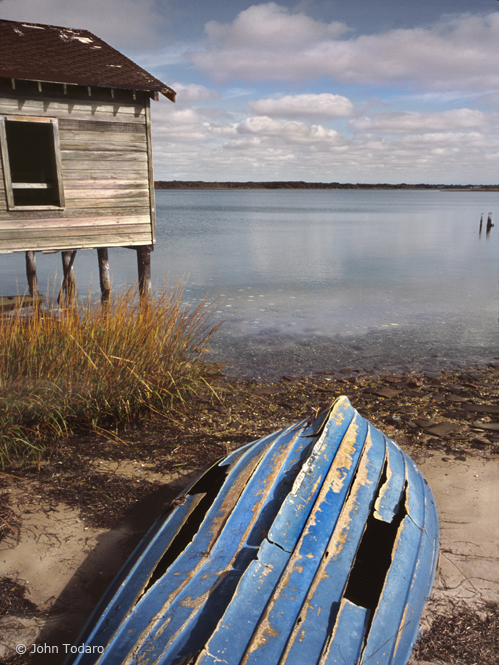
A morning kayak trip across Shinnecock Bay yielded several photographs of the historic Meadow Lane boathouse. Although this structure rises from the marshy flats of Eastern Long Island, much about it reminds me of similar abandoned buildings from the high plains – both from an historical context and also because of its sequestered setting. For Southampton, the boathouse is a footnote to a local history which is all but gone. It stands (at least for now) as a monument to former times. Approaching it from the bay by kayak is a good way to get a feel for this place – a building far more connected to the sea than the land.

Other photographs of abandoned structures from the west and elsewhere may be seen by clicking on this link:

https://johntodaro.wordpress.com/category/viewpoints/solitary-structures/

Here’s a link to another photograph from Shinnecock Bay on the same kayak outing:

https://johntodaro.wordpress.com/2010/05/13/southampton-photographs-great-egrets-and-duck-blind-shinnecock-bay/

Napeague Harbor Sequence – Petite Landscapes

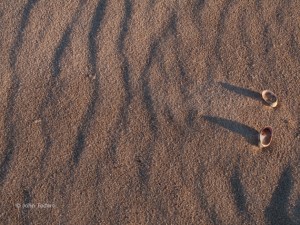
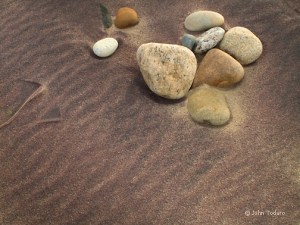
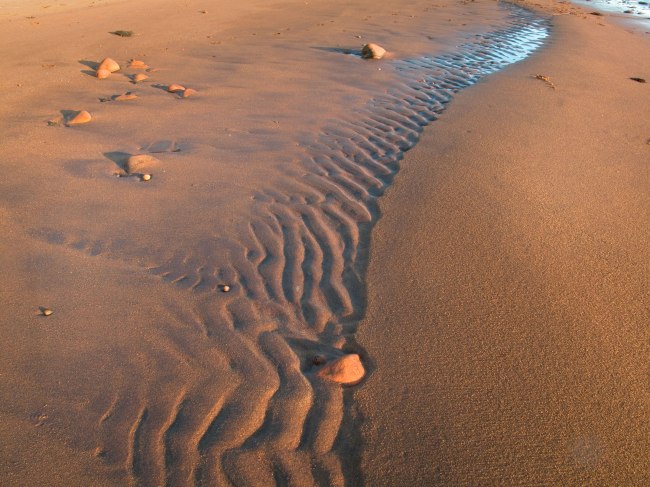
This is is a sequence of four images from various points around the perimeter of Napeague Harbor.  There’s a number of ways to group these, but in this instance I’ve arranged them vertically to convey something of what you might find at your feet during a walk on the beach.  I like to think of these images as petite landscapes – photographs close to the observer, with most of the elements of the larger picture. Clicking on them will produce an enlargement.

For other sequences from Amagansett and elsewhere go to this link:

Shipwreck, Two Mile Hollow Beach

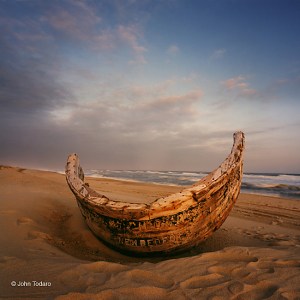
In Sag Harbor, you may have noticed the weathered wooden ship stern which decorated the grounds in front of the Bay Street Theater for a number of years. Before ending up there, it spent most of the last century submerged near Two Mile Hollow Beach between East Hampton and Amagansett where it was said to be visible during times of exceptionally low tides. When it washed ashore on a cold afternoon fifteen years ago, I drove to the beach and joined a crowd of hushed-voiced locals who had already converged on the scene. We huddled around the boat in the last hour of daylight.  It seems that whenever the ocean coughs up a ship or a whale they  arrive with equal measures of sadness and curiosity. Except for the words on the transom indicating a home port of New Bedford, no one could say much about the vessel. As the sun went down I took some photographs. The remains of the boat sat on the beach glowing – a gilted wooden crescent.  I returned the next afternoon hoping to see it again but it was already gone.

Wainscott Photographs: Killcare and the Pebble

Killcare

The view of the ocean from Wainscott and the west end of Georgica is dominated by the iconic home known locally as Killcare. Whether seen up close or from a quarter mile down the beach, it catches the eye and stirs the imagination the way few buildings ever do.  I’ve been watching it for twenty years, in every manner of light – holding its own on the dunes amidst the awesome flux of landscape. I feel lucky to have glimpsed a small part of a creative project that’s lasted for over a century.

On a certain level, the subject of this picture is impermanence because I can’t help but notice that the structure’s isolation within the landscape is made more beautiful by that fact. The picture is also about the curiosity of brushing against it with your own mutable presence. In a sense I was taking a cue from the house – interfacing with the landscape to see if there was any poetry in it.  I’ve sometimes walked my own shadow into a picture and felt the chilly effects of an unannounced visitor. On other occasions I’ve left my footprints where others had left theirs and then faced the empty beach to release the shutter.

This time it was a pebble – the one that got tossed into the temporary trough of flatwater that forms on the beach in between breaking waves.  I’ve been tossing pebbles into spots like these for as long as I can remember.  As always the event began with radiating concentric circles. There was time for a single exposure. The ripples subsided and the water itself began the process of evaporation. This was a scene in no mind to stay in one place. In ten minutes nothing remained  but swash marks. The piece is entitled Killcare –  a landscape and a self portrait.

Montauk Photographs – Shadmoor


The camera at this location was one with a sweeping view of the Atlantic,  a logical segueway from the photograph in the previous post from Bandon, Oregon. This time I was visiting Shadmoor State Park in Montauk,  New York.  Again, the weapon of choice – the Hasselblad 903 SWC. By way of comparison, the Montauk photo was made on positive film (or transparency), and the picture from the West Coast was a negative. Same camera, different coast and different film.

If you are still intrigued by putting a roll of film in your camera, the two pictures provide a good opportunity to study the differences between negatives and transparencies. Whereas the Bandon picture has a decidedly warmer pallet, the Montauk scene is one of cool tones and snappier contrast. The smoothness of the Bandon picture is answered by Montauk’s abundant detail. Two different looks – both of which can translate agreeably into digital files (assuming you still have the patience for scanning). To some of us, there is nothing like the delicious clumpy grain of silver halide.

In the decade that’s passed since I took this picture, the 99 acres of Shadmoor have  been declared a State Park and its cliffs have become dangerously eroded. These days a fence keeps visitors away from the edge in an effort to protect the habitat and prevent injuries. The park is unique for many reasons, not the least of which are its wetlands, its thick stands of Shadbush, and the historic bunkers that have been fronting the Atlantic Ocean since WW II.

To see other photographs taken with the Hasselblad 903 SWC click on this link:

https://johntodaro.wordpress.com/category/viewpoints/square-format-hasselblad/

Bandon, Oregon – Hasselblad 903 SWC

This photograph was taken fifteen years ago, looking west from the left-coast  at an ocean I’ve rarely photographed. It was November and I was high on a bluff  in Bandon Oregon – an unpretentious town at the end of a dusty road with a surprisingly epic view of the Pacific. Something about this place reminded me of off-season Montauk and  similar towns – timeless places putting on their winter clothes – communities that can be counted on not to change for the worse.

Admittedly the view of the ocean here was more like Montauk on steroids – scenery on a truly grand scale. Appropriately, I chose my Hasselblad 903 SWC – a medium format camera that came fixed with what quite possibly was the finest wide angle lens ever made – the 38mm f4.5 Biogon. This was a camera unburdened with bells and whistles and redundant gadgetry. With it’s detachable viewfinder and ability to accept a ground glass back, the 903 has reigned for years as the ultimate choice for wide angle devotees.  Perhaps for this reason, the camera has earned it’s nickname “Superwide” although the number of people familiar with it on that basis is sadly dwindling. In the previous century when Hasselblads were in vogue both here and on the moon, the Superwide had a much deserved reputation for pinpoint accuracy and corner-to-corner sharpness. But now, due to the lack of a digital back, it sadly falls out of fashion with those of us producing millions of pixels. Perhaps its moon is waning.

My friend Jonathan who studies these things tells me that the 903  was first produced in Sweden in 1954 which also happens to be the same year I was manufactured. An early prototype was unceremoniously shipped to our shores around the time Charlie Parker was making his final recordings. With only minor modifications it has remained unchanged ever since. You can still buy it, or you can buy an older one and put a brand new back on it which will attach with no problem. That was the point.  It was produced when things were still bench-made by guys who assembled things with a panache for precision. It was put together with sturdy parts and close attention to details. The damn thing worked. It felt good in your hands. When you put it back in it’s case and took it out the following spring, it didn’t need any improvements. Once you bought this camera there was no need to upgrade your operating system.

And so I am not yet ready for it’s elegy. Digital imaging is here for good and I’m not inclined toward orthodoxy whether it’s on one side of this argument or the other. I can live with the complexities of being a hybrid and will happily scan my film.

To see other photographs taken with the Hasselblad 903 SWC click on this link:

https://johntodaro.wordpress.com/category/viewpoints/square-format/

For a commentary about the use of the detachable rangefinder and  ground glass back on the 903, go to this link:

https://johntodaro.wordpress.com/2011/03/26/hasselblad-903swc-rambling-thoughts/

East Hampton Photographs-Main Beach (Square Format)

This image was taken with my Hasselblad 903 SWC one winter morning during the opening blast of daylight – a moment when everything ignites into a harmony of striking colors. I was much in the mood for photography especially with the addition of all those footprints and not a single person in sight. On this occasion and on many others,  framing the scene in a square made it sing with the sweetest voice.

Squares are uncommon and if you chose to put your landscape into one,  you can congratulate yourself on an unconventional choice. In these days of digital capture, the square is becoming downright eccentric.

Having no bias for up or down and not being partial to across, square compositions can also be what you might call pleasantly ambiguous. If you’ve been frustrated by horizontality – try throwing a square around your scene and you might be onto something. The photographer David Plowden did this to the seriously horizontal high plains of the American west back in the 70’s and made extraordinary use of squares.

Many landscapes, to be sure, will never work as squares. But setting landscapes to default horizontals shows little imagination.  Squares can create a surprising twist on a feeling. They can bring mystery through the door and take the mundane out to the trash. Squares can say something new rather than old, and can sometimes speak volumes when there’s otherwise nothing to say.

To see other photographs taken with the Hasselbad 903 SWC, go to the Location and Topic menu on the sidebar on the right and click on Square Format-Hasselblad. You’ll find additional commentaries about the camera at several of those posts.

.

Southampton Photographs – Great Egrets and Duck Blind, Shinnecock Bay

A worthwhile excursion by sea kayak (assuming the winds are cooperating) takes you from the landing east of the Shinnecock Canal over to the marshy area which backs up to Meadow Lane in Southampton. The bay is shallow, easy to cross and is a place that’s full of expectations for rare birds.

Early on the morning I took this picture, getting over to the beach was no issue. The sky had intriguing color and there was a captivating chill in the air. Once in the marshes, I spent some time floating about in the vicinity of the old boathouse. I was occupied by short paddle strokes and subsequent long glides over mud banks which were pleasantly stuffed with mussels. It’s the quiet in places like this that appeals the most– and I was trying to keep it that way because I had a hunch that something interesting lay ahead.  I’d packed my camera in a dry bag just in case and the bag was stuffed under my spray skirt.

Just west of the boathouse I suddenly came upon two Great Egrets sunning on top of a duck blind. These birds are by no means rare in Southampton, but good photographs of them are– especially if the photographer is nervous about keeping his camera dry and isn’t looking for reasons to capsize his boat. They watched with suspicious eyes.

With a bit of luck, I managed to locate my camera, change a lens, brace myself with a paddle float, and capture an image just as the birds flew off.

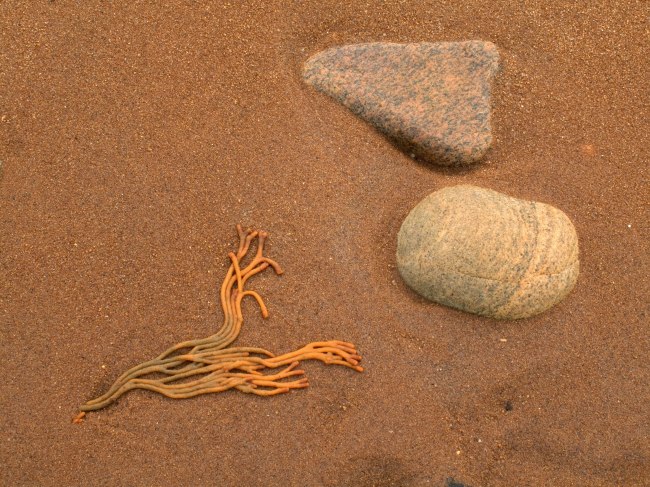
Sequence Photographs – Seaweed and Sand, Amagansett

I’ve been working on a project which involves grouping compatible images into sequences.  This began a few years ago with a series I called “Dune Studies” –seen here:

https://johntodaro.wordpress.com/2011/02/15/amagansetteast-hampton-dune-image-sequence/

Last summer while on vacation in Utah, the idea gained momentum.  We were taking hikes each day, often following streams in canyons. On these walks, I was photographing water reflections, rocks and lichens- all subjects that were easily found a few feet away.

At home, I began sorting through these pictures along with others shot on local beaches during similar walks. I found that if you assemble a group of three or four images, the results can suggest the movement of both time and space experienced during a walk.

Over the last few months I’ve put together 8 sequences of either three or four pictures each. I made two groups from last summer’s Utah trip- one of lichens and another of creeks. All the rest of the photographs were taken on beaches in East Hampton and Amagansett. In addition to those, I created a series of photographs made on various segments of the Paumanok Path (a 125 mile trail that winds across eastern Long Island). Two of my beach sequences (including the one on this page) are from Napeague Harbor at low tide. This harbor, especially in the vicinity of the Walking Dunes, has striking color and texture:

All of these sequences share characteristics—For one thing, they’re made up of individual photographs of what one might expect to encounter when hiking in a quiet place.  But with these pictures I don’t want to convey the larger landscape. This isn’t about distant horizons or dramatic skies. What matters here are the textures and colors of “local” things – subjects found while walking, often no more than ten feet away.

That’s the stepping-off point. Sequencing begins another process.

To do this, it seems to help if you view your project much as a painter might. You dab, so to speak, and you try things out. You play with line and texture. You move things around until it all starts to work.

If you pay attention to your groups you soon have something new. You’ve created a sequence of photographs that is asking to be viewed as a single unit. Its lines, colors, textures are now an integrated whole.

At times, the impressions generated from these sequences can be both refreshing and complex.

More sequences from the beach (and elsewhere) can be seen by clicking here:

https://johntodaro.wordpress.com/category/viewpoints/sequences-and-grouped-images/