
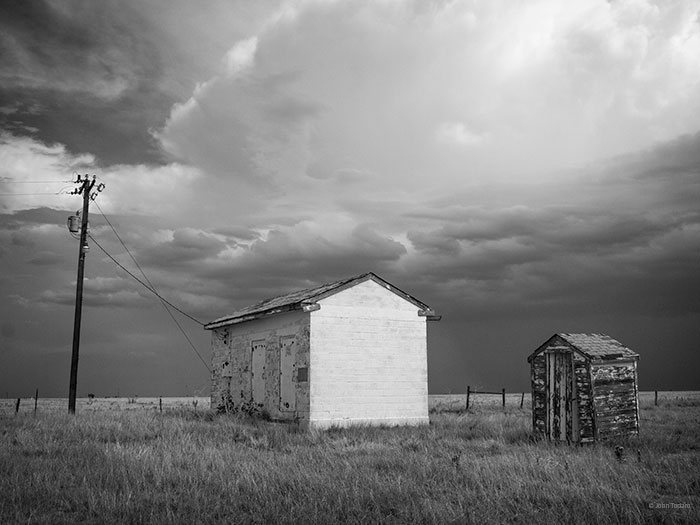
A New Mexico photograph published last summer, and moved back into the queue this morning. Click on it for a larger version.
A New Mexico photograph published last summer, and moved back into the queue this morning. Click on it for a larger version.
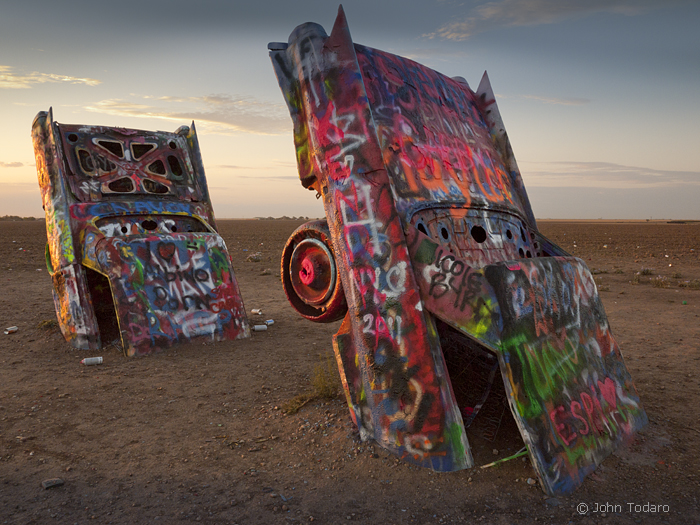
I’m back at Cadillac Ranch again, but only because photographs sometimes travel with memories.
Last summer when I made the trip I was hungry for the details. The story goes like this: It was 1974 when the junked Caddies were interred into the plains of Amarillo. The act was committed by a wily group of artists who called themselves The Ant Farm. Since then, visitors have begun to leave their marks. Over the years we’ve unleashed a monument unlike any other.
A hundred yards north, the east-bound lanes of Interstate 40 funnels a river of vehicles toward a distant Atlantic coast. Out here in the heartland, the bloated roar of eighteen-wheelers is virtually non-stop. On the other side of the fence are the three lanes of the western artery. Either way you travel, it’s fifteen hundred miles to an ocean.
The traffic keeps flowing here because that’s the way desire works. There’s a thirst in this place that never really gets quenched. The Cadillacs are buried in the heart of the continent and it’s from that spot that we reflect on the backwash of our dreams.
At sunrise, I was alone with my cameras, but within a few moments a dingy car pulled in behind mine. A young couple walked across the field to where I was setting up my tripod. There was a boy with hair knotted up in a blue bandana and arms blazoned with tattoos. He wasn’t much older than my fifteen year old son. His short-haired girlfriend was wearing a white hoodie because the heat had yet to arrive. She approached me shyly asking if I would agree to take their picture with her phone.
I did what she asked because it mattered more than what I was doing.
They explained that they were eloping. They’d driven all night from Tennessee en route to Las Vegas where they hoped to make it official. I took their picture and gave her the phone back. They happily looked at their portrait. The boy asked me if it was okay to spray paint one of the Cadillacs.
“Yeah, everyone does,” I said, feeling like the curator.
“I always wanted to see this place,” he explained.
“Me too,” I said.
He pulled a can of paint from his hip pocket and walked behind a Cadillac at the far end of the row. His girlfriend smiled and followed. For a few minutes they were out of sight but I could hear their muted voices. Once, between the Cadillacs, I could see her stepping backwards. She was angling for a picture with her cell phone, trying to find the best position to photograph her boyfriend. This was body language which I understood. After a while they waved to me and walked off to their car.
There was the crank of ignition and then they pulled away. For the second time that morning, I was alone with the Cadillacs.
I looked at the view from my tripod but my heart was no longer with it. My thoughts had gone with those kids. They were young and it was a really long way to Vegas. There was a door that was about to swing open into the rawness of their lives and I had been ambushed by an unexpected wave of sorrow.
•••
My earlier post about Cadillac Ranch can be found here:
https://johntodaro.wordpress.com/2011/09/22/amarillo-twelve-megabytes-for-the-ant-farm/
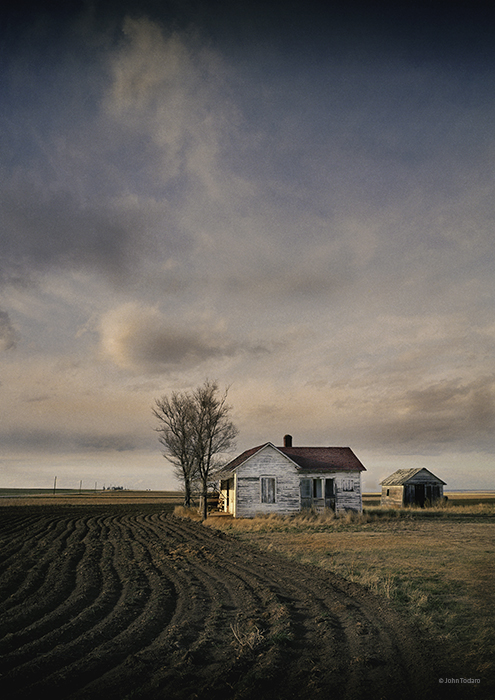
I’ve queued up another image from the archives–one with a similar story to the glowing gate from the previous post. In both cases, the capture involved archaic weaponry: a roll of Kodak negative film and an obscure 120 film camera. For this one, it was the Fuji 645W, an odd plastic camera known for its unusually sharp lens. I also owned the 645S–similarly designed with the addition of a “roll bar”. I liked them both because they were undersized. I could travel light and shoot without a tripod. Nowadays they’re stored in the basement in a shoe box near my record collection.
The abandoned house was discovered after an afternoon of zig-zagging through the plains. As usual, we were out on the greyest roads on the map. Once you get into this part of the country you begin asking yourself, “Now what do we do?”
My companion took no pictures, but I was engaging the question.
The plains are the least photographed part of North America–a fact which is even more astonishing when you realize that they represent about a third of the United States.
As I’ve written before, this is a place which is currently reexamining a number of historic assumptions–having had a lengthy quarrel with invading Europeans. At the moment, the plains are back in charge, especially west of the 100th meridian where the middle of North America is filling up with ghost towns. It’s the same story from Saskatchewan to the Texas panhandle.
There have been books which tell the of the struggle, and Willa Cather’s My Antonia is a personal favorite. But the contest has also being written into the the photographic record. Two photographers come to mind: John Vachon and David Plowden.
Vachon was an artist employed by the FSA seventy years ago during the depression, and was one of the first photographers to focus a lens on the life and landscapes of the farming population of the Dakotas. By the 1930’s it was already apparent that this was not an easy place for a gig. He took many images, but none is more deeply felt than the one of school children playing in a snow storm. It was recess. It looks cold, and the children are constructing a fort. Behind them: a one-roomed schoolhouse in blowing sheets of snow. A few decades later, Plowden published The Floor of The Sky. This time, many of the photographs were in color. The photographer wisely chose to make C Prints. They were warm-toned, bittersweet and full of lonely grass.
Both photographers looked closely at the people as well. As I flip through their books nowadays, it’s hard not to notice the similarity between the furrows in the fields and the deep lines in the faces.
There’s a link for Vachon’s image (at the Library of Congress) below in the comments.
And, keeping within this theme–two related posts from a few months ago:
https://johntodaro.wordpress.com/2010/12/06/one-room-schoolhouse-western-south-dakota/
https://johntodaro.wordpress.com/2011/01/26/abandoned-home-approaching-storm-north-dakota/

Another predawn expedition on our recent trip took me to the outskirts of Amarillo. I’d been curious about the Cadillac Ranch for years. This was the place where they buried some cars in a cornfield so I wanted to have a look. Back in 1974 the project was the brainstorm of a local iconoclast (who prefers to be called Stanley Marsh 3). He was assisted by an unusual group of friends known as the Ant Farm.
I was never sure what I’d think of the Ranch, and now that I was in Amarillo I wasn’t even sure where it was. My atlas indicated that the ten Cadillacs were located somewhere west of the city on the south side of I 40. This also happens to be the former path of Route 66, and so it was undoubtedly considered a perfect place for the half-burials.
I drove out there and couldn’t find them. It seemed I needed coffee.
There was a Starbucks on Soncy Road at the previous exit. I returned, wondering if my family was still asleep at our nearby motel. Inside the coffee shop, the two employees who took my order debated the best way to send me to the Cadillacs. I thanked them and headed back, this time with plenty of caffeine and several sets of directions.
I found the Ranch right away. It was right off of the Interstate in a field just like the one in my imagination.
As you can see from my photograph, the cars have been spray-painted over the years. The interesting thing is that Marsh and the Ant Farm have encouraged everyone to do this. Purists argue that the original Caddys were far lovelier with their peeling factory paint and without all the annoying graffiti. Now that I’ve seen the cars in person I completely disagree. I’ll elaborate on that in a moment.
In the meantime, empty cans of paint littered the ground in open defiance of Texas law.
Being a photographer, I noted that the sun was about to peer over the horizon, so I got to work. The impulse is to stand back from the cars in order to take a group portrait. I have to admit they look good from back there (something like a GM version of Stonehenge). But I also felt I was taking pictures of a Little League team. I took a few anyway and they looked like all the other ones I’d Googled back home.
I decided to go in closer. What I discovered, is that when appoaches the cars they inspire a palpable sense of reverence. I sidled up to one. The fins were high above my head and looked especially wonderful in the first rays of daylight. I was feeling something like one of the apes in Kubrick’s 2001 and so I placed two fingers on a wheel. I was surprised that it spun freely.
Of the pictures I took after that, the one I liked the best was the one at the top of my post. Truthfully, it’s not easy photographing someone else’s artwork.
The problem is, whose artwork is it exactly?
These handsome vehicles were first penciled up by a creative team of designers back at General Motors. That was a long time ago, so I don’t know if anyone has properly celebrated their achievements. Years later, ten Cadillacs were dragged from their various junkyards to be partially interred here in a cornfield. This was not an easy task and involved the use of a crane and other massive equipment. Like it or not, Marsh and his friends made an auspicious attempt to clarify the meaning of the cars. They also remade a landscape. Since then, anyone who has sprayed any paint here has tweaked the project slightly, and those who of us who come here and take the pictures have taken it somewhere else.
Everyone’s involved at Cadillac Ranch. It keeps going. That appears to be the point.
Did I spray paint something?
Yes. I picked up a couple of spent cans and shook them until I found some paint. Carefully aiming, I hissed out a tribute on a wheel strut. I did this for Joe Strummer, the former frontman for The Clash who would’ve thought the Ant Farm rocked.
It was red paint, of course.
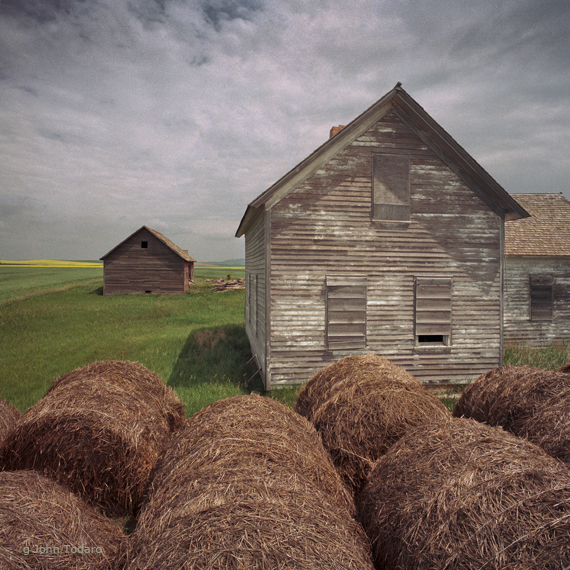
Another from western North Dakota taken with the Hasselblad 903. I’ve called this one Quiet House. More images of abandoned structures on the high plains (and elsewhere) can be seen by clicking on this link:
https://johntodaro.wordpress.com/category/viewpoints/solitary-structures/
To see other photographs taken with the Hasselblad 903 SWC, go to the same menu and click on Square Format-Hasselblad. You’ll find additional commentaries about the camera at several of those posts.

We encountered this building a number of years ago while driving across South Dakota. I’d been hoping to see such places and so we’d driven the entire state on the grayest highways we could find on the road map.
We climbed out of the car into a landscape which mixed the serene with the surreal as effectively as any Hopper painting. Around and behind the building there was nothing but grass as far as you could see – a scene of such elemental minimalism that it was close to breathtaking. For me, finding these places has become the defining moments of many trips and I’ve never been able to walk away from them without engaging the camera.
Between the 1890’s and the 1950’s one room schoolhouses existed at regular intervals across the high plains. These were the same years when the middle third of our continent underwent a radical transformation – and as we all know, the changes didn’t come easy. If the prairie was easy to plow it was often harder to tame. The wooden grain elevators and other structures have now mostly faded into the landscape. Perhaps what remains is totemic, an expression of a deep-rooted simplicity that belongs to that landscape and belongs with us as a people. If the buildings stay with us, they will be the relics of an uncomplicated esthetic that existed before the arrival of modern clutter.
While I was taking this picture, my wife and two year old son played nearby in the grass. For me it was easy to conjure up the bygone recesses… running children in hand sewn-clothes, scolding teachers and fifth grade crushes. My son was oblivious to those thoughts because it was June and a good time for insects. The winds picked up and I walked around the building with my camera. Each side seemed to have it’s own game – four courts of light and four plays of texture. Above us the sky was strewn with clouds – distant, but at the same time appearing unusually close. My wife and son sat down on the doorstep and I took pictures of them. When we peered in the windows we discovered desks, shelves, furniture covered with blankets and a long-forgotten piano.
Yesterday I found a link to historic photographs of Kansas one-room schoolhouses. The site is an excellent example of an archive doing exactly what it’s supposed to do. My wife and I spent much time poring over the pictures, especially the class portraits. These were auspicious warm-weather events with kids in their finest clothes – days when everyone was ushered outside onto the grass to pose before the large camera. The children formed a group and their teachers were placed behind them. Everyone stood still and the exposure was made filling the air with the smell of magnesium flash powder. Behind the class the photographers kept it simple…always the school house and maybe a glimpse of prairie. You might find, as we did, that the faces of the children will unleash your imaginations with the details of their many possible stories:
http://www.kansasheritage.org/orsh/Gallery/index.htm
More images of abandoned buildings from the Dakotas (and elsewhere) can be seen by clicking on this link:
https://johntodaro.wordpress.com/category/viewpoints/solitary-structures/
 JOHN TODARO