Abstractions: New Photographs From New Bedford

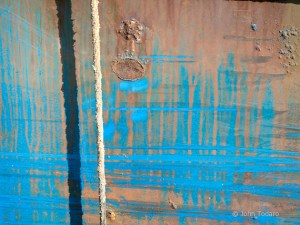
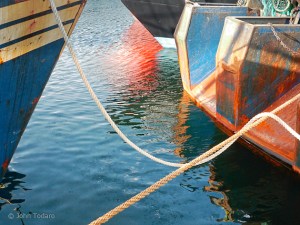
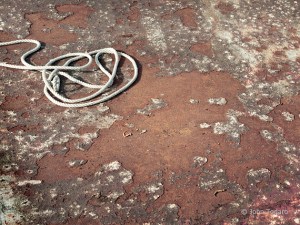
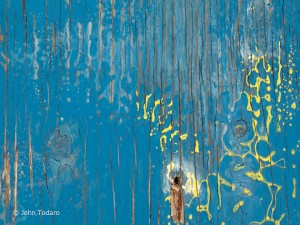
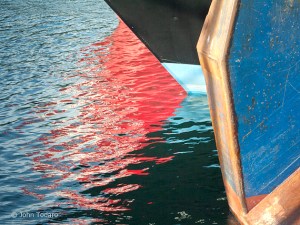
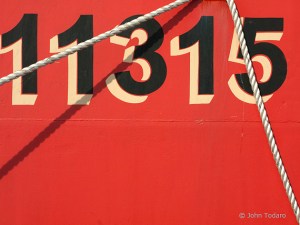
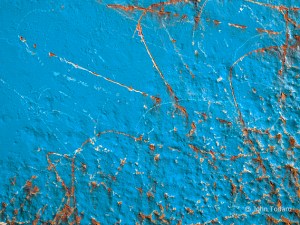
The photographs were taken last week at the commercial fishing docks in New Bedford, Massachusetts. There are close-up details (and reflections) of boats, and studies of metal and wood surfaces from around the docks. In truth, many of these images could be more accurately described as semi-abstract. All were shot without a tripod which encouraged a free-flowing sense of connecting ideas.

New Bedford is a city with a waterfront revitalization in progress and is worth visiting if you’re in southern New England. The National Park Service administers New Bedford Whaling National Historic Park which includes a museum and visitor center located within walking distance of where the pictures were made.

Any of the thumbnails above can be enlarged by clicking on them. Email me if you have any questions about what you’re looking at.

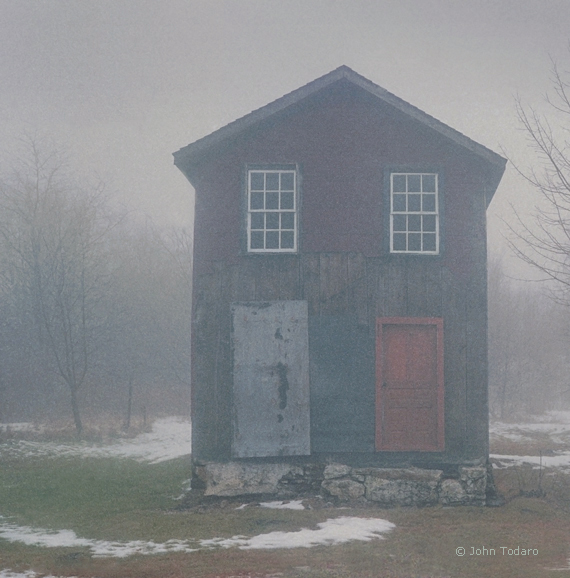
House In Fog With Orange Door – Eckley, Pennsylvania

This photograph was taken a few years ago at Eckley, an historic mining town in Northeastern Pennsylvania.  Nowadays it’s an unusually quiet place tucked into the mountains – two straight rows of company houses which face each other across a simple road.  At the time of our visit it was a place of abundant texture, because the laborious work of restoration had barely begun.

Much like the photographs in the two previous posts, this is a portrait of a building blending with its landscape. Again, a solitary structure photographed from the front in two dimensions without the intrusion of architectural perspective. I’ve done this habitually over the years, at first being unaware of my tendency. Over time, I’ve grown attached to this technique the same way one becomes fond of good advice. It’s not always the answer but it is a way of looking at things that has its own unusual language. I’m not exactly sure what’s going on aesthetically, but let’s take a stab at it.

An image of an old building taken directly front-on creates a facade – a face of sorts with character and personality. Under the right circumstances, this will have a tendency to simplify a composition rather than complicate it. Simplicity is good. This angle often represents the most lyrical view.  It can also hint at humor and at times can impart a desirable sense of the surreal. Importantly, these images defy the funneling effects of perspective, and bring a calm stability which keeps one’s eyes attached to surface qualities. Textures are enhanced in such pictures because they’re not competing with perspective. What appeals to me most in this image is the muted harmony of closely matched color values. The teal green of grass is both complimented and refreshed by the vertical orange door. In a dense fog, colors will often appear as similar grays, at least to the talented squinter.

House With Red Roof, Gaspé, Québec

This piece will introduce a new category, one with an overly long and confusing title that definitely requires pruning:

Solitary dwellings, abandoned structures and other unattended human artifacts photographed within the greater landscape.


At the moment, I can’t think of a shorter way to say it, and if you have suggestions for a more truncated one – by all means post a comment.

Why put photographs into such a category in the first place? I’m not exactly sure, other than the fact that when I go back and look at what I’ve been doing for the last 35 years, obvious patterns emerge. I find myself peering through a camera at the lonely stuff we left behind; and if we hadn’t left it behind then there was probably no one home:

…a miners’ cabin in Eckley Pennsylvania…a capsized boat in Springs…an abandoned Chevy truck  on the plains of Colorado…the desolate corral in southern Utah…a house with a tin roof in North Carolina…the house with the red roof in Québec.

The list goes on and on even though I never set out to perform variations on a theme. I guess it just happened that way. Perhaps it’s because I take the pictures and the patterns take care of themselves.

Finding myself in front of the solitary houses was the beginning of the process. Next came the postures – how the stuff posed, where it was positioned relative to the camera. In each instance there was a right combination of things that evoked the desired mood.  For photographers, it can occur without warning. Things come together and you’ve arrived at your picture – and when that happens it feels something like it did back in middle school the first time you pulled open your combination lock. It’s why I like this job.

Again, the patterns:  A lonely house leashed with a power line. An abandoned home beneath the complex geometry of a storm.  One hundred and fifty years ago a photographer no doubt discovered that by shifting his position a few feet to the left, he set his picture ablaze with mood. This is key. With my own work, the moods have varied over time but hopefully not too much. If I’ve been doing my job right  I’ve just wanted the pictures to speak of simple things:

Solitude, detachment and fluidity.  If a photograph of a house is able to convey something timeless, that’s wonderful.  But if it also suggests something about the passage of time, then that is a picture with a taste for one of our finest paradoxes. Sometimes my pictures have gotten there but others have fallen short.  All honest photographers know there’s luck involved.

Over the coming weeks I’ll be posting more of this work – photographs of the lonely stuff out there in the landscape.

I’ve come up with a shorter title:

Solitary Structures:

https://johntodaro.wordpress.com/category/viewpoints/solitary-structures/