Photography from the Sea Kayak: Bullhead Bay, Southampton

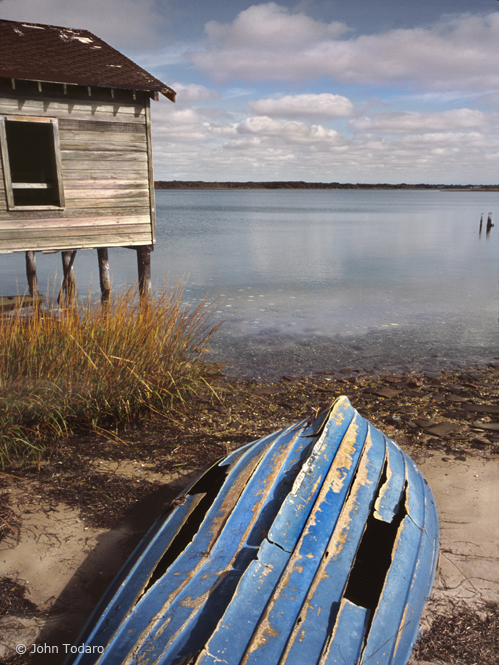
A few years ago, I paddled up to this dinghy while exploring the wetlands of Bullhead Bay in my sea kayak.  The bay is a good place for this sort of exploration and much of the land from there up to Scallop Pond has been preserved by the Town of Southampton and The Nature Conservancy. The picture was taken in November–a time of the year when you pretty much have the estuary to yourself. In this setting, the boat seemed appropriately named.

The picture was captured on transparency film using  a Contax G2 with a 90mm lens. In order to do this, some preparations were needed.

Once I was positioned close to the dinghy, I inflated a paddle float and placed it on my paddle. Holding the paddle behind my back, I braced myself against the water. By using a paddle float in this fashion, you create a relatively stable outrigger from which you can then carefully take some photographs.

The 90mm is a fast lens, and this situation is a good example of when you might prefer a fast prime to a zoom. A slower zoom would’ve been unusable at ISO 100, and also would’ve been very difficult to stabilize while trying to shoot one-handed.

Because I was willing to take an expensive camera out onto the bay without any waterproof housing, I was taking some chances. To minimize the risk of water damage, I sealed my equipment in a water-tight dry bag which I then sat on top of my lap. I also stashed a bottle of fresh water in my cockpit so that I could wash my hands before handling the camera. The deflated paddle float was bungeed to the boat. After taking a few pictures the camera went back into the dry bag and I continued on my way.

Attempting this procedure in rougher surf requires a bit more attention to bracing properly, but I’ve done it successfully several times.

The picture at the link below was taken near Cedar Point with the same camera and the same film.  On that occasion,  I was bracing myself against a fast moving tidal rip in thirty feet of water:

https://johntodaro.com/buoy-6-profile.htm

The red dinghy up above required a bit of post-processing. The first step was to make a high-res scan on my Epson V 700. After a bit of clean-up work I settled on a cropped square image which made it very compatible with a number of my full-frame images from the Hasselblad. One thing I’ve noticed about scans from Provia F is that the intensely blue bias of the film often benefits from a bit of desaturation in Photoshop.

November Light – Sagg Main Beach

This recent scene from Sagg Main demonstrates the sun’s current position relative to the beach at sunrise. It shines directly down the beach and sets the place ablaze. You won’t see that here in summer. Another interesting thing about the picture is the graceful pattern formed by the tire tracks – something which I’m usually trying to avoid!

 The picture was photographed with the Panasonic Lumix Gf2.

How Bridgehampton Got It’s Name

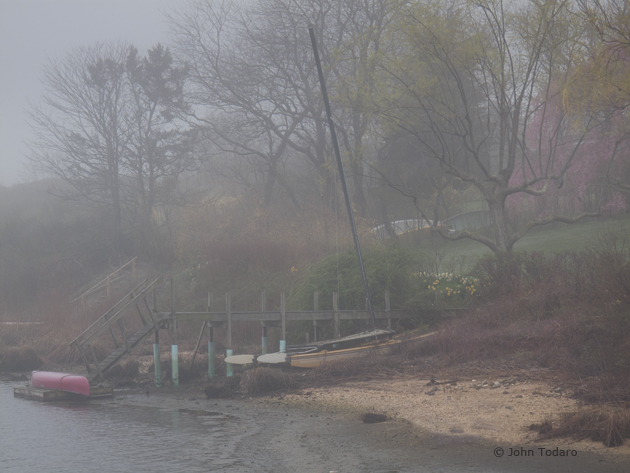
In 1686, an ambitious settler known as Ezekiel Sandford was hired by The Town of Southampton to build a small bridge over Sagg Pond connecting Sagaponack with what was then known as Mecox. Sandford’s sturdy bridge held up for nearly a hundred years and is the reason we now have a place called Bridgehampton. Nowadays the bridge is accessed from Bridge Lane, and after all these years it’s still situated on a quiet backroad where it spans the same salty creek.  To photograph this scene I was standing on the current bridge looking south.  It was good morning for photography because it had arrived with appealing light. In the picture, the catamaran and canoes appear to spring seamlessly from the surrounding hazy marshes, an effect which I like and which can be amplified by a very dense fog.  In Bridgehampton this time of the year, such fogs come rolling in just in time for breakfast. Perhaps Ezekiel Sandford would’ve recognized the light, and some of the elements of the place where he once constructed a bridge.

Southampton Photographs – Meadow Lane Boathouse

A morning kayak trip across Shinnecock Bay yielded several photographs of the historic Meadow Lane boathouse. Although this structure rises from the marshy flats of Eastern Long Island, much about it reminds me of similar abandoned buildings from the high plains – both from an historical context and also because of its sequestered setting. For Southampton, the boathouse is a footnote to a local history which is all but gone. It stands (at least for now) as a monument to former times. Approaching it from the bay by kayak is a good way to get a feel for this place – a building far more connected to the sea than the land.

Other photographs of abandoned structures from the west and elsewhere may be seen by clicking on this link:

https://johntodaro.wordpress.com/category/viewpoints/solitary-structures/

Here’s a link to another photograph from Shinnecock Bay on the same kayak outing:

https://johntodaro.wordpress.com/2010/05/13/southampton-photographs-great-egrets-and-duck-blind-shinnecock-bay/

Sagaponack Photographs – Cutting Garden

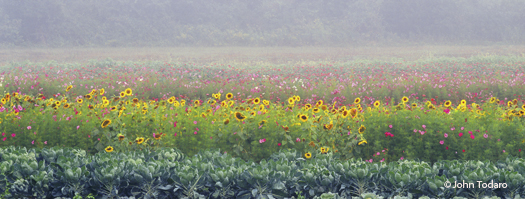
Sagaponack is contrast. It’s a place where traditional Long Island potato barns now live side by side with dwellings that can only be described as radically modern.  A short but astonishing walk will take you from one of the smallest public schools in the state to the largest home in the nation. Buisnessweek described Sagaponack as the most expensive small town in the country, but it’s also a place where farmers still wake up to plant cauliflower.

From a photographic point of view, fog can be an exquisite equalizer. Sagaponack gets more than its fair share, which is not surprising considering there’s ocean in town that backs up to potato fields. Truthfully, the place should be as famous for its fogs as it is for its fortunes.  In a Sagaponack haze, things are delightfully seamless.  In a proper fog, this is one of the loveliest places around.

These images admittedly have a biased view. I’m an unabashed fan of fields and what you might call a classical definition of open space. I’d rather watch flowers blooming than Bloomberg News. I have sentimental ties to Eastern Long Island agriculture. I like ducks and broccoli. In the fall the potatoes in our fields can smell as good as roasting coffee. Have I already said I love fog?

Above and below – roadside views of a cutting garden on Parsonage Lane.

Southampton Photographs – Great Egrets and Duck Blind, Shinnecock Bay

A worthwhile excursion by sea kayak (assuming the winds are cooperating) takes you from the landing east of the Shinnecock Canal over to the marshy area which backs up to Meadow Lane in Southampton. The bay is shallow, easy to cross and is a place that’s full of expectations for rare birds.

Early on the morning I took this picture, getting over to the beach was no issue. The sky had intriguing color and there was a captivating chill in the air. Once in the marshes, I spent some time floating about in the vicinity of the old boathouse. I was occupied by short paddle strokes and subsequent long glides over mud banks which were pleasantly stuffed with mussels. It’s the quiet in places like this that appeals the most– and I was trying to keep it that way because I had a hunch that something interesting lay ahead.  I’d packed my camera in a dry bag just in case and the bag was stuffed under my spray skirt.

Just west of the boathouse I suddenly came upon two Great Egrets sunning on top of a duck blind. These birds are by no means rare in Southampton, but good photographs of them are– especially if the photographer is nervous about keeping his camera dry and isn’t looking for reasons to capsize his boat. They watched with suspicious eyes.

With a bit of luck, I managed to locate my camera, change a lens, brace myself with a paddle float, and capture an image just as the birds flew off.