Another Hoodoo…Montauk

I rarely make these statements, but I’d have to say that this picture is my favorite of all my own hoodoo images, east, west or anywhere in between. I do concede that it’s a gloomy scene, but for me it evokes the place, and I can smell the tide and the crumbling earth and the oozing out of spring.

They don’t call them hoodoos for nothing.

Have you ever been at Shadmoor and asked yourself, “How did they get here?” These formations (unlike their more famous cousins in places like Bryce Canyon) are not comprised of eroded sedimentary rock.  What we have here is a mish-mash (my wife’s words) of sand, clay and gravel–also known as glacial till. Long Island itself is pretty much nothing more than a sandbar full of such debris left by retreating glaciers.

The formation of hoodoos here in Shadmoor occurs when water percolates down and begins to move horizontally in the ground. There it pushes out the softer deposits, which kicks off a process of slumping and erosion creating hoodoos out of the remaining harder sediments.  In spring, if you hike down in front of the bluffs on the beach, you’ll often find water leaching out of the clay. In some spots, it forms rivulets which flow onto the sand below. The ocean takes care of the finishing touches with its own brand of erosion, chomping off huge vertical sections after storms.
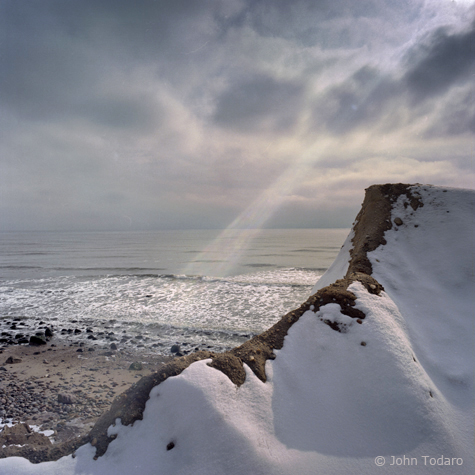
Montauk Images – Hoodoos In Winter

Anyone who has visited National Parks in Utah (or who has read anything by Edward Abbey) invariably comes away with a fondness for the term “hoodoo”. In the west, a hoodoo is a name for eroded sandstone and limestone formations, especially the ones that conjure up ghastly shapes, anthropomorphic or otherwise. The term is an alternate take on the word voodoo and probably originated in Africa. You can see plenty of hoodoos in Goblin Valley State Park (in central Utah) or in Bryce Canyon.

But the west doesn’t own them all.

Similar spires may be seen in Shadmoor State Park in Montauk, where eroded bluffs create a fantastically ragged coastline. Much like their western cousins, Montauk’s formations continue to erode and reshape themselves (and are arguably just as spectacular).

This photograph was taken a few years back on an obstreperous winter’s day when a storm was clearing out. For about a half hour, I was present for a very interesting display of light which included the occasional sunbeam slanting down to the ocean. The picture was shot on negative film with my Hasselblad.

Montauk – Ocean (and Bluffs) At Shadmoor

Shadmoor State Park preserves a half mile of oceanfront in Montauk along with 99 acres of parkland up on top, and is home to a variety of rare plant and animal species and unusual wetland habitats. Sand Plain Gerardia is present here along with thick stands of Black Cherry and Shadbush, the small tree which gives the park its name.


Shadmoor has historic significance because it’s also the location of Camp Wikoff, where Theodore Roosevelt and his troops were quarantined after the Spanish American War.  Additionally, there are two observation bunkers in Shadmoor which date to WW II and which were part of our coastal defenses.

I’ve photographed Shadmoor at various times and seasons. This image is from down on the beach in front of the bluffs facing Ditch Plain. A half mile walk will get you up-close and personal with the famous Montauk hoodoos, which is the local name for the eroded bluffs of the park.

Vintage Photograph of Uihlein’s (Montauk, 1988)

Keeping with the theme of bygone scenes and time exposures, this post resurrects an off-season glimpse of Montauk made some twenty three years ago. To me, this quiet image is especially welcome given the degree of rowdiness emanating from Montauk during our current summer. The evening I took this picture, the town was about as remote as you could get on Long Island – a sandy wind-blown place at the end of the road (with just enough characters to keep things interesting).

The good news is that this old boat shack is still there hunkered down by the harbor and minding its own business. Like many current residents, the building now sports a face-lift and some newly acquired shrubbery. Back in the eighties, it counted the days of winter with a degree of solitude which is almost unimaginable in the current decade.

Much like the photograph of my previous post, this was an image recorded at dusk. Here, an especially gloomy evening had been caught unawares. There is an uneasy feeling that no one is left in town. A compelling pair of neon lights have blinked on, and are available to tell the story.

Montauk Photographs – Shadmoor


The camera at this location was one with a sweeping view of the Atlantic,  a logical segueway from the photograph in the previous post from Bandon, Oregon. This time I was visiting Shadmoor State Park in Montauk,  New York.  Again, the weapon of choice – the Hasselblad 903 SWC. By way of comparison, the Montauk photo was made on positive film (or transparency), and the picture from the West Coast was a negative. Same camera, different coast and different film.

If you are still intrigued by putting a roll of film in your camera, the two pictures provide a good opportunity to study the differences between negatives and transparencies. Whereas the Bandon picture has a decidedly warmer pallet, the Montauk scene is one of cool tones and snappier contrast. The smoothness of the Bandon picture is answered by Montauk’s abundant detail. Two different looks – both of which can translate agreeably into digital files (assuming you still have the patience for scanning). To some of us, there is nothing like the delicious clumpy grain of silver halide.

In the decade that’s passed since I took this picture, the 99 acres of Shadmoor have  been declared a State Park and its cliffs have become dangerously eroded. These days a fence keeps visitors away from the edge in an effort to protect the habitat and prevent injuries. The park is unique for many reasons, not the least of which are its wetlands, its thick stands of Shadbush, and the historic bunkers that have been fronting the Atlantic Ocean since WW II.

To see other photographs taken with the Hasselblad 903 SWC click on this link:

https://johntodaro.wordpress.com/category/viewpoints/square-format-hasselblad/