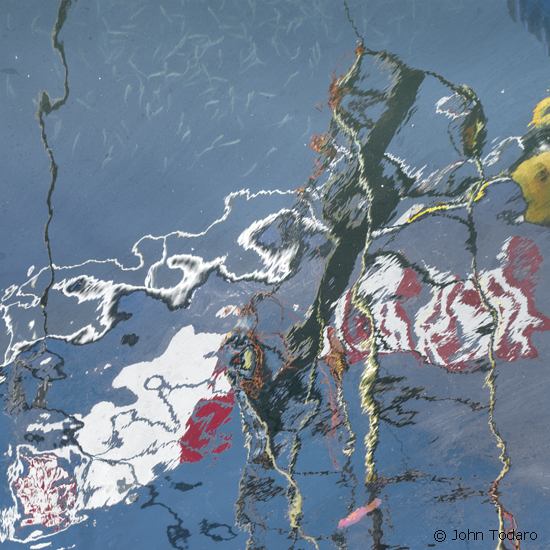
“Chimera” – Mid Week Art at Ashawagh Hall Tuesday and Wednesday July 24 and 25

The photograph of reflecting boats, ropes and buoys is entitled “Chimera” (and yes, that’s a small school of fish swimming in the upper part of the picture). I’ll be displaying this piece and other images at an upcoming show at Ashawagh Hall in East Hampton, in NY.

The show will take place on Tuesday and Wednesday July 24th & 25th, and will run from noon until 9pm on Tuesday (with a reception beginning at 5pm) and also from 10 am until 5 pm on Wednesday.

“Chimera” is being made as a limited edition pigment print in a 22 x 22 mat, and the first print in the edition is currently available.

Ashawagh Hall is located at 780 Springs-Fireplace Road in the historic area of Springs. It’s a short walk to Accabonac Harbor, The Springs General Store and the Pollock-Krasner House.

There’s free admission and kids are most certainly welcome!

I’ll be displaying with painters Cynthia Loewen, Phyllis Chillingworth and Anahi DeCanio and also the pressed-flower artist Deborah Anderson. The five of us participated in a very well-attended show at Ashawagh Hall this past February, and I’m really looking forward to showing again.

There’ll be a good mix of landscapes and abstractions at the show, with lots of new work from everyone. There’s plenty of visitors on the East End right now, so we’re hoping you stop by after a day at the beach, especially for our Tuesday evening reception.

Below, you’ll find some details on the artists with links to their sites. Please email me if you have questions.

Cynthia Loewen is a realist painter from East Hampton, who renders her subjects in minute detail. Her specialty is local landscapes and seascapes which she’ll be displaying as acrylics and watercolors. Cynthia has a talent for evoking a sense of place (a technique no doubt informed by her family’s long history in the area). She’s also the founder of the new Community Art Project in Springs which has been having quite a year. Here’s Cynthia’s work:

http://www.aaeh.org/Cynthia_Loewen.html

Phyllis Chillingworth is a painter whose watercolors and oils evoke the transient moods of light from Montauk and nearby areas. Her paintings are bold, beautiful–full of the flavor of local light.  She’s a graduate from the Yale School of Art and Architecture and also the Illinois Institute of Technology, and she also attended the Art Students League and NYU and exhibits frequently in the NY area. She’ll be showing new oils from Montauk and Napeague.  Here’s a link to Phyllis’ work:

http://www.phyllischillingworth.com/

Anahi DeCanio’s abstractions and multimedia works have won many awards and have been exhibited worldwide. Her abstractions demonstrate a sophisticated sense of color and line, and her work often ties in themes of women’s issues in very creative ways. Her work has been displayed at Pen And Brush (NYC), and the International Museum of Women and also at The Milan Film Festival and the Boca Raton Museum of Art. Here’s a link to Anahi:

http://fineartamerica.com/profiles/anahi-decanio.html

Deborah Anderson is the creator of “Pressed Petals Of Sag Harbor”. Deborah’s art involves detailed arrangements of dried flowers, butterflies and other botanicals which she fashions into a variety of framed formats. Her work recalls elegant botanical art and design from the 19th century. Deborah has showed extensively here on the East End and will be displaying many new framed pieces at the show.
Winter Beaches – Square Format Images

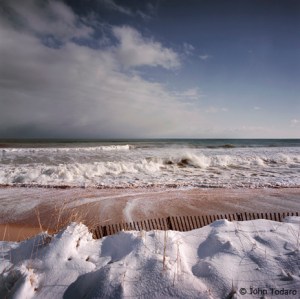
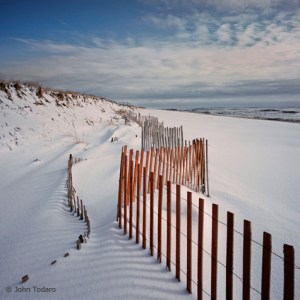
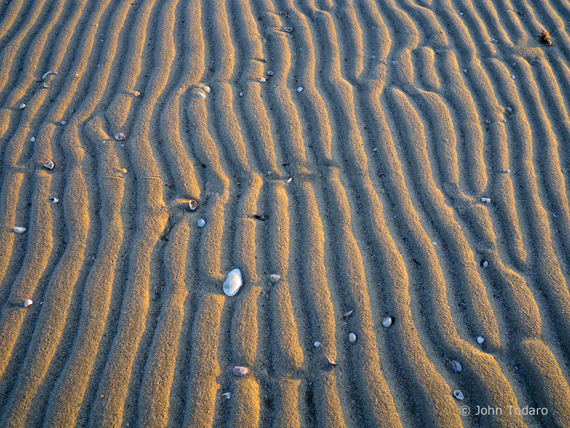
The four square format ocean landscapes were shot on negatives with the Hasselblad 903 SWC – a fixed wide angle camera with a 38mm Biogon lens. To this day, the 903 is totally without peer in terms of its compactness and the ability to deliver a ruthlessly precise and highly accurate wide-angle image. Click on the thumbnails to see an enlarged picture:

Winter Trees – Barcelona Neck

Barcelona Neck is a peninsula in Northwest Harbor that is home to the 500 acre Linda Gronlund Memorial Nature Preserve. Linda was a Sag Harbor native who died in the Pennsylvania plane crash which occurred on 9-11. The park has a network of well-maintained trails that explore field edges, salt marsh, second growth forest and beaches. There are many water views. My picture above was taken there a few years ago around this time of the year.

The peninsula has historic ties with Sag Harbor, although the park itself is within the Town Of East Hampton. It’s been said that homesick Spanish sailors thought the bluffs at the north end of the peninsula resembled those in Barcelona. On a clear day from on top you can see the distant archipelago formed by Plum Island, Great Gull, Little Gull and Fishers Island.

I gravitate to the park mostly to photograph fields, or more specifically to photograph the “gradient” of habitation as it fades gracefully into the woods. In some respects a lot of my pictures appear to be preoccupied with this, although it’s not usually a conscious function and is sometimes not successful.

Winter arrives in a week. If you live far enough north to have an ice rink in your birdbath then you’ll be enjoying a low angle of sun for another month. It can be a reason to plot an escape, perhaps to a warmer place with a sun on a higher perch. But on the other hand (if you stick around),  you can always grab a camera and try to harvest the light.

East Hampton Train Station, 1987

It’s August first. On queue this morning is a vintage picture of our local train station from twenty five years ago. I shot the scene employing one of two Fuji 645 cameras that I was playing around with at the time. It was a color negative, and the image was a time exposure. Over the years, the area around Railroad Avenue has changed considerably. In 1987, the area had a scruftier look. I could be wrong, but it seemed to be a part of town that conveyed a sense of being “way out east”. When we moved here earlier that year, that’s exactly what we were looking for. We were not moving into the Hamptons, so much as we were moving onto the South Fork. There was a difference, although admittedly it was mostly a state of mind.

Years have passed. The picture is a window into former times. Looking back, I’d have to say I was fortunate to have caught the building in early evening (November, as I recall). In the distance, the sun has sunk away. The lamps have gone on and have struck up an agreement of sorts, between natural and artificial light.  As is often the case, such agreements are lonely ones.

Dawn Sky With Cormorants – Sammy’s Beach toward Hedges Banks

This was recorded on a recent morning from the East Hampton side of Gardiner’s Bay at Sammy’s Beach.  From this spot there are expansive views in all directions and it’s possible to walk north to the Cedar Point Lighthouse, a distance of three miles. The flock of birds entering the scene from the right hand side of the image are Double Crested Cormorants and so I’ve appropriately entitled the piece Cormorants.

The Outhouse of Mulford Farm

The image below was taken last week during a morning of fickle weather. For several hours it alternated between stormy and foggy with the ocean blowing air into the village that felt damper than a boat sponge. The turbulence is standard fare in May and is caused by warmer morning temperatures and their ongoing argument with the chilly ocean.

You’re looking at an unceremonious outhouse located at the historic Mulford Farm in East Hampton Village which I photographed in the fog.

Interestingly, a bit of research has uncovered a wealth of information about outhouses.  I was surprised to read that they’ve been called biffies – a term which may have had its origin with Browning Ferris Industries, a waste collection company (with a conspicuous logo) which once serviced portable toilets. Long ago, Girl Scouts put another spin on it when a biffy became a bathroom in the forest for you. Various campers have also employed the term kybo.  This is thought to have originated in Vermont where Kybo Coffee cans were once filled with lyme and placed inside the structures to keep the odors to a minimum. I would’ve loved to have visited one of those north woods shacks with a Kybo can, especially in the moonlight beneath a silhouette of spruce.

Less frequently the outhouse has been referred to as a backhouse, and in Australia, they’re known as dunnies. In New Zealand you might call them long drops. 

Outhouses originated in Europe over 500 years ago which means they’ve been around for centuries. During the depression, WPA carpenters were hired by the government to build them in rural areas. You don’t hear about that in eighth grade American history. One wonders if any of those New Deal outhouses are still in service today?

Where I grew up on the west Coast of Florida some of my classmates lived in homes with privies near the woods. Whenever I visited these places I was awestruck. To a transplanted New Yorker in elementary school, having an outhouse on the property was evidence of very serious credentials. These friends of mine were not living in the rubber stamped homes popping up elsewhere in Florida (such as the one I lived in) and they didn’t come from the wealthiest families.  It didn’t matter. Their dwellings had  abundant wealth of character.

Outhouses at Mulford Farm would’ve been constructed during colonial times. It was during those years when the crescent moon cutout was first employed. The ones with crescents were for women and ones with stars were for men. I was truly amazed to discover this and it raises an obvious question. Why did the star fall out of fashion?   It’s been theorized that men let their privies fall into such horrible states of disrepair that they faded out, becoming rotted piles of wood in forgotten rural places.

It’s the feminine crescent cutout which has stood the test of time.

Shipwreck, Two Mile Hollow Beach

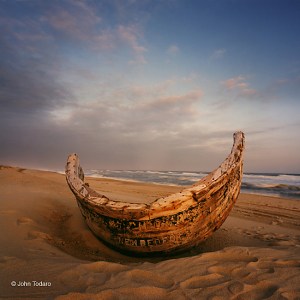
In Sag Harbor, you may have noticed the weathered wooden ship stern which decorated the grounds in front of the Bay Street Theater for a number of years. Before ending up there, it spent most of the last century submerged near Two Mile Hollow Beach between East Hampton and Amagansett where it was said to be visible during times of exceptionally low tides. When it washed ashore on a cold afternoon fifteen years ago, I drove to the beach and joined a crowd of hushed-voiced locals who had already converged on the scene. We huddled around the boat in the last hour of daylight.  It seems that whenever the ocean coughs up a ship or a whale they  arrive with equal measures of sadness and curiosity. Except for the words on the transom indicating a home port of New Bedford, no one could say much about the vessel. As the sun went down I took some photographs. The remains of the boat sat on the beach glowing – a gilted wooden crescent.  I returned the next afternoon hoping to see it again but it was already gone.

Wainscott Photographs: Killcare and the Pebble

Killcare

The view of the ocean from Wainscott and the west end of Georgica is dominated by the iconic home known locally as Killcare. Whether seen up close or from a quarter mile down the beach, it catches the eye and stirs the imagination the way few buildings ever do.  I’ve been watching it for twenty years, in every manner of light – holding its own on the dunes amidst the awesome flux of landscape. I feel lucky to have glimpsed a small part of a creative project that’s lasted for over a century.

On a certain level, the subject of this picture is impermanence because I can’t help but notice that the structure’s isolation within the landscape is made more beautiful by that fact. The picture is also about the curiosity of brushing against it with your own mutable presence. In a sense I was taking a cue from the house – interfacing with the landscape to see if there was any poetry in it.  I’ve sometimes walked my own shadow into a picture and felt the chilly effects of an unannounced visitor. On other occasions I’ve left my footprints where others had left theirs and then faced the empty beach to release the shutter.

This time it was a pebble – the one that got tossed into the temporary trough of flatwater that forms on the beach in between breaking waves.  I’ve been tossing pebbles into spots like these for as long as I can remember.  As always the event began with radiating concentric circles. There was time for a single exposure. The ripples subsided and the water itself began the process of evaporation. This was a scene in no mind to stay in one place. In ten minutes nothing remained  but swash marks. The piece is entitled Killcare –  a landscape and a self portrait.

East Hampton Village Nature Trail – Cinnamon Fern and Bittersweet

A photograph of Cinnamon Fern, Asiatic Bittersweet and Sweet Pepperbush – captured a few days ago on the East Hampton Village Nature Trail which meanders through the wetland corridor just south of the Village. This hike can be accessed from either Huntting Lane or David’s Lane. Another of my posts with a group of three landscapes from this trail may be seen at this link:

https://johntodaro.wordpress.com/2010/10/20/three-photographs-east-hampton-village-nature-preserve/

For more information about local trails, The East Hampton Trails Preservation Society website is a good source: http://www.easthamptontrails.org/

East Hampton Photographs-Main Beach (Square Format)

This image was taken with my Hasselblad 903 SWC one winter morning during the opening blast of daylight – a moment when everything ignites into a harmony of striking colors. I was much in the mood for photography especially with the addition of all those footprints and not a single person in sight. On this occasion and on many others,  framing the scene in a square made it sing with the sweetest voice.

Squares are uncommon and if you chose to put your landscape into one,  you can congratulate yourself on an unconventional choice. In these days of digital capture, the square is becoming downright eccentric.

Having no bias for up or down and not being partial to across, square compositions can also be what you might call pleasantly ambiguous. If you’ve been frustrated by horizontality – try throwing a square around your scene and you might be onto something. The photographer David Plowden did this to the seriously horizontal high plains of the American west back in the 70’s and made extraordinary use of squares.

Many landscapes, to be sure, will never work as squares. But setting landscapes to default horizontals shows little imagination.  Squares can create a surprising twist on a feeling. They can bring mystery through the door and take the mundane out to the trash. Squares can say something new rather than old, and can sometimes speak volumes when there’s otherwise nothing to say.

To see other photographs taken with the Hasselbad 903 SWC, go to the Location and Topic menu on the sidebar on the right and click on Square Format-Hasselblad. You’ll find additional commentaries about the camera at several of those posts.

.