 A photograph taken in November on the south beach of Napeague Harbor (just east of the Art Barge). For this one I employed a Panasonic GF 2 and its wide angle 14mm lens.
Amagansett
Not Just For Portraits…the Olympus M. Zuiko 45mm f1.8

In December, as I’ve mentioned, I picked up a lens for my Panasonic Micro 4/3 outfit – the Olympus M. Zuiko 45mm, a lens of such beguiling compactness, it could snuggle up next to a golfball. But more to the point, it’s the very satisfying speed (f 1.8) which has been making most of the news.
By designing it both small and fast, they’ve escorted handheld telephoto imaging into a new dimension. Interestingly, the M. Zuiko suggests a miniature version of my much-used 90mm Sonnar (for my Contax G2)–a Zeiss telephoto that was another good performer when used without a tripod.
Much has been written about the lens’ ability to deliver a creamy soft focus when used wide open (aka bokeh). As you might know, this is an old technique which is quite the rage at the moment. And it is true–with this lens, a very shallow depth of field is possible, to an extent not previously achievable with point-and-shoot. If you’re into bokeh, this lens is your huckleberry.
Needless to say I’m generally not using it for portraits (nor for shallow depth of field). The picture above demonstrates how an effective handheld picture is possible in low light outside. My camera was set at ISO 400, at a moderate f 9 aperture, with a shutter speed of 1/400. Because I was only ten feet from my subject, the depth of field achieved here (with a handheld camera) is quite impressive throughout the image. Plus, because this lens is so fast, the image was recorded in the very sweet central area of the glass. (Using a zoom I would’ve been shooting much closer to wide open, and would’ve also required a tripod which would’ve made this particular image nearly impossible to take.)
To me, getting handheld images like this is a testimony to the compactness of this lens, and the beauty of the Micro 4/3 system. The 45 f 1.8 is capable of delivering stunning bokeh wide open, moderate bokeh when used around f 5.6 (something which I often employ when shooting in fog), and superb depth of field at the higher f stops (which, in truth, is even greater than a comparable 35mm lens because the lens construction for Micro 4/3 is so much smaller). In these terms, the Olympus 45mm f1.8 is extraordinarily versatile and one of the most usable telephotos ever made.
The lilliputian character of this lens relates directly to the Micro 4/3 sensor. It should be interesting to see if the (significantly larger) Sony NEX 7 system will have a comparable fully automatic prime telephoto available in the next year. I doubt it, but even if one comes along, it’s likely to be larger. For landscapes I much prefer a fast telephoto that’s usable without a tripod. I’m not ditching my Panasonics, and I suspect there’s an argument to make for using both formats.
BTW–This is how I’m currently working with my 4/3 primes:
I pack the Panasonic G 3 and the GF 2 into a small Tenba bag. The weight of both cameras (and all three prime lenses) is less than my old Hasselblad 180mm. That’s a lot of lightweight equipment using very little space. I keep the 14mm Panasonic on my G 3 and the 45mm Olympus on my GF 2. Since my GF 2 is silver, the lens is quite bewitching when paired this body.
The odd man out is my equally speedy 20mm f 1.7 which I can quickly install onto either body when needed. Having two bodies affixed with prime lenses makes it very easy to switch horses in the middle of a shoot. Advice: if you already have a GF body and are considering the G 3 (or GX 1)–keep your original camera. With prime lenses in your bag, having more than one body makes a lot of sense.
Here’s some specs on the lens from the Olympus press release:
http://www.olympus-global.com/en/news/2011a/nr110630zuiko45e.html
Slipper Shells (and a Scallop) – Amagansett Photographs
Here are four close-up studies of shells found at low tide on the south side of Napeague Harbor. I like to think of these images as fractions of the larger landscape – scenes which are found in abundance on any beach that has not been visited by tires. Unfortunately a passion for recording of such details is generally not recognized in beach driving debates.

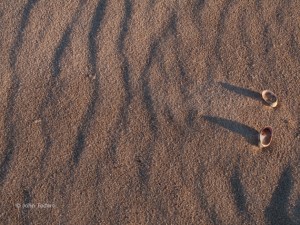


Napeague Harbor Sequence – Petite Landscapes

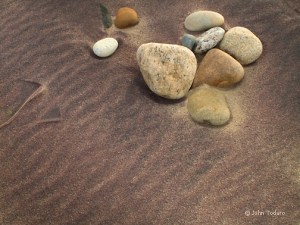

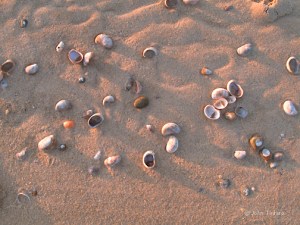
This is is a sequence of four images from various points around the perimeter of Napeague Harbor. There’s a number of ways to group these, but in this instance I’ve arranged them vertically to convey something of what you might find at your feet during a walk on the beach. I like to think of these images as petite landscapes – photographs close to the observer, with most of the elements of the larger picture. Clicking on them will produce an enlargement.
For other sequences from Amagansett and elsewhere go to this link:
Shipwreck, Two Mile Hollow Beach

In Sag Harbor, you may have noticed the weathered wooden ship stern which decorated the grounds in front of the Bay Street Theater for a number of years. Before ending up there, it spent most of the last century submerged near Two Mile Hollow Beach between East Hampton and Amagansett where it was said to be visible during times of exceptionally low tides. When it washed ashore on a cold afternoon fifteen years ago, I drove to the beach and joined a crowd of hushed-voiced locals who had already converged on the scene. We huddled around the boat in the last hour of daylight. It seems that whenever the ocean coughs up a ship or a whale they arrive with equal measures of sadness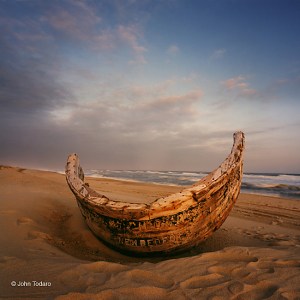 and curiosity. Except for the words on the transom indicating a home port of New Bedford, no one could say much about the vessel. As the sun went down I took some photographs. The remains of the boat sat on the beach glowing – a gilted wooden crescent. I returned the next afternoon hoping to see it again but it was already gone.
Sequence Photographs – Seaweed and Sand, Amagansett
I’ve been working on a project which involves grouping compatible images into sequences. This began a few years ago with a series I called “Dune Studies” –seen here:
https://johntodaro.wordpress.com/2011/02/15/amagansetteast-hampton-dune-image-sequence/
Last summer while on vacation in Utah, the idea gained momentum. We were taking hikes each day, often following streams in canyons. On these walks, I was photographing water reflections, rocks and lichens- all subjects that were easily found a few feet away.
At home, I began sorting through these pictures along with others shot on local beaches during similar walks. I found that if you assemble a group of three or four images, the results can suggest the movement of both time and space experienced during a walk.
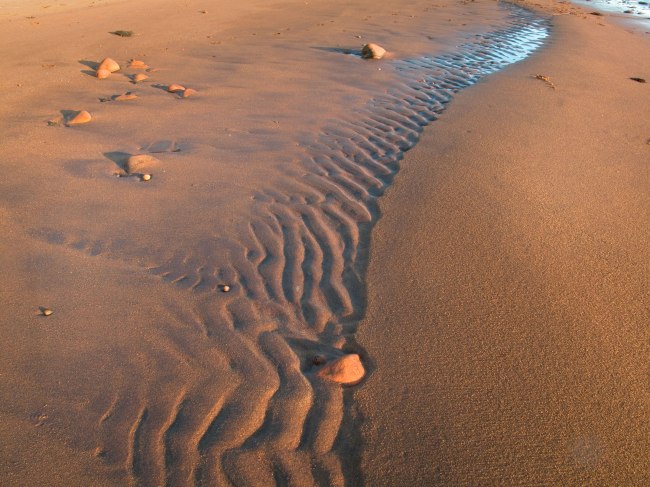
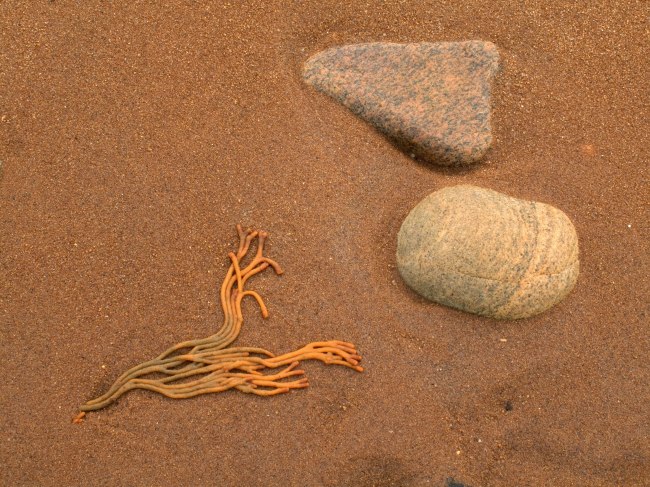


Over the last few months I’ve put together 8 sequences of either three or four pictures each. I made two groups from last summer’s Utah trip- one of lichens and another of creeks. All the rest of the photographs were taken on beaches in East Hampton and Amagansett. In addition to those, I created a series of photographs made on various segments of the Paumanok Path (a 125 mile trail that winds across eastern Long Island). Two of my beach sequences (including the one on this page) are from Napeague Harbor at low tide. This harbor, especially in the vicinity of the Walking Dunes, has striking color and texture:
All of these sequences share characteristics—For one thing, they’re made up of individual photographs of what one might expect to encounter when hiking in a quiet place. But with these pictures I don’t want to convey the larger landscape. This isn’t about distant horizons or dramatic skies. What matters here are the textures and colors of “local” things – subjects found while walking, often no more than ten feet away.
That’s the stepping-off point. Sequencing begins another process.
To do this, it seems to help if you view your project much as a painter might. You dab, so to speak, and you try things out. You play with line and texture. You move things around until it all starts to work.
If you pay attention to your groups you soon have something new. You’ve created a sequence of photographs that is asking to be viewed as a single unit. Its lines, colors, textures are now an integrated whole.
At times, the impressions generated from these sequences can be both refreshing and complex.
More sequences from the beach (and elsewhere) can be seen by clicking here:
https://johntodaro.wordpress.com/category/viewpoints/sequences-and-grouped-images/
 JOHN TODARO