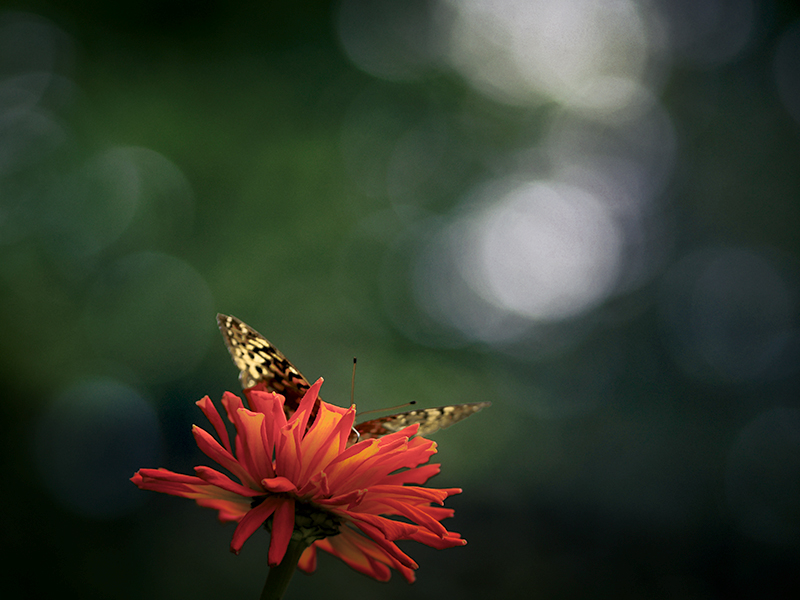
I’ve started to take some pictures of insects the last few weeks, including a pair of Speyeria cybele (one of whom appears on the zinnia). These aren’t macro images, but they do involve using a telephoto lens at the closest focus. To photograph the butterfly, I used a wide open aperture, just as I have been with many of my landscapes. With insects, this requires lots of patience and time. (I have a lot of the latter…maybe a little less of the former.)


⭐️⭐️⭐️⭐️⭐️
LikeLiked by 2 people
Thanks Philip 📝
LikeLiked by 2 people
Hi John and thanks for sharing your great photo! Wishing you a very happy New England weekend…😊⭐️😊
LikeLiked by 1 person
Thanks
LikeLiked by 1 person
Patience, that is all you need! 😴
LikeLiked by 1 person
Thanks to a coffee habit, nodding off behind the lens is not something that’s happened yet
LikeLiked by 3 people
Love this one. The wings make it look whimsical
LikeLiked by 1 person
That’s a good comment. It’s great the way these tiny creatures can convey that
LikeLiked by 1 person
love how you have created space around this pairing such that they seem to float together
p.s. and thank you for the technical info on how you did it. Me I’ve very little patience so tend to still be snap happy after all these years with a camera (shamefaced!)
LikeLiked by 1 person
Thanks. I should also mention the telephoto was an f1.8 prime, a lens which would be a 150mm equivalent on a 35mm camera.
That space you see is definitely a result of the speed of that lens. Hope all this info helps
LikeLiked by 2 people
the added info is well received John – if only I could retain technicalities
LikeLiked by 2 people
When I visit your site, your retention seems fine to me 😊
LikeLiked by 1 person
This is definitely not like anyone else’s insect photograph. It seems to tease the viewer by offering more of the flower than the butterfly, but looking a little longer brings out the charm. It’s as if the butterfly floated gently down to the flower on bubbles of light. The soft edges of the wings give the impression of lightness that I associate with butterflies.
LikeLike
Most insect photography (including my son’s) is macro, with identification being an important part of the photograph. These days, with the magic brought into the equation with stacking, the macro becomes supercharged with focus. I went a different direction with this, I guess. And the ones in monochrome are two steps away…
Thanks for the nice comment
LikeLike