We were on the roof shoveling yesterday. 🙂 I now own my first roof rake.
Be careful up there! 😊
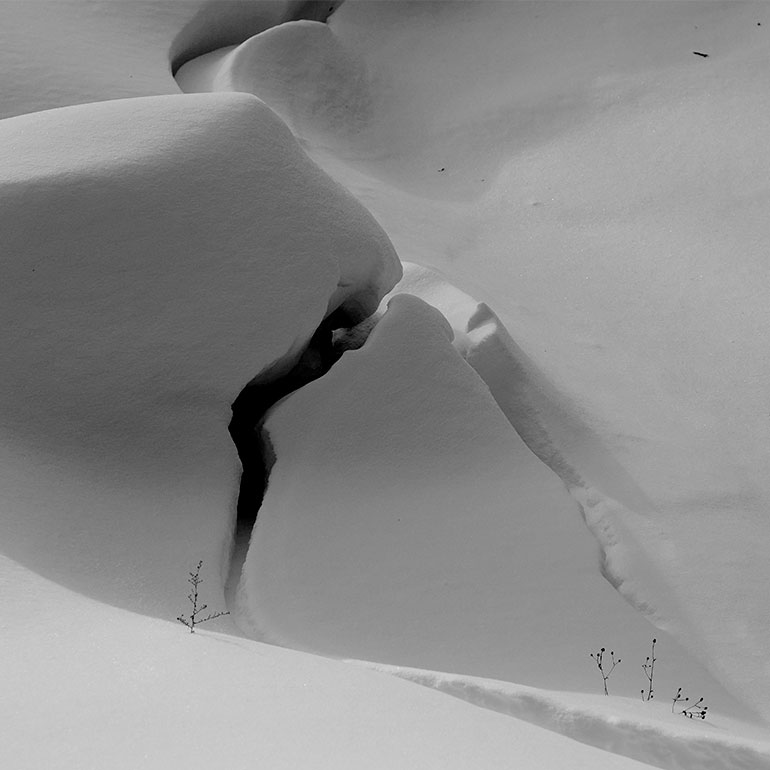
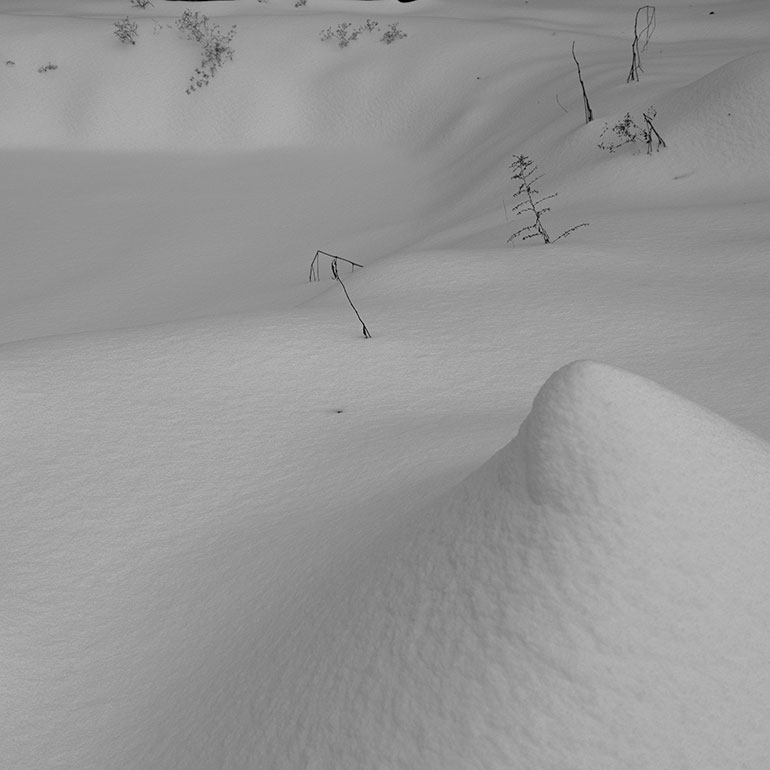
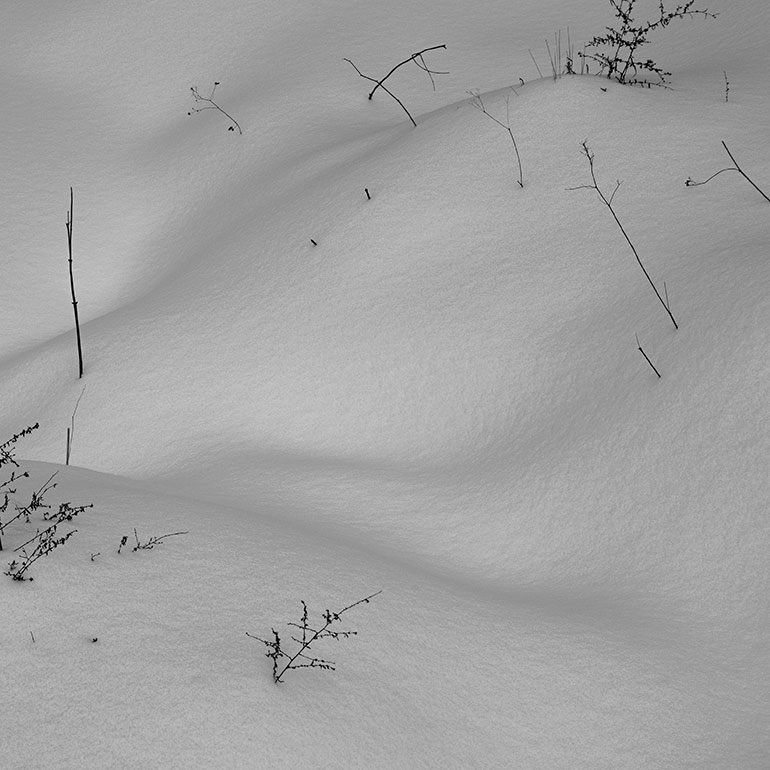
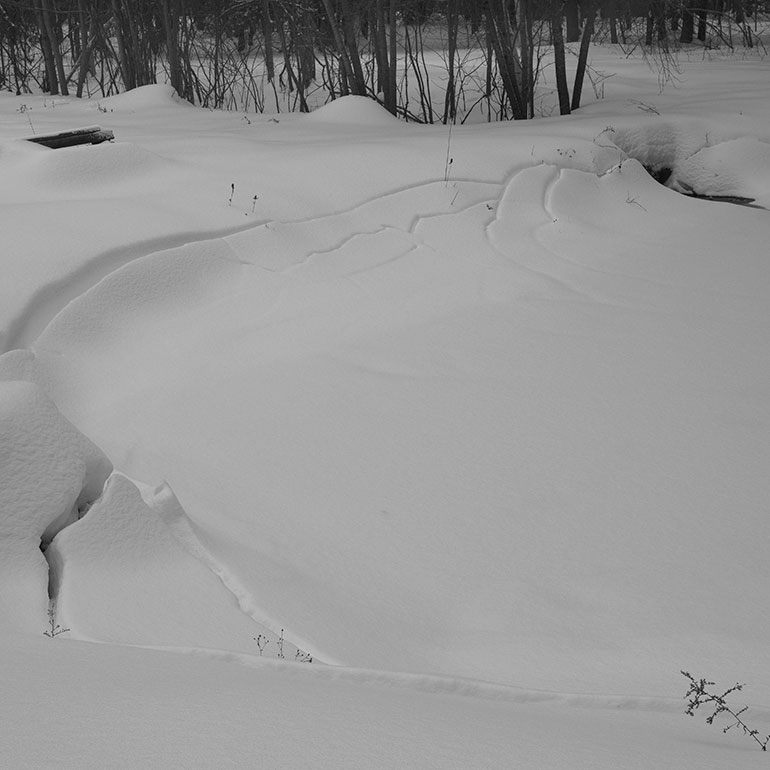
Innocently pure white, fits perfectly in a square.
Thanks
Some restraint with contrast helped, I think. Snow… with just enough light to cast a shadow
This set does a lot – first there’s the title, of course. When viewed one at a time, the third photo, being so much quieter than the first two, which are very dynamic, forces the viewer to look harder, to think. Then the last one gives a context that surprises. The four tell a story together.
Thanks Lynn, I like the thread you wove here. By the way, I shot all of these, as well as the subsequent posts (including today’s), with the 45mm M. Zuiko. Since you own the lens, I thought you might be interested. I hadn’t used it much in the last 6th months, but it had the perfect reach for what I was trying to do, and just the right amount of space compression, so it’s gotten quite a work out 😊
Yes, thanks for telling me. With my lack of technical camera education, I still don’t have a clear feeling for the ways different lenses compress the scene. I tend to think of a lens as having a wide or narrow field of view, and a particular brightness. For me, the 45mm is a good quality lens and it’s bright at f1.8, so it’s great for times when there’s not much light available and for creating nice bokeh. The field of view is neither wide nor narrow, which might be why I don’t use it a lot. I actually love that little lens though. Maybe if I had a better understanding of the compression that would give me another reason to bring it.
Anyway I’m glad you’re making use of yours!
…that 45mm is the classic focal length for portraits (90mm on a 35mm camera), so I would say it is, in fact, a narrow field of view, albeit “entry level” narrow. A normal lens (25mm on M43 cameras) is the one that’s neither wide or narrow.
Glad you love the lens! I do too 🙂
I agree, it’s a fairly narrow field of view…I’ve read about 90mm being the classic portrait lens and 50mm being in the middle. That all makes sense. What I haven’t been able to fully grasp is the idea of compression – in my head I know that a long lens compresses the scene but I never think of compression when I’m using the camera. That means I never take advantage of what it might mean to have a more or less compressed field of view. Maybe I need to make a point of trying to think about it when I have the camera.
Whenever I use the word “compressed” in this context, what I mean is the perception that three dimensional space has been flattened just a tiny bit. I like to think of it as the “sound” of that portrait focal length.
On my Hasselblad, it was my 180mm lens, and on my Contax 35mm camera, it was my 90mm. And on our Olympus M4/3 cameras, it’s the 45mm 🙂
Thanks. I know it refers to the flattening of the space, or place, and just a little bit for the 45mm makes sense, I wouldn’t have thought of that. But more as you go longer, i.e. more compression with the 75mm and longer, right? I just wish I saw that more while I’m taking pictures. I’m more aware of things like light & composition. Something I can work on. 🙂
 JOHN TODARO
⭐️⭐️⭐️⭐️⭐️
Thanks Philip 👋🏼
Hi John and you’re welcome!
We were on the roof shoveling yesterday. 🙂 I now own my first roof rake.
Be careful up there! 😊
Innocently pure white, fits perfectly in a square.
Thanks
Some restraint with contrast helped, I think. Snow… with just enough light to cast a shadow
This set does a lot – first there’s the title, of course. When viewed one at a time, the third photo, being so much quieter than the first two, which are very dynamic, forces the viewer to look harder, to think. Then the last one gives a context that surprises. The four tell a story together.
Thanks Lynn, I like the thread you wove here. By the way, I shot all of these, as well as the subsequent posts (including today’s), with the 45mm M. Zuiko. Since you own the lens, I thought you might be interested. I hadn’t used it much in the last 6th months, but it had the perfect reach for what I was trying to do, and just the right amount of space compression, so it’s gotten quite a work out 😊
Yes, thanks for telling me. With my lack of technical camera education, I still don’t have a clear feeling for the ways different lenses compress the scene. I tend to think of a lens as having a wide or narrow field of view, and a particular brightness. For me, the 45mm is a good quality lens and it’s bright at f1.8, so it’s great for times when there’s not much light available and for creating nice bokeh. The field of view is neither wide nor narrow, which might be why I don’t use it a lot. I actually love that little lens though. Maybe if I had a better understanding of the compression that would give me another reason to bring it.
Anyway I’m glad you’re making use of yours!
…that 45mm is the classic focal length for portraits (90mm on a 35mm camera), so I would say it is, in fact, a narrow field of view, albeit “entry level” narrow. A normal lens (25mm on M43 cameras) is the one that’s neither wide or narrow.
Glad you love the lens! I do too 🙂
I agree, it’s a fairly narrow field of view…I’ve read about 90mm being the classic portrait lens and 50mm being in the middle. That all makes sense. What I haven’t been able to fully grasp is the idea of compression – in my head I know that a long lens compresses the scene but I never think of compression when I’m using the camera. That means I never take advantage of what it might mean to have a more or less compressed field of view. Maybe I need to make a point of trying to think about it when I have the camera.
Whenever I use the word “compressed” in this context, what I mean is the perception that three dimensional space has been flattened just a tiny bit. I like to think of it as the “sound” of that portrait focal length.
On my Hasselblad, it was my 180mm lens, and on my Contax 35mm camera, it was my 90mm. And on our Olympus M4/3 cameras, it’s the 45mm 🙂
Thanks. I know it refers to the flattening of the space, or place, and just a little bit for the 45mm makes sense, I wouldn’t have thought of that. But more as you go longer, i.e. more compression with the 75mm and longer, right? I just wish I saw that more while I’m taking pictures. I’m more aware of things like light & composition. Something I can work on. 🙂