


Some of you are aware of my interest in 19th century photography and that I’ve been collecting prints for a while. A percentage of those are portraits on cabinet cards, like this one. What could be so interesting about a picture that looks like it belongs in a box in an attic? For me, it’s a way of making connections, and in this case they’ve lead to subject, print type and photographer.
The woman in the photograph was named Dora, and she was around 19 years old when she walked into the Robinson Studio at 2320 3rd Avenue in Manhattan in her puff-sleeved jacket. The studio’s owner was Mrs. W. A. Robinson, one of only a handful of female photographers who owned a portrait studio in the city in the 1890’s. For both the photographer and her subject, the right to vote was still thirty years distant. Sadly, I haven’t been able to find out what Mrs. Robinson’s first name was.
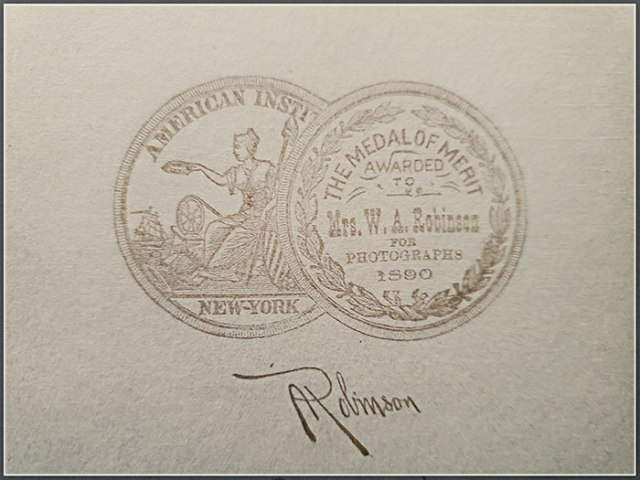
“Mrs. R” had moved to New York from Chicago in the early 1880’s with her husband William and his business partner Alfred Roe (both of whom were also photographers). She worked for them for a time, but left in 1889 to open her own studio, followed by a second a few years later. In 1890, she displayed her work at the American Institute winning an award for her prints. Running a photography business at that time meant being confident with a large camera, indoor lighting, glass plate development, ordering equipment, making prints and staying on top of technology that was changing quickly. And of course, there was also a staff to supervise.
To print the cabinet card images for her client, Mrs. Robinson opted for collodion printing-out paper, nowadays an archaic process which peaked in popularity in the 1890’s. The paper was comprised of three layers, had superb detail and tonal range and resisted fading to a far greater extent than earlier albumen prints. But the collodion emulsion scratched easily and that’s the damage you see in the original. Printing-out papers weren’t put into the developer tray after exposure, they were chemically prepared beforehand, placed in a frame with the negative and exposed to sunlight to develop the latent image. After that, there was a bit of fixing and washing. The restored picture you see here is the result of my Photoshop clean-up which did take a few hours.
A few years after this portrait was made, Dora married Joseph Cook, the son of English and German immigrants. They settled into a tenement in Manhattan, and over the next few decades she had fifteen children, five of whom died before the age of five. Joseph struggled early on with alcoholism, eventually being unable to work, and the large family felt the crush of poverty. Over the next fifty years, Dora welcomed fifteen of her sixteen grandchildren, before passing away in 1953 out on Long Island.
The only one of those grandchildren she never met was born the following year. That was me.
___
Cabinet cards are photographs mounted on 4 1/4″ x 6 1/2″ card stock. Peak popularity was from 1870-1910.
For more info on collodion printing-out prints there’s a good discussion at the Image Permanence Institute, and another at The Getty Center.
For more information about Mrs. Robinson, her husband William and his partner Alfred Roe, visit this site.
Special thanks to Brad Purinton and E. Lee Eltzroth, whose historic photography sites provide lots of inspiration.
 JOHN TODARO
What a great post, John, and a very interesting and also touching story!
Much appreciate the comment Peter!
great picture and great story
Thanks Phyllis. Happy to hear you found it interesting. ✍
Such a story and impressing restoration.
Thanks Hans. I appreciate the comment.
That’s a heck of a story, John. Too bad she never met you. She would have been proud.
btw: your restorations skills are admirable.
Thanks Ken. I actually never met any of my grandparents, I do appreciate what you’ve said.
So sad that you never knew your grandmother in real life John.
As I mentioned to Ken, I never met any of my grandparents and perhaps that’s one of the reasons why these old portraits mean so much. Thanks for commenting, Rudi. It’s always nice to hear from you.
Great job with the restoration. I’m sorry you never got to know your grandmother.
Incidentally, I’ve been going through old family photos, too. Like you, I’ve found a connection with a past filled with monochrome faces who are not strangers anymore. Many of the photos were taken by family and friends. It really underscores just how available photography already was a century ago, when a few horse drawn carts and cabs were still around.
Thanks for this nice comment Mike; it’s good to hear you’ve found so much meaning in your own family’s snapshots. The restoration I did on this one was about six years ago and it’s interesting because the current edition of Photoshop comes with an Ai filter that makes quick work of restoring photos. When I was working on this picture at 66% magnification I was noticing how even a single hit with the cloning tool or healing brush could result in a subtle change in expression. Because of that, I found myself backing out to print size frequently to make sure I hadn’t screwed something up. In a way, we’re stewards of these pictures of our ancestors, and I’m not yet at the point where I can trust a restoration of their images to the judgement of Ai.
What a wonderful, wonderful account. Thank you for sharing.
She looks a little like Jane Wyman
Thanks so much Randye, that’s an interesting observation. I need to refresh my memory and watch one of her old films. Nice to hear from you!
A fascinating story, John, and a beautiful surprise at the end…”That was me.” It is a wonderful ( and emotional) experience to delve into the past, something I have experiences with my recent posts about my father in WW2. I hope you have more images from the past to share!
I did enjoy your posts about your father, and I do hope to post a few more of these periodically. Always great to hear from you Geoff…
Wow! Thanks for the education. What an interesting and sad story. With a knockout finale, my boy.
Thanks Ed, as you know, there’s not many things more complicated than families. Appreciate the visit!
I can’t imagine having fifteen children, losing five, and somehow shepherding ten to adulthood. She must have been a very strong and resourceful person, to say the least.
I’m glad to know about Mrs. W. A. Robinson. Why did some photographers re-embrace the collodion printing-out process in the 1890s? There’s so much to learn about the history of photography. Your introductory post on the subject was a real humdinger!
I’ve never been able to imagine what she did either, and I like to think she may have been the one pillar of strength in a family with no shortage of problems. Since she resembles my favorite aunt, it’s not hard to think that. 😊
Thanks for drawing my attention to an awkward sentence (which I’ve now fixed). Printing-out papers (collodion or gelatin) are archaic nowadays, with their hey-day being the 1890’s. As a collector, it’s interesting to note the percentage of American prints from those years which were made on those papers, yet you rarely hear the print type mentioned. Beginning around the turn of the century there’s also a matte-finish collodion print (similar in appearance to platinum). Many of those photographs are wonderfully rich, deep-toned images and I’m guessing you have some in your collection.
Oh, I understand now what you meant. Sorry to be obtuse. I don’t really know much about the various early processes, although I’m trying to remedy that. Some seem to have held up better than others over 180+ years. Environment also seems to be a major factor, i.e., how photographs were handled, stored, displayed, matted, framed and so on.
I agree; humidity and UV light being the biggest culprits, especially with all those albumen prints.
John, this is a remarkable and very touching story, and the commentaries and discussions add to the impact.
I knew both my maternal grandparents (who almost certainly had an impact on my life and maturation), but I never knew either of my paternal grandparents. That grandfather died 5 years before I was born, and the grandmother apparently suffered from severe dementia.
My father abandoned the family when I was about 4 or 5 years old, so I didn’t know much about that side of my family history. He apparently even abandoned the rest of his his family about 6 or 8 years after that; I think I recall being told that no one knew how to contact him when his mother died.
Last year, I discovered, through one of those online ancestry sites (a freebie photo, no less!), a family portrait of those grandparents and several children, when he was (I’m guessing here) in his 30s or early 40s. Remarkably, he and I were almost dead-ringers at that age.
Thanks Gary, the discussion at this post has surprised me a bit, in a good way. I’d love to see the dead-ringer image of your grandfather and another of you at the same age. Good to hear from you!
I love this post. Honestly, I thought when I saw her: She looks sad. And I think she looks older than nineteen. Are you sure this wasn’t taken AFTER she had lost five children and found herself living with an alcoholic husband?
Thanks for commenting, Susan. I arrived at age 19 after taking a lot into consideration. My grandmother was born in 1873, married in 1895. Her first child, my Aunt Anna, was born in 1896. The first child to die was in 1898, and there was another in 1902. My Aunt Clara, who survived, was born in 1900. Family history from my mom (the last of the 15 kids) conveyed the sense that her father’s deep dive into alcoholism was a bit later, during the first decade of the 20th century.
I also considered the little we know about the photographer and some things about the print. Being that it’s a fairly unadorned cabinet card, with nothing on the back, no scallops or gold leaf, and printed with fairly simple typography, I was thinking early 1890’s. In addition, the photographer’s award says “1890” and she did win another in 1892 (according to the link supplied at the end of the post). I’ve got to assume Mrs. Robinson would’ve wanted to update her cabinet cards to showcase her most recent medals. So that’s how I arrived at age 19 (1892). But I could be wrong!
A final point, my mother was born in 1913. Her earliest memories were of a family in profound turmoil; no source of income, and a serious struggle to find food. If my grandmother was already experiencing that level of chaos as far back as this portrait, I doubt she’d have had any reason for a trip to the photographer nor the funds to pay for a picture.
Incidentally, I copied that award logo from a more pristine cabinet card I own from the same Mrs. Robinson, but it is the same one found on my grandmother’s portrait. I do think age 19 is about right, give or take a few years. This was my first time doing this and it’s safe to say I’ve learned as much as my readers. 😊
I appreciate your comment!
This is beautiful beginning to the new website, John. It is such a compelling story, imagining this young woman entering the studio of a known photographer, visualizing the studio and processes, and then the surprise personal connection. Nicely written. I love these tangible connections back to an earlier time; they remind us of the value of handheld prints as we have discussed. I assume the building on 3rd Avenue is gone now?
Well-said. Tangible connections with hand-held prints from a bygone era can’t be measured in auction value, and the intimacy of that experience may be unique to photography. I’m embarrassed to say how infrequently I’ve been to Manhattan recently, but the street view on Google confirms that those two locations appear to be different now, with an elevated road adjacent to the Harlem River dominating the scene. Photographers in the latter half of the 19th century typically looked for an upstairs studio with a skylight, and those buildings do still exist, especially in rural towns. I was happy to hear from you Mic. Thanks for commenting.
You tell your story so well, John. I’m glad your new website will offer more narrative. Peter Grey and Gary Souci used the word “touching” in their comment to describe your tale of Dora; I agree. I was bequeathed cabinet cards of some of my ancestors, and I know who most of them are. All the cards have the name “Blessing” and under that the city “Bergen” in the same spot that “Robinson” is placed on your card. Since I have Blessings in my ancestry who came from Bergen, Norway, I thought for a long time that that name identified the family whose members were photographed. Only later did I realize that the photographer was a Blessing. I like to think that the love of photography runs in my blood.
Thanks Linda, it’s been a surprise, the response to this post, and comments like yours have been the best part. I looked up “Blessing” and “Bergen Norway,” but couldn’t find a reference to a photographer. I can tell you that there were more women photographers in Scandinavia than anywhere else in that century, so it would be interesting if your Blessing was female. There were a pair of Blessings working in Salamanca NY at that time (John, and son Jesse), That’s western New York, actually not too far from Ohio; could there be a family connection with them?
First, I apologize for being late to read your post. It deserves as many “wow’s” as I can muster. You had me from the first sentence and I had no idea where this was going – so the last sentence shocked me. Great writing! I was reminded of my own German immigrant grandmother who lost a daughter – her only girl – before the age of 5, to brain cancer. My father said she went to the cemetery often (weekly, I think), even after they moved from Brooklyn to Bronxville. The work you did on the card is impressive – I can see why that would take hours! And there she is, with an inscrutable expression – part wistful, part resigned, part strong and confident.
This was a very satisfying post and though I can’t imagine what you can do to top it, I expect you will come up with something equally interesting before too long. 🙂 Congratulations!
Thanks, that must’ve been a difficult period of life for your grandmother, and it’s easy to imagine her trips to the cemetery. Dora was German as well (both parents). It wasn’t until last week that I discovered some of the names of her deceased children (all girls, I think). One of them was Celina, and I found out that she’s buried in a cemetery in the Bronx. It would be interesting to locate her grave. Those girls are all my aunts but it’s hard to wrap my brain around that fact.
Great post, this was so interesting! Love Dora’s jacket too 🙂
Thanks for stopping by. Her jacket is great, isn’t it? 🙂