
Hampton Bays NY
This one, from a couple of years ago, is actually a sequestered tidal area (not a fresh water pond).
This one, from a couple of years ago, is actually a sequestered tidal area (not a fresh water pond).



Some of you are aware of my interest in 19th century photography and that I’ve been collecting prints for a while. A percentage of those are portraits on cabinet cards, like this one. What could be so interesting about a picture that looks like it belongs in a box in an attic? For me, it’s a way of making connections, and in this case they’ve lead to subject, print type and photographer.
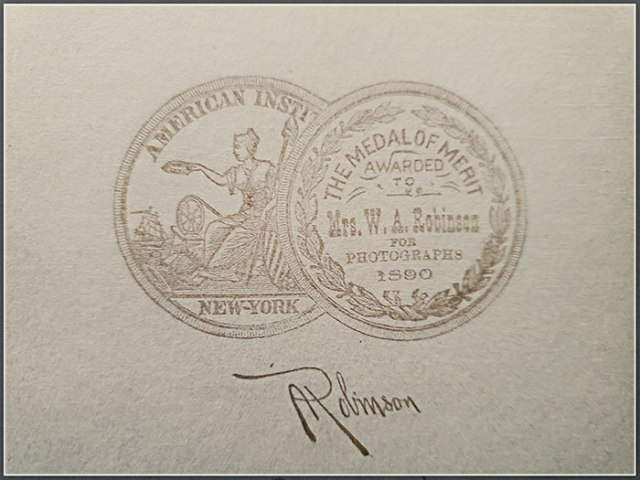
The woman in the photograph was named Dora, and she was around 19 years old when she walked into the Robinson Studio at 2320 3rd Avenue in Manhattan in her puff-sleeved jacket. The studio’s owner was Mrs. W. A. Robinson, one of only a handful of female photographers who owned a portrait studio in the city in the 1890’s. For both the photographer and her subject, the right to vote was still thirty years distant. Sadly, I haven’t been able to find out what Mrs. Robinson’s first name was.
“Mrs. R” had moved to New York from Chicago in the early 1880’s with her husband William and his business partner Alfred Roe (both of whom were also photographers). She worked for them for a time, but left in 1889 to open her own studio, followed by a second a few years later. In 1890, she displayed her work at the American Institute winning an award for her prints. Running a photography business at that time meant being confident with a large camera, indoor lighting, glass plate development, ordering equipment, making prints and staying on top of technology that was changing quickly. And of course, there was also a staff to supervise.
To print the cabinet card images for her client, Mrs. Robinson opted for collodion printing-out paper, nowadays an archaic process which peaked in popularity in the 1890’s. The paper was comprised of three layers, had superb detail and tonal range and resisted fading to a far greater extent than earlier albumen prints. But the collodion emulsion scratched easily and that’s the damage you see in the original. Printing-out papers weren’t put into the developer tray after exposure, they were chemically prepared beforehand, placed in a frame with the negative and exposed to sunlight to develop the latent image. After that, there was a bit of fixing and washing. The restored picture you see here is the result of my Photoshop clean-up which did take a few hours.
A few years after this portrait was made, Dora married Joseph Cook, the son of English and German immigrants. They settled into a tenement in Manhattan, and over the next few decades she had fifteen children, five of whom died before the age of five. Joseph struggled early on with alcoholism, eventually being unable to work, and the large family felt the crush of poverty. Over the next fifty years, Dora welcomed fifteen of her sixteen grandchildren, before passing away in 1953 out on Long Island.
The only one of those grandchildren she never met was born the following year. That was me.
___
Cabinet cards are photographs mounted on 4 1/4″ x 6 1/2″ card stock. Peak popularity was from 1870-1910.
For more info on collodion printing-out prints there’s a good discussion at the Image Permanence Institute, and another at The Getty Center.
For more information about Mrs. Robinson, her husband William and his partner Alfred Roe, visit this site.
Special thanks to Brad Purinton and E. Lee Eltzroth, whose historic photography sites provide lots of inspiration.

It’s a new year. Best wishes to everyone.
Here at my site, there’s a new theme and home page and I’m rebuilding galleries and creating a page devoted to recent work and other projects. There will also be occasional posts this year relating to my interests in historic photography. Overall, less blogging in ’24, but more going on at the rest of the site. As always, thanks for visiting.
 JOHN TODARO