As always, stars much appreciated. Have a nice evening Philip! ✍🌓
Hi John and you’re welcome! Wishing you and family a great Thanksgiving…😊⭐️😊
You as well. 🌟🌞
More stars !!
Many thanks Geoff 🌟
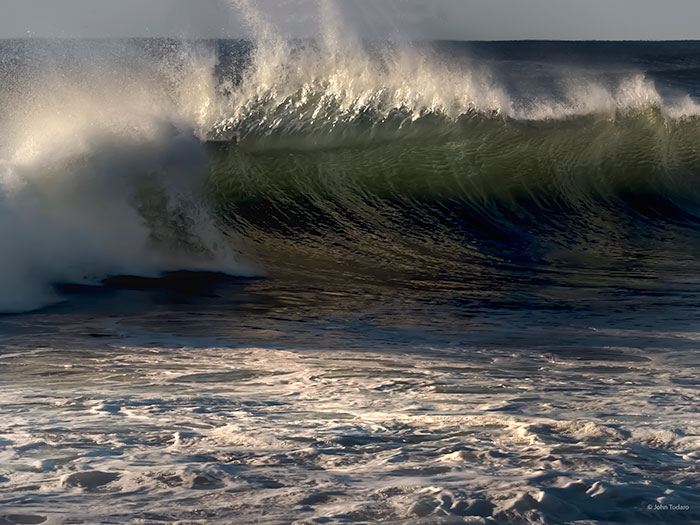
A great image, John. My mind wonders why the wave is softer on the left and sharper on top but I answer myself, saying that’s what’s so wonderful here. And the foamy foreground.
Much appreciate your comment. I suspected this picture wouldn’t fly with a lot of my regulars on here, and there’s other files which I’ve been going back and forth on because of the variety of treatments or because they’re looser compositions than I normally post.
It’s interesting the overlap that exists when shooting ICM* images and waves: you don’t know what you’re gonna get until it’s in the can, but with some practice you can steer the images to somewhat predictable results. The shutter speed of 1/640 was enough to nail the center of the wave but not for the faster moving curl. To me, that’s a fascinating contrast in focus, but I understand it’s not a look that appeals to everyone.
*intentional camera movement
To me, there’s no question that the way the camera handled the difference in wave speed is what’s fascinating and what makes the photograph memorable. How many times do we something out of the corner of our eye that’s just a blur? It goes back to what you said somewhere recently about eschewing the tack-sharp. Although there’s a place for that, too…there’s a place for everything.
It’s a pleasure to come back and look at this again.
Tack sharp photographs have had a really long run. Weston and Adams even started an f/64 club 😄
Right!
Speaking of history, I picked up an issue of Aperture at the used bookstore (the one I go to practically every day!). It’s a tribute to Minor White – issue #95 from 1984. I’m really enjoying it. Have you seen it?
I feel lucky to have purchased it for about $5.00 cash + $4.00 store credit. What a bargain for 78 pages of quality text and photographs!
The same day, I paged through a large book of photos by Carleton Watkins, about whom I know nothing. I noticed he often used a kind of fade from very dark to very light tones in his landscapes. The tones encompass a very wide range but are very smoothly graduated and often he would use the technique on the diagonal. It was a simple “discovery” to make and maybe it was fueled by the espresso but I think I learned something. Whether I can put it use, that’s another thing. 😉
Wow, interesting. I have some of those Aperture issues, but I need to look later to see if I have that one. Watkins. That’s so great that you’ve found your way back there.

 JOHN TODARO
⭐️⭐️⭐️⭐️⭐️
As always, stars much appreciated. Have a nice evening Philip! ✍🌓
Hi John and you’re welcome! Wishing you and family a great Thanksgiving…😊⭐️😊
You as well. 🌟🌞
More stars !!
Many thanks Geoff 🌟
A great image, John. My mind wonders why the wave is softer on the left and sharper on top but I answer myself, saying that’s what’s so wonderful here. And the foamy foreground.
Much appreciate your comment. I suspected this picture wouldn’t fly with a lot of my regulars on here, and there’s other files which I’ve been going back and forth on because of the variety of treatments or because they’re looser compositions than I normally post.
It’s interesting the overlap that exists when shooting ICM* images and waves: you don’t know what you’re gonna get until it’s in the can, but with some practice you can steer the images to somewhat predictable results. The shutter speed of 1/640 was enough to nail the center of the wave but not for the faster moving curl. To me, that’s a fascinating contrast in focus, but I understand it’s not a look that appeals to everyone.
*intentional camera movement
To me, there’s no question that the way the camera handled the difference in wave speed is what’s fascinating and what makes the photograph memorable. How many times do we something out of the corner of our eye that’s just a blur? It goes back to what you said somewhere recently about eschewing the tack-sharp. Although there’s a place for that, too…there’s a place for everything.
It’s a pleasure to come back and look at this again.
Tack sharp photographs have had a really long run. Weston and Adams even started an f/64 club 😄
Right!
Speaking of history, I picked up an issue of Aperture at the used bookstore (the one I go to practically every day!). It’s a tribute to Minor White – issue #95 from 1984. I’m really enjoying it. Have you seen it?
I feel lucky to have purchased it for about $5.00 cash + $4.00 store credit. What a bargain for 78 pages of quality text and photographs!
The same day, I paged through a large book of photos by Carleton Watkins, about whom I know nothing. I noticed he often used a kind of fade from very dark to very light tones in his landscapes. The tones encompass a very wide range but are very smoothly graduated and often he would use the technique on the diagonal. It was a simple “discovery” to make and maybe it was fueled by the espresso but I think I learned something. Whether I can put it use, that’s another thing. 😉
Wow, interesting. I have some of those Aperture issues, but I need to look later to see if I have that one. Watkins. That’s so great that you’ve found your way back there.