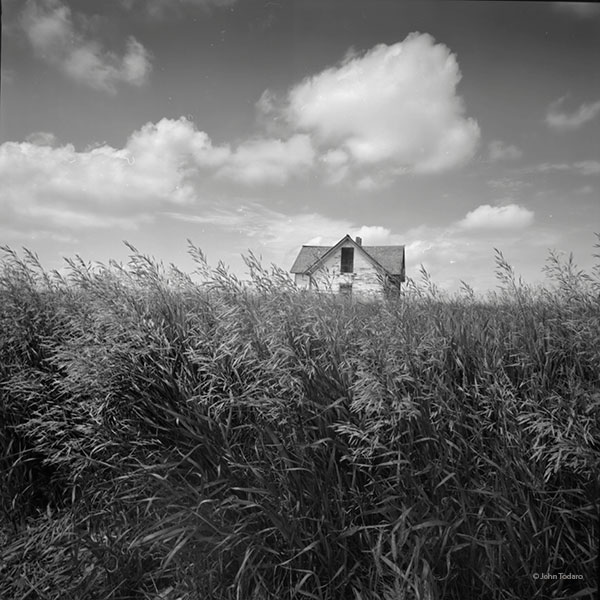
I’ve been scanning some film from 20+ years ago, images which I never printed or did anything with. I’ve been looking specifically for ones that make good black and white conversions. This picture was taken in color on Agfa Ultra 50, a film that had an unusual contrast and palette which I only shot two or three times. That film was medium format so you’re looking at the uncropped full-frame image. I’m pretty sure I used my Hasselblad 903 SWC for this, a wide view camera that came with a fixed 38mm lens and a detachable viewfinder. There were no electronic parts. You relied on a hand-held meter (or a good guess) to take your picture.
There’s a new feature in Photoshop’s neural filters suite which removes dust commendably. That’s a job that used to take many hours, especially if you intended to make prints from digital film scans. I scanned this one yesterday with my Epson V700, which is still running after twenty years. I did leave the remaining dust visible up there in the sky. Maybe it will give the image some provenance. 😏
 JOHN TODARO
We can just call it daytime stardust, like the way you put the field in the foreground.
That’s a great thought. Daytime comets for the field?
Love it!
Appreciate that– thanks!
Lovely image
Thank you!
Wonderful! Incredibly evocative.
thanks so much Brad!
It’s a beautiful phot and a great scan, John. You managed to keep detail in the shadows and highlights nicely.
Thanks Ken, that’s always a goal (especially with scans). When using the scanner app that means making sure I have “elbow room” on that slider (shadows to the left and highlights to the right). I much prefer to deal with that stuff in post-processing, where there’s more opportunity for subtlety.
I’m using a Epson V850 at the museum and it’s fantastic although I like the older software better than the new version.
To Epson’s credit, they make machines that last longer than most stuff does these days.
Do you know where in SD?
Somewhere in the northwest part of the state, I think. Unfortunately, I didn’t jot down any notes.
A beautiful picture. It reminds me of Edward Hopper’s paintings of half houses with the railroad tracks.
Thanks Ed. Those paintings are iconic, And when you look at work by photographers like David Plowden you realize how much influence Hopper’s had outside of painting.
🩶🏠
Merci. Thanks Christine
It’s a very compelling image, the way you hid part of the building behind the grasses. I enjoyed your comments on the whole series and hope you’ll do that again!
Appreciate the encouragement to do it again. This group was selected from sixty rolls of film in two boxes, and aside from the contact sheets stored with the film, most of those exposures were never printed or even enlarged. Long story short: there’s a lot of possibilities. 😊
I’ll say! Quite a lot.
The farm is not the only thing abandoned. This entire part of the country has been shuttered up and forgotten. As the human artifact in this picture returns to nature, we are left with what the Great Plains always featured: grass and sky. This picture captures the feel and look of the Dakotas as I remember them. I happen to like that look and feel (as well as this great pic.)
Well said. Thanks bro