
I promise this won’t be a review. Well at least not exactly. I will take this opportunity to crank out a bit of a “rolling plug”
I started working in the 4/3 format earlier this year using a Panasonic Lumix GF2 and a pair of those morsel-sized a la carte lenses. I have the 14mm and the 20mm primes which translate into a 28mm and 40mm respectively (0n a 35mm camera). These lenses are sometimes referred to as “pancakes” and we can rest assured that whoever conjured up such a name had a functional imagination. (We could also call them truffles, or slightly flattened cupcakes).
There’s been plenty of hype about this format along with all the hyperactive comparisons that we’ve come to expect at regular intervals every time a new product arrives. Rejoice in knowing that I won’t contribute anything else to that particular subject.
Those in love with increasing numbers of megapixels got their fix a couple of years ago when the format first surfaced. Plus there was a larger sensor. We now know that the RAW files produced by any of the Olympus or Panasonic bodies will serve you well if you caress them properly. But … be warned: If you own one of these cameras, don’t doubt for a minute that you’ll be seriously tempted by the next wave (spelled: NEX 7). If you decide to chase that carrot next February it will be your strictly your decision. My advice is to sit back and relax. Be a tortoise. Avoid the bleeding edge. They’ve stumbled onto a nice balance between performance and weight here at the moment — and we might as well enjoy it.
My friend (and fellow photographer) John Ellsworth told me last week that handling one of these micro 4/3 lenses is something like handling a “chess piece”. I enjoyed the thought. (He was actually referring to the Olympus M Zuiko 45mm f1.8, another lens which I finally sprung for). John and I are old enough to remember what 120 film cameras feel like when they’re hanging around your neck.
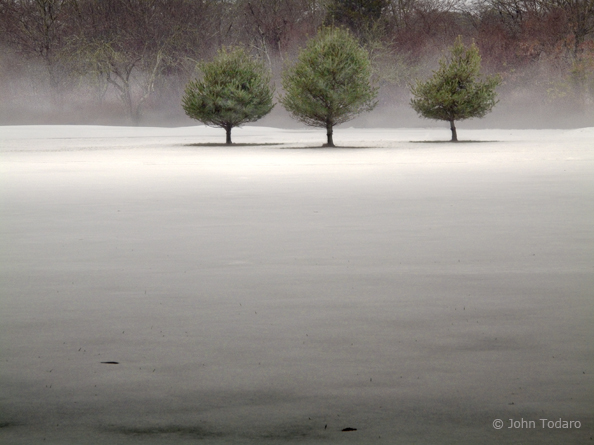
Anyway, the photograph above was taken with the Panasonic GF 2 (and the 20mm f1.7). With this camera, I’m able to focus the picture and adjust the exposure by the very simple act of touching the screen, (something which I still regard with amazement). I’ve been surprised to read that touch-screen navigation has aggravated some photographers. It seems there’s those who’d rather twist a dial. I’m fine with the touch screen because it appeals to my severely limited capacity to follow instructions. Look at it this way: touching a screen requires only one finger and turning a dial takes two.
I’ll admit that since I bought this camera I’ve been cornering opportunities to explore the speed of these lenses. Believe it or not you can perform a variation on street photography far from any lamppost. The 20mm lens is also capable of producing shallow depth of field. In Japan they call this effect “bokeh”. I’m still uneasy with the pronunciation but I’ve been using the word a lot lately because it’s a lot sexier than saying “shallow depth of field”.
At any rate, my camera was hand-held for this picture and was therefore free to shoot six or seven variations in several positions and all in less than a minute. I feel like I’m playing jazz when I’m not off mucking around with my tripod and its multitude of extended joints. Let’s face it; tripods are a bit clunky by nature. They also require at least three fingers to operate. That makes them even more complicated than turning a dial and much more so than touching a screen. I use them strictly when I need to.
Enough with cameras. Let’s move on to the West.
I’ve visited the eastern plains of New Mexico many times over the years and I always wonder why everyone else is driving though the place as fast as they can. I concede that there’s nothing much to see except for open space, which for me, is pretty much the point. This is not the Grand Canyon. If you spend any time out on the plains your expectations for normal landscapes will need to evolve. The scenery basically comes down to various combinations of grass and clouds, and (for better or worse) the ever present evidence of humans which usually takes the shape of a fence. There’s cows everywhere but one thing about the plains is that you hardly ever see the people. That’s okay, because their absence creates interest.
One visit didn’t involve taking any pictures. Many years ago my wife and I took a train ride west from Long Island. We took it all the way to Albuquerque just to see what it was like.
It was long. Even compared to a bad day at the airport, this was a trip which slowed time down to a slurpy crawl. It seemed like years before we were rid of the east (but once we were past Chicago things did get more interesting). My favorite part was the morning after the second night. We got up and walked groggily through the train to a very lovely dining car. I remember cloth napkins. We were seated at small table and had the most delicious breakfast with a very compelling view. We were now chugging through the plains and were finally situated in New Mexico. All you could see was mile after mile of grass, clouds and the ubiquitous fences of ranching. It looked something like my picture up above except it was brighter because the sun coming up.
As I said, it wasn’t a day that I used my camera. The train window took all the pictures and we stored them in our memory.

 JOHN TODARO